

The United Nations Environment Assembly (UNEA) is the world’s highest-level decision-making body on the environment. Established in June 2012 as a result of the United Nations Conference on Sustainable Development. Since 2014, UNEA has held six sessions during which 105 resolutions have spurred action on critically important issues, including air pollution, biodiversity and health, financing for development, plastic pollution, marine litter, environmental education, water management, nature-based solutions, sustainable consumption and production, sustainable and resilient infrastructure, climate change, Science-Policy Panel for chemicals and waste and to prevent pollution, the illegal wildlife trade and protecting the environment in areas affected by armed conflict and disasters, minerals and metals management, sustainable and resilient infrastructure, amongst many others.
About UNEA-7
The seventh session of the United Nations Environment Assembly (UNEA-7) will take place from 8 to 12 December 2025 at the United Nations Environment Programme (UNEP) headquarters in Nairobi, Kenya. UNEA-7 will be preceded by the seventh meeting of the Open-ended Committee of Permanent Representatives (OECPR-7) which will be held from 1 to 5 December 2025.
The UNEA-7 Bureau was elected for a period of two years starting at the closure of the sixth session of UNEA on 1 March 2024 and it is composed of ten members, comprising one President, eight Vice Presidents and one Rapporteur, with two members representing each of the five United Nations regions. The Sultanate of Oman — represented by His Excellency Abdullah Bin Ali Al-Amri, Chair of the Environment Authority of Oman — was elected to the presidency of UNEA-7.
UNEA-7 will be held under the theme “Advancing sustainable solutions for a resilient planet”, sending a strong message to accelerate sustainable solutions and effective responses for a safer and more resilient planet.
UNEA-7 Theme | Advancing sustainable solutions for a resilient planet
The theme of the Environment Assembly sessions is chosen following broad consultations with Member States and a wide cross-section of stakeholders and endorsed by the Bureau at least one year ahead of the session.
The theme “Advancing sustainable solutions for a resilient planet” was chosen by the UNEA Bureau during the joint meeting of the Bureaux of UNEA and the CPR on 11 December 2024. It sends a strong message to accelerate sustainable solutions and effective responses for a safer and more resilient planet.
This theme recognizes that striving for a world that is just, equitable and inclusive hinges on advancing sustainable development, promoting sustained and inclusive economic growth, social development and environmental protection to benefit all, as recognized in the “Future We Want.”Thus, a resilient planet is one where healthy ecosystems are prioritized; where resource intensity is reduced and efficiency is enhanced; where consumption and production demands are reoriented towards sustainability; and where new technologies and practices can sustainably anticipate and prevent environmental risks. To be successful and truly catalyze the achievement of the Sustainable Development Goals, all of these conditions must be underpinned by effective and inclusive environmental governance and respect for the human right to a clean, healthy and sustainable environment.
UNEA-7 Programme
UNEA-7 will follow the structure:
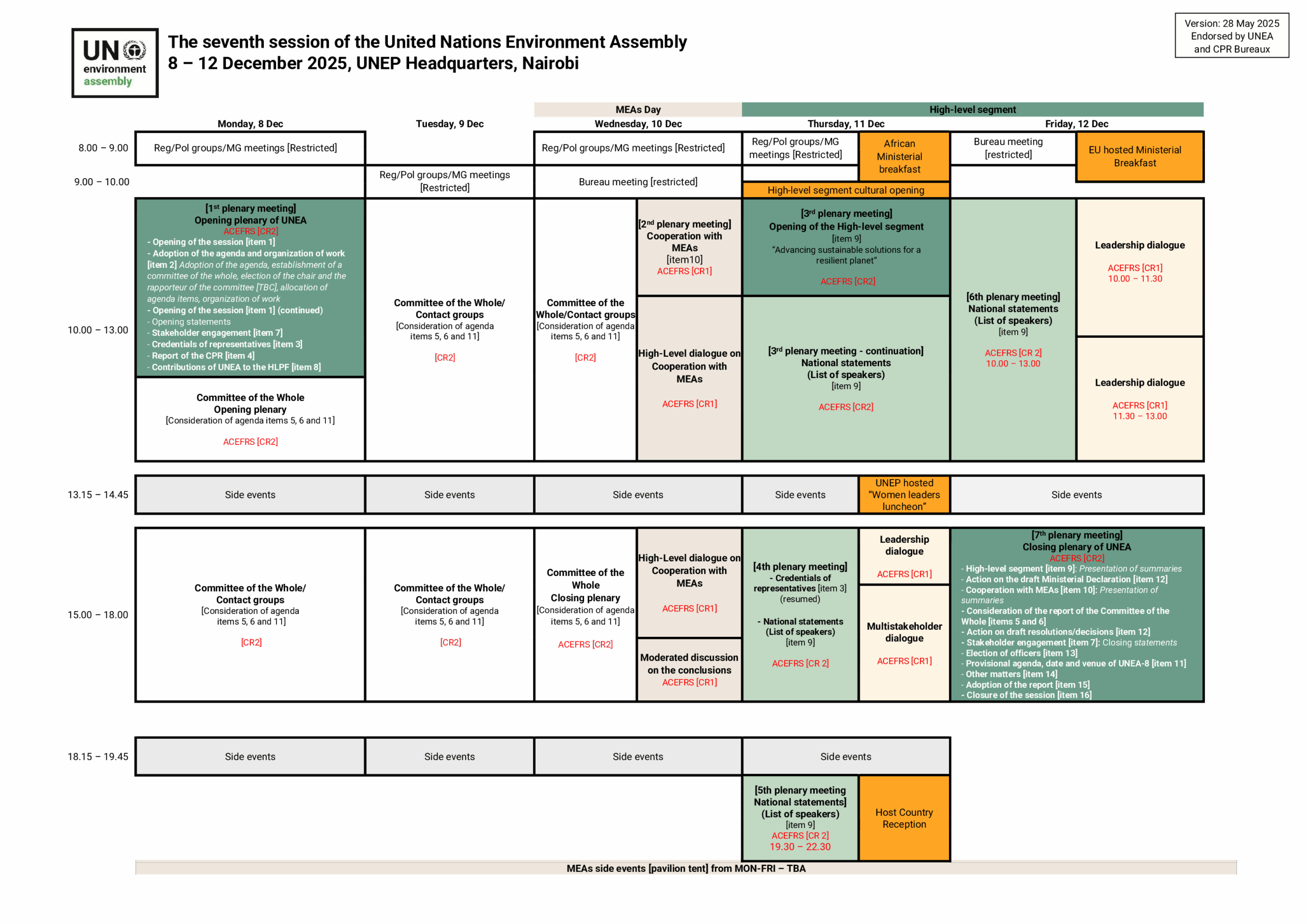
For a detailed outlook on the items to be addressed at UNEA-7, consulting the Provisional Agenda (UNEP/EA.7/1) is advised.
What to Expect from UNEA-7
UNEP Executive Director, Inger Andersen, released the first part of her report on UNEA-7 “Priorities for advancing sustainable solutions for a resilient planet” (UNEP/EA.7/2), suggesting possible areas for UNEA-7 resolutions for the consideration of Member States, such as:
- Addressing the global hydrological cycle
- Tackling nutrient pollution
- Critical energy and digital transition minerals
- Protecting the stratosphere
- Deploying and scaling environmentally sustainable artificial intelligence
The second part (UNEP/EA.7/2(II)) of the report takes a broader view, reflecting on UNEA’s evolution over the past decade. It draws lessons from its first ten years and explores how the Assembly can continue to grow as a vital platform for global environmental governance. This reflection aims to ensure UNEA remains responsive, inclusive, and effective in addressing the complex environmental challenges of our time.
Draft Resolutions
The draft resolutions or decisions submitted by Member States for adoption by UNEA represent current collective thinking on pressing environmental issues, build consensus and are a vital first step in spurring action. They also define priority areas of work for UNEP and are therefore central in the process.
All draft resolutions and decisions should be announced and submitted by the main proponent via the “e-Proposals” module on the e-deleGATE platform no later than 29 September 2025, 10 weeks in advance of UNEA-7 pursuant to UNEA decision 6/7 and as indicated in the CPR based review.
Submitted draft resolutions/decisions will be made available on the e-Proposals platform (replacing the resolutions portal). All relevant information including contact details of the focal points for the main proponents of the resolution, co-sponsors, concept notes, secretariat technical notes and different versions of the draft will be made available on e-Proposals.
Seventh Open-ended Committee of Permanent Representatives (OECPR-7)
Every second year, the Committee of Permanent Representatives meets as the Open-ended Committee of Permanent Representatives. It holds a five-day meeting, chaired by the Chair of the Committee of Permanent Representatives, immediately before the session of the Environment Assembly. During the meeting, representatives of Member States meet in formal plenary sessions and informal working groups and contact groups to negotiate draft resolutions and decisions for consideration and possible adoption by the Environment Assembly.
Usually, the Presidency of the Environment Assembly also conducts informal consultations on the margins of the meeting of the Open-ended Committee of Permanent Representatives to seek consensus on a draft ministerial declaration for consideration at the upcoming session of the Environment Assembly.
The seventh Open-ended Committee of Permanent Representatives will take place from 1 to 5 December 2025.
Ministerial Declaration of UNEA-7
The roadmap for an iterative, open, transparent, participatory and inclusive intergovernmental consultations on the draft ministerial
declaration of UNEA-7 has been developed based on established practice and experience gained for this process since UNEA-1, as well as the guidance provided by the Committee of Permanent Representatives (CPR) in its decision 167/1 on UNEA-6 lessons learned. It has been forwarded in conjunction with a letter by UNEA-7 president, inviting to consider the following questions:
- What would the Ministers for the Environment propose as the most important elements and or key messages that would enable the ministerial declaration to take forward the UNEA theme in the most impactful manner?
- What key messages or conclusions from recent scientific reports would the Ministers for the Environment recommend for consideration in the ministerial declaration?
- What proposed collective actions and policy solutions should the Ministers for the Environment adopt to advance the UNEA theme and promote effective and inclusive environmental governance?
- Any other message(s) would the Ministers for the Environment wish to be considered or included in the ministerial declaration?
Consultations have been held on 15 April 2025 (First intergovernmental consultations on the draft ministerial declaration) and 16 June 2025 (Second intergovernmental consultations on the draft ministerial declaration).
Global Major Groups and Stakeholders Forum (GMGSF)
The 21st Global Major Groups and Stakeholders Forum (GMGSF) will take place on 6 and 7 December 2025. It will provide an avenue for Major Groups and Stakeholders to craft their stances, statements, and contributions for the UNEA-7 process, encompassing formal meetings and negotiations conducted within the Assembly.
The Forum informs civil society stakeholders about existing and future UNEP policies. It also provides a platform for representatives from Major Groups to exchange ideas and find common ground in order to contribute to multi-stakeholder policy talks during UNEA. Preparatory Regional Consultative Meetings (RCMs) among civil society are held prior to the Forum to ensure that regional perspectives on all UNEP mandates are incorporated in UNEA.As the Forum is also open to organizations that are not accredited by UNEP, it offers an opportunity for both accredited and non-accredited stakeholders to exchange perspectives among themselves and with representatives from the UNEP Secretariat and interested Member States. The primary objective is to foster dialogue and collaboration in addressing significant environmental issues within the framework of the UNEA-7 agenda.
The deadline for registration is 31 October 2025
Youth Environment Assembly 2025
The Youth Environment Assembly (YEA) is a premier platform that unites young environmental leaders, advocates, and policymakers from across the world to engage in policy dialogues, knowledge exchange, and collective action. As the largest youth-led environmental forum within the United Nations Environment Programme, YEA plays a vital role in shaping youth contributions to UNEA, UNEP, MEAs and other relevant processes.
YEA 2025 will take place on 29 and 30 November 2025 and on 7 December 2025 in the lead-up to the 7th session of the UN Environment Assembly, aligning with its overarching theme. The Assembly will serve as a space for youth to formulate the Global Youth Declaration on Environment, ensuring that young people’s perspectives, solutions, and priorities are integrated into UNEA-7 discussions and outcomes. Through interactive sessions, capacity-building workshops, policy consultations and high-level segments, YEA 2025 will amplify youth voices in advancing environmental multilateralism and sustainable solutions for a resilient planet.
Consultations for UNEA-7 draft resolutions and the Global Youth Declaration will take place in the run-up to the meetings. → Learn more
The Role of Geneva
Highly engaged in the process, actors and stakeholders from International Geneva have provided written submissions for the Draft Ministerial Declaration:
Multilateral Environmental Agreements Day
Following the success of the first MEAs Day at UNEA-6 in 2024, the second Multilateral Environmental Agreements Day will take place on 10 December 2025.
These engagements provide a compelling platform to highlight cooperation between UNEP and MEAs as well as among MEAs – celebrating success stories, championing integrated solutions, and inspiring greater collective environmental action. The day is convened under the agenda item “Cooperation with multilateral environmental agreements (MEAs)”, as endorsed in UNEA decision 6/7.
The day will feature:
- An opening plenary session will be held on 10 December 2025 from 10 am to 10.30 am EAT in Conference Room 1. This will be presided over by His Excellency Abdullah Bin Ali Al-Amri, Chair of the Environment Authority of Oman and President of UNEA-7, followed by a statement by the UNEP Executive Director.
- High-level dialogues:
- “Signed, Sealed, Delivered?” – Turbocharging MEA implementation through whole-of-government and whole-of-society approaches.
- “Keeping the Promise” – Boosting SDG implementation through the MEAs.
MEAs Pavillion
The MEAs pavilion will host side events and exhibitions organized by the MEAs, while also offering space for all participants to connect and share ideas.
- Side events will be held from 8 to 12 December 2025 as part of the agenda item “Cooperation with Multilateral Environmental Agreements.” and provide a platform to showcase topics, ongoing projects, activities, and lessons learned in promoting the coherent and synergistic implementation of MEAs, in alignment with the UNEA-7 theme: “Advancing sustainable solutions for a resilient planet.”
Global Major Groups and Stakeholders Forum
The 21st Global Major Groups and Stakeholders Forum (GMGSF) will take place on 6 – 7 December 2025. The Forum provides an avenue for Major Groups and Stakeholders to craft their stances, statements, and contributions for the UNEA-7 process, encompassing formal meetings and negotiations conducted within the Assembly. As the Forum is also open to organizations that are not accredited by UNEP, it offers an opportunity for both accredited and non-accredited stakeholders to exchange perspectives among themselves and with representatives from the UNEP Secretariat and interested Member States. The primary objective is to foster dialogue and collaboration in addressing significant environmental issues within the framework of the UNEA-7 agenda.
The deadline for registration is 31 October 2025 and should be processed through Indico.