
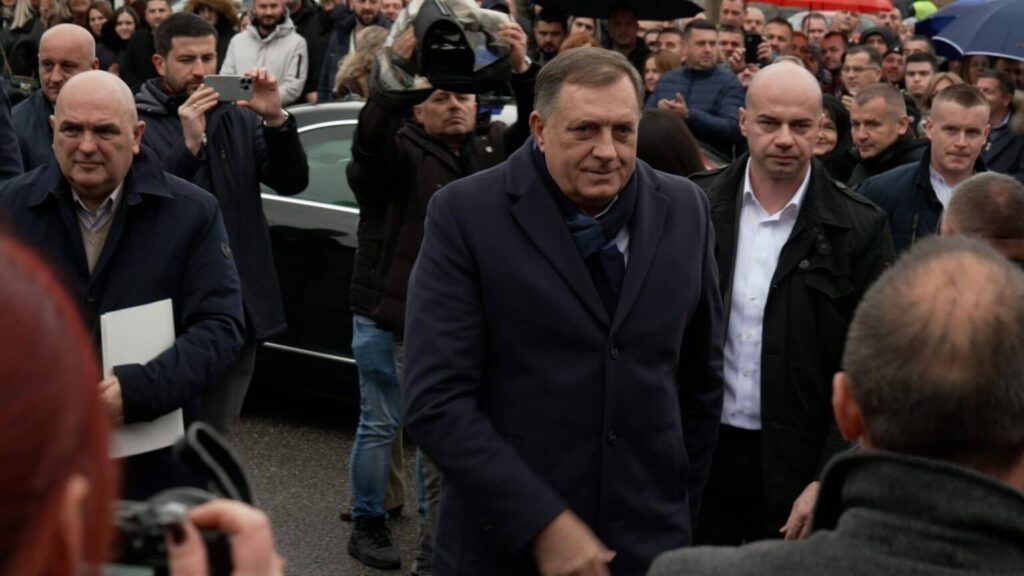
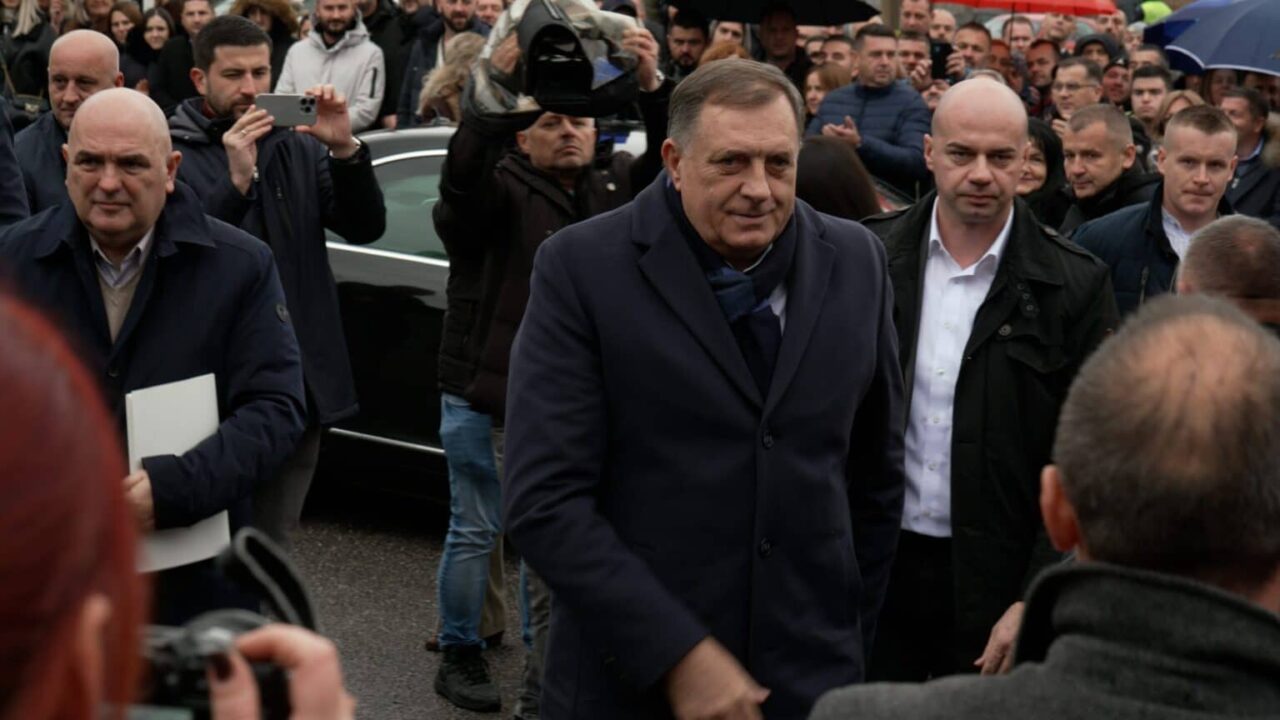
Republika Srpska President Milorad Dodik outside the state court for a previous hearing. Photo: BIRN.
The appeals chamber of the Court of Bosnia and Herzegovina on Friday confirmed the first-instance verdict sentencing the President of Republika Srpska, Milorad Dodik, to a year in prison and issued a six-year ban on him holding the office of president of the Serb-led entity.
Dodik was convicted of knowingly defying decisions issued by Bosnia’s High Representative, Christian Schmidt, in July 2023.
Schmidt, Bosnia’s international overseer, had blocked implementation of two laws adopted by the Republika Srpska authorities – one preventing enforcement of state-level Constitutional Court rulings in the entity, and another amending legislation on publishing official acts. Despite this, Dodik continued legislative procedures in defiance of Schmidt’s decisions.
Dodik stated defiantly that he will continue performing his duties despite the verdict, while his legal team announced it will file an appeal to the Constitutional Court of Bosnia and Herzegovina.
In a vague response to the judgment, Dodik told media in Banja Luka that it “does not prohibit him from being party president [of his Alliance of Independent Social Democrats, SNSD]”, and added that he will seek support from Serbia, Russia, and “the new US administration.”
He also said that if snap elections are called, political parties should not participate, and vowed to “deploy the police to prevent any polling stations from being set up”.
Dodik’s co-defendant in the trial, the former acting director of Republika Srpska’s Official Gazette, Milos Lukic, was acquitted, but strongly criticised the ruling against Dodik.
“After I learned of the decision from the lawyer, the only thing I can say is that Bosnia and Herzegovina has missed yet another opportunity today – and this one is probably the last – to even consider being a place where Serbs are allowed to live the way they want,” Lukic told Republika Srpska public broadcaster RTRS.
The first-instance verdict issued on February 26 this year triggered a political crisis. A day afterwards, the Republika Srpska assembly passed laws banning Bosnia’s state prosecution and court, the State Investigation and Protection Agency, SIPA, and the High Judicial and Prosecutorial Council, from exercising any jurisdiction in the entity.
Bosnia’s Constitutional Court suspended these laws at the end of May. But after Dodik insisted that the new laws would be implemented in Republika Srpska, a new criminal investigation was opened.
Dodik, the Republika Srpska assembly speaker, Nenad Stevandic and the entity’s prime minister, Radovan Viskovic, were all accused of “an attack on the constitutional order”.
Despite this, the Republika Srpska assembly continued to take steps to undermine state-level institutions. It adopted a draft new entity constitution and a law granting it the right to form its own army and intelligence service, and to prosecute everyone who “works against Republika Srpska’s constitution”.
The final verdict cannot be appealed. However, under Bosnian legislation, prison sentences of up to one year can be exchanged for a fine of 52 euros per day of prison time.
Nasa Stranka (Our Party), which is a member of the state-level governing coalition in Bosnia and Herzegovina, welcomed the ruling.
“This ruling represents an important step toward establishing the rule of law and restoring hope among citizens that the judiciary, despite numerous pressures and attempts at political interference, is still capable of making decisions in line with the law and justice,” Nasa Stranka said in a statement.
But the head of the parliamentary group of Dodik’s SNSD party in the National Assembly of Republika Srpska, Srdjan Mazalica, insisted that the trial was a “judicial disgrace” and the case should be taken to the European Court of Human Rights.
“Without getting into the legitimacy of Schmidt or his right to impose laws, the verdict against Dodik is full of procedural mistakes and violations of the Criminal Procedure Code. The so-called Sarajevo deep state has decided to further deepen the crisis. This case should go all the way to Strasbourg,” Mazalica said.
NOTE: This article has been updated to include the reaction from Milorad Dodik.