
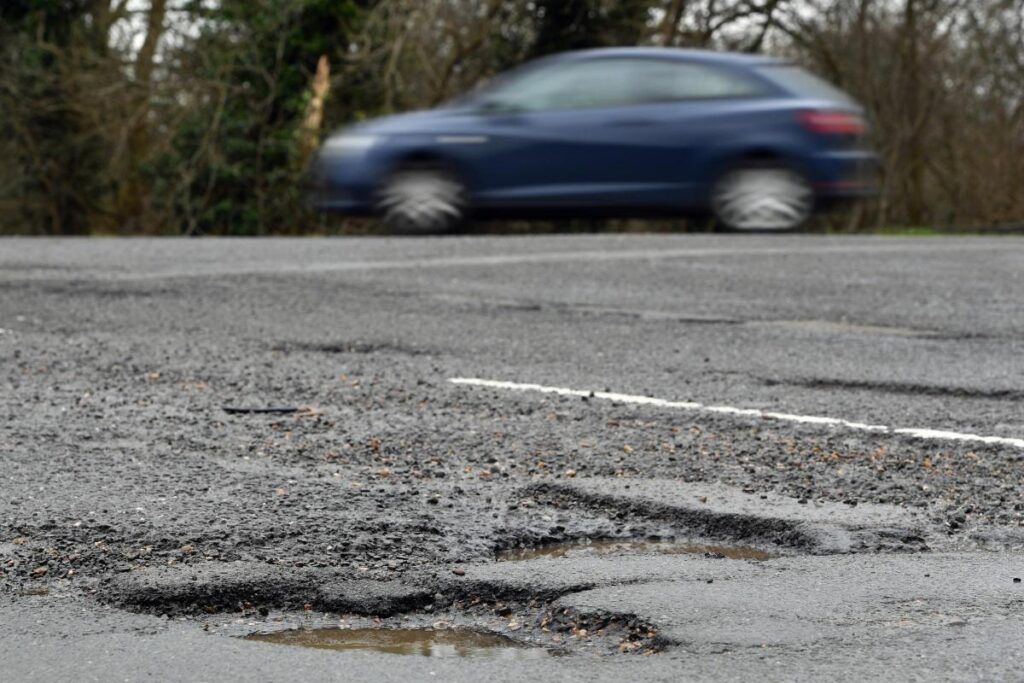
Drivers are calling for action on pothole-riddled roads across Fenland following an article by the Cambs Times last week, which sparked more than 200 comments on social media.
Dozens of roads across the Fens have been highlighted by motorists for being full of potholes, with cracking surfaces, and sinking verges, and in need of urgent repairs following the article, which reported Cambridgeshire County Council’s monitoring of Manea Road, Wimblington.
Cambridgeshire Highways has placed ‘Uneven’ surface signs along the road between the A141 turn and the Boots Bridge junction, along with slow-down signs to warn drivers of the collapsing roadway.
Cllr Robin Wyatt, vice-chair of Cambridgeshire highways and transport committee at Cambridgeshire County Council, said: “Our highways team is monitoring the road, increasing the number of inspections, carrying out repairs to ensure public safety, and has put out warning signs to advise drivers.
RECOMMENDED READING: Manea Road from Wimblington is badly cracked and subsiding
Cambridgeshire Highways has installed ‘Slow’ and ‘Uneven road surface’ signs along the Manea Road at Wimblington.(Image: Sarah Cliss/Newsquest)
“We are doing everything we can locally to maintain and keep these roads safe, but addressing this challenge properly requires national support and government funding for long-term solutions.”
The story gathered more than 200 comments from readers, all anxious to raise issues with roads they feel need action.
Roads highlighted included Chatteris to Somersham, with one person stating: “They’ll need to come and cut the weeds growing in the cracks and not to mention the sink holes.”
One woman said: “A1122 is sinking, but they have placed ‘Ramp’ signs next to two sunken stretches.”
Other roads mentioned were the Forty Foot, which came up multiple times, the Sixteen Foot, A605 towards Turves, Benwick Road into Doddington, Ponders Bridge Road, roads around Willingham, Ramsey Mereside, Welney to Littleport, and many more.
RECOMMENDED READING: Fenland’s new food waste collection will increase recycling
Another post said: “Is monitoring another way of saying ‘we’re doing nothing but fob you off’?”
Local campaign James Fuller, a lorry driver from Stonea, has carried out research following the article. He has looked at how the Netherlands tackles similar problems.
He believes the problems drivers in our area face every time they get behind the wheel – cracking surfaces, giant potholes, and sinking roads – would have been tackled long ago if we were Dutch.
James thinks our Highways chiefs could do worse than take a trip across the Channel to find out how the Dutch tackle the issues of building roads on soft, shifting soils like ours.
He said: “The Dutch are on top of this problem. Twenty-six percent of their country lies below sea level, much of it on soft ground like our Fens.
“They plan, innovate, and engineer with purpose. Their mindset is always: how can we solve this problem? — Not this can’t be done.
“Dutch engineers expect the ground to shift, and they design roads for it. Their roadbeds are built specifically for soft, moving soils.
“Engineers specialise in polder infrastructure (low-lying reclaimed land), treating weak ground as a puzzle to be solved, not a curse to be endured.
They also use practical safety measures, such as metal crash barriers along water edges.
“While Cambridgeshire councils have reportedly been cautious about installing these barriers due to concerns about soft banks, the Dutch routinely make them work, often using steel-reinforced timbers and other solutions to stabilise the ground.
“Beyond engineering techniques, the Dutch take a holistic approach to rural infrastructure. In many low-lying areas, local roads are managed by waterschappen (water boards) alongside dykes, drainage, and flood-prevention measures.
“This coordinated management ensures roads are maintained with full awareness of soil conditions, reducing subsidence and prolonging lifespan.
“They also keep heavy traffic off backroads that are most vulnerable, directing lorries and buses onto stronger routes. This protects delicate infrastructure and ensures minor roads remain safe and usable.”
Here in Britain, we already have talented engineers, but James said they are often left to improvise on roads like ours, and he believes there should be specialised courses on offer at local universities and colleges.
He said: “In the Netherlands, Wageningen University & Research trains engineers in land and water management, preparing them to design roads for soft, shifting soils. Twinning with institutions like WUR would allow Fenland engineers to acquire the same expertise locally.
“Fenland should become a national test-bed for innovation. That means not just rebuilding roads, but building knowledge.
“Twinning with Dutch regions, research exchanges, and pilot projects would allow engineers and universities to learn directly from the best, cultivating homegrown expertise for the long term.
“Yes, it will be expensive. But people in the Fens pay their taxes like everyone else. Rural communities deserve the same rights to safe, high-quality roads as any other area of Britain.
“Engineering and money only go so far. The Dutch example shows something deeper: they simply demand better. They expect standards to be met and do not tolerate excuses. Until we adopt the same approach in Fenland, our roads will remain stuck in the mud.”