
The U.S. government, through the Department of Housing and Urban Development (HUD) and the McKinney-Vento Act, defines homelessness across four categories:
1. Literally Homeless (no fixed, regular, or adequate residence, living in shelter, or exiting institutions after 90 days)
2. Imminent Risk (losing housing in 14 days with no support)
3. Homeless Under Other Statutes (primarily youth facing instability)
4. Fleeing Domestic Violence (seeking shelter from abuse)
Posted by Negative-Swan7993
25 Comments
Yes, expensive housing but it doesn’t help when other localities deal with their own issues by buying their homeless one way bus tickets to NYC or California.
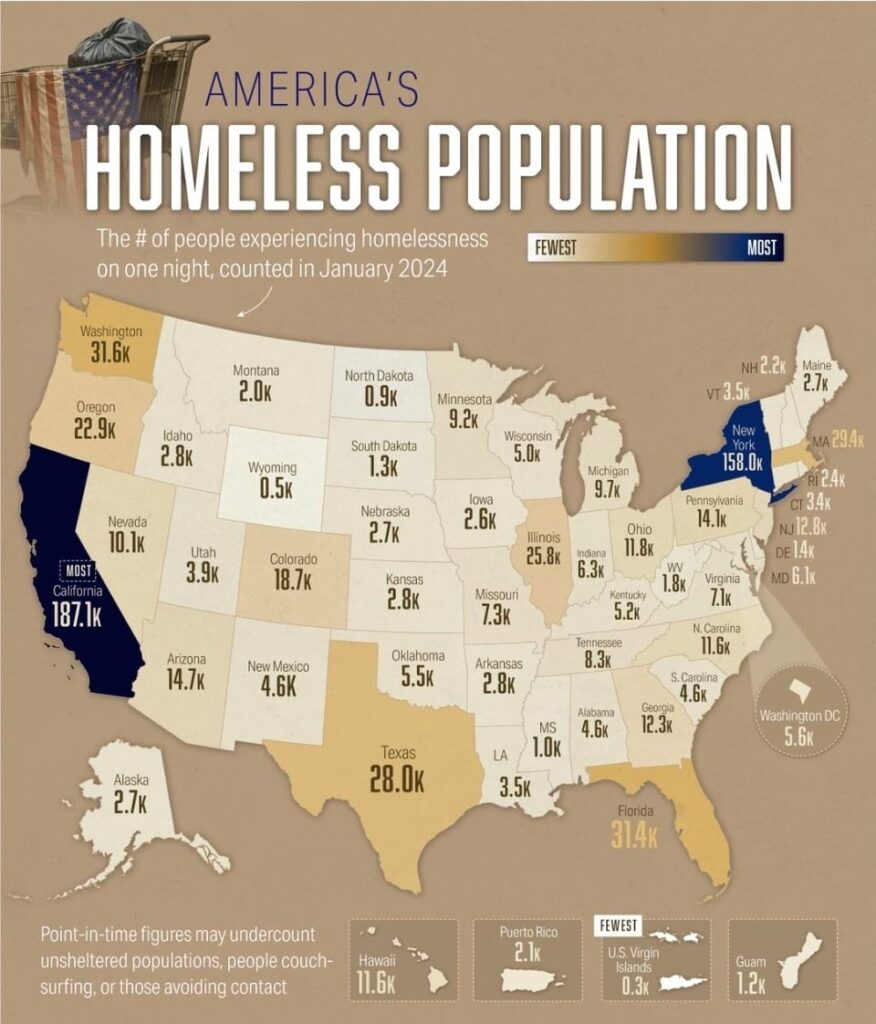
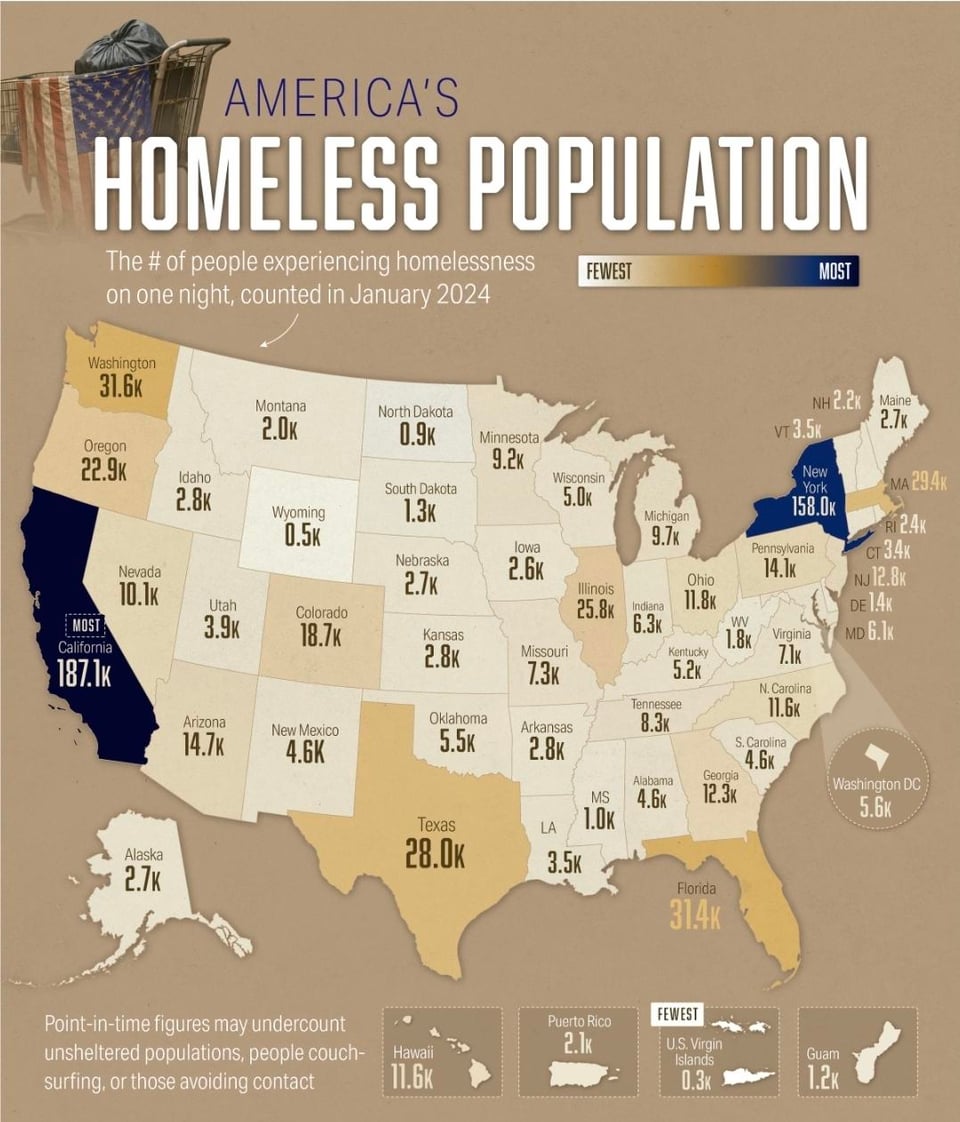
there’s only 500 homeless people in wyoming?
Is this a map of where people live?
Normalize this by population or GTFO
People don’t take into account how California and New York have better services for homeless people, and treat them better, and the red states literally criminalize it. And California has mild winters and summers so is easy to stay there during summer and winter, and not die of heat or cold outside.
Perhaps it would be better to look at it per 100k people to give a better idea of the actual rate in each state.
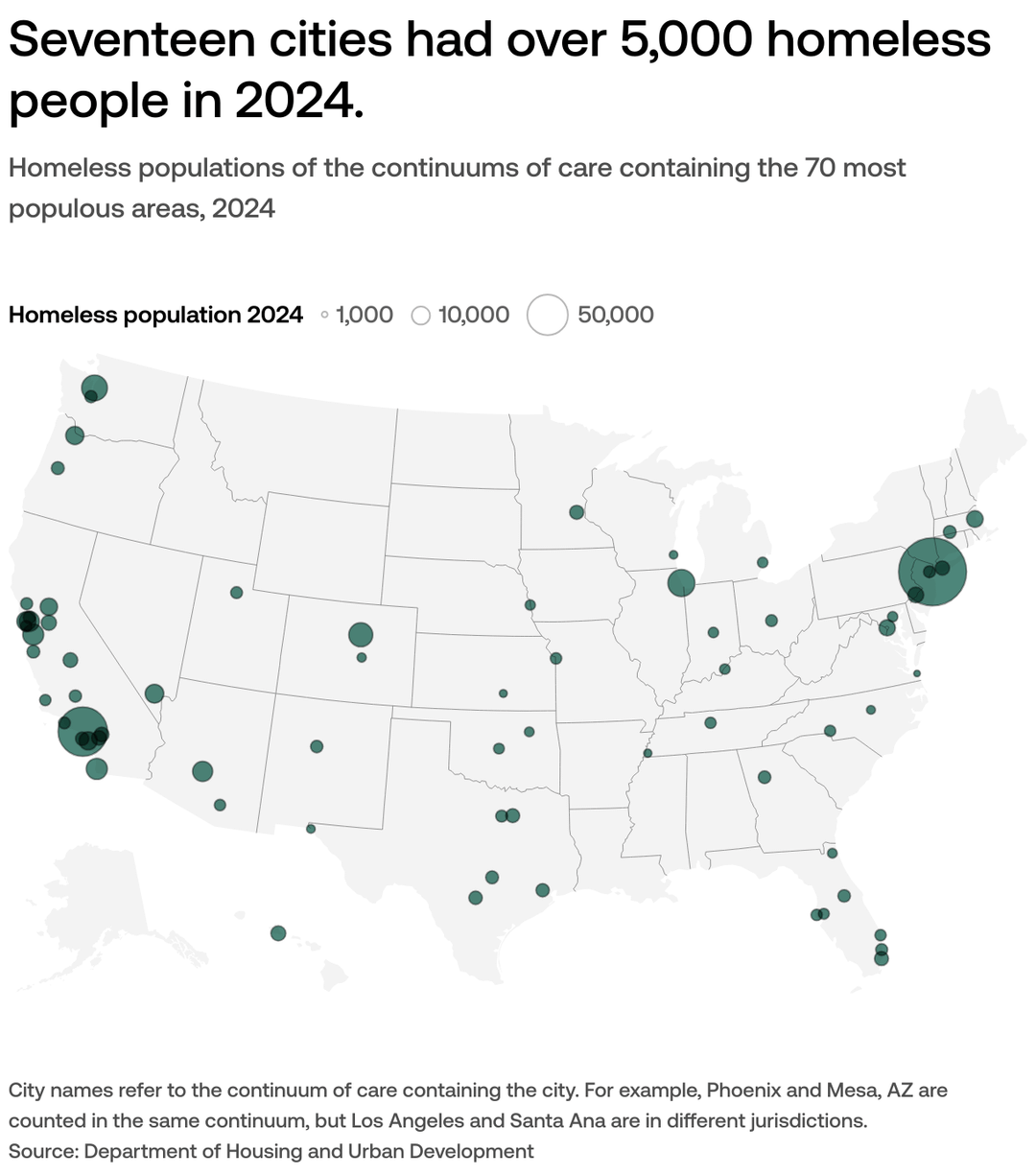
Isn’t that also depending on total population and population density? Homeless will move to cities because they can find better opportunities in a city than in a village out of nowhere in mid west.
Should really do #/100k population.
Per Capita
Kicking and screaming will mapmakers avoid per capita
Memphis has cheap housing and a significant homeless population.
I’m curious how they collected this data – surely with something like this, it’s almost impossible to get an accurate number so the real total is probably much higher in NY and LA, right?
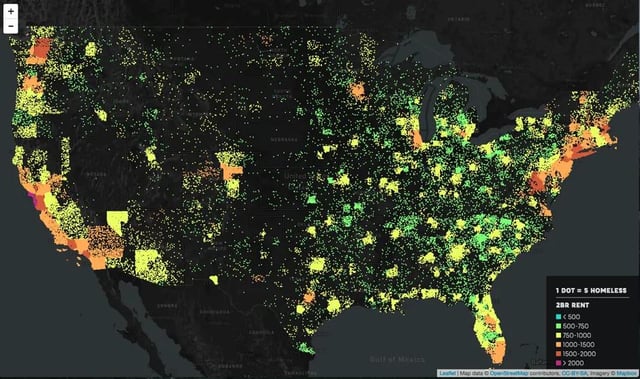
This map has so much regional variation because [homelessness is a housing problem](https://homelessnesshousingproblem.com/), and homelessness rates are caused (exclusively) by **high rents and low vacancy rates**. This is a damn-near universal academic consensus among researchers: they’re homeless because *there aren’t enough homes*.
These things don’t correlate to homelessness rates:
– Drug use rates
– Poverty rates
– Nice weather days
– Quality of social services
A divorced elderly man born in New York is likely to be homeless. If he were born in Detroit though, he is unlikely to be homeless. This is because Detroit has low rents and plenty of vacancies, so it’s easy to find housing if your life is a mess. West Virginia is the epicenter of the opioid epidemic, but has next to zero homelessness; because *drum roll* – West Virginia doesn’t have a housing shortage.
There is also no evidence supporting the myth that “That other state sent them all here”. The most [comprehensive, peer reviewed academic studies we have](https://www.ucsf.edu/news/2023/06/425646/california-statewide-study-investigates-causes-and-impacts-homelessness) show that the overwhelming majority of California’s homeless population grew up in – you guessed it – *California*. A handful of anecdotes about some shitty governor giving some people one-way bus tickets is not evidence, it’s anecdote.
Which states have the highest and lowest rates of homelessness? | USAFacts https://share.google/xjBBHTtdE0W4Kx7yA
Needs to be a rate or per capita to have any meaning.
An today, a special, high-resolution episode of r/PeopleLiveInCities !
This map should be done on a per capita basis.
This is eyeaopening. We need to do better.
We need more affordable housing
Vermont is way up there in terms of or capita.
I was one of those statistics in NYS. It’s no joke. We have 3, maybe 4 floors worth of homeless people in hotels alone in my town. That’s not including the boarding houses and outskirt motel riddled with bedbugs. Idk wtf they plan on doing about the situation. I’m just glad I got lucky. Very lucky.
ITT: people trying to excuse californias failure to address homelessness
In California, even the nicest neighborhoods, particularly on the coast, have homeless around. It’s sad. The state and local governments have absolutely no handle on it.
I think California has a lot of homeless because of failed dreams. This place is not for the faint of heart.
It should be noted that homelessness is not just a city problem. The reason the homeless congregate in cities is because they offer services and tolerate them.
Yes, California, and specifically SF and LA have a ton of homeless, but a large portion of them migrate there from out of state. They leave their small towns which lack any supportive services, hop on a bus and end up in the cities.
To eliminate homelessness in the cities, rural areas need to also invest in their communities, specifically into mental health and drug addiction programs.