
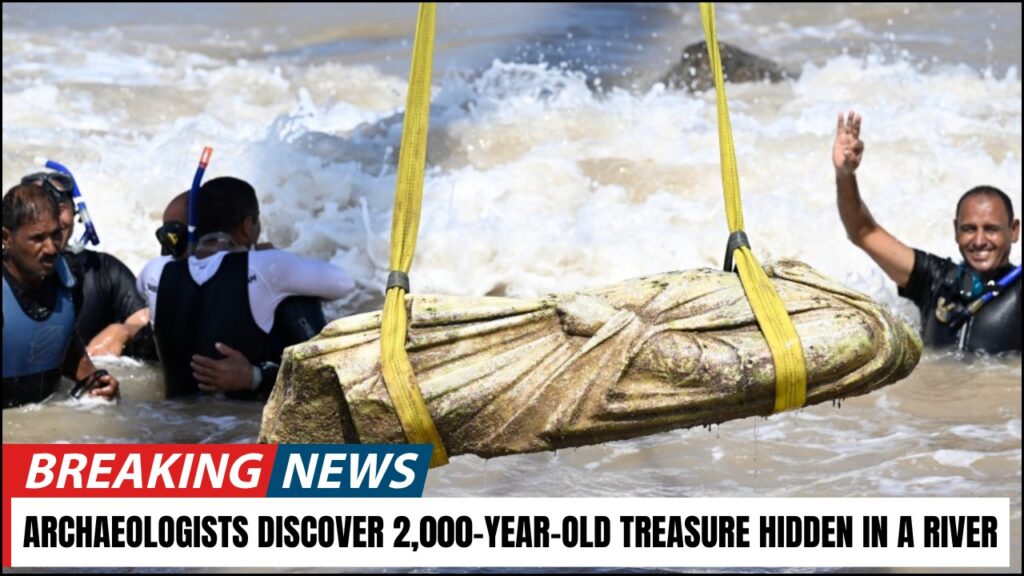
Along the murky riverbed of the Sava River in northeastern Bosnia and Herzegovina, an astonishing discovery has emerged—one that promises to reshape our understanding of ancient European trade and craftsmanship. After only two days of underwater exploration, archaeologists unearthed nearly 200 iron ingots buried in the sediment near Bosnian Posavina. This treasure, dating back over two millennia, offers a rare glimpse into the technological and economic world of Iron Age Europe.
The Discovery That Shocked Archaeologists
The excavation was led by Krunoslav Zubčić, senior conservator archaeologist at the Croatian Conservation Institute’s Department for Underwater Archaeology. The site was first noticed by a local history enthusiast, whose keen eye led to a professional team descending into the river to map, photograph, and carefully retrieve each iron ingot.
“This is one of the largest finds of its kind in this region,” Zubčić said. “Almost two hundred iron ingots, each perfectly shaped—this is an extraordinary window into our past.”
The sheer scale of the discovery sets it apart. Most previous finds involved isolated ingots, but a cluster this size points to a well-organized system of production, storage, and trade.
What Makes These Ingots Special?
These are not ordinary iron bars. Known as bipyramidal ingots, they are shaped like two pyramids joined at the base—a design widely used in the ancient world. This shape made them easy to transport, store, and reforge into tools, weapons, and fittings as needed.
Their uniformity and craftsmanship suggest they were more than raw material—they were standardized trade stock, likely moving through regional and cross-border markets. The Sava River itself may have served as a vital trade corridor, connecting Celtic tribal areas with the expanding Roman frontier.
The Art of Ironmaking in Ancient Europe
Recovering the bars is only the beginning. Scientists now aim to uncover how they were made and where the iron originated. Chemical and isotopic analyses will compare trace elements in the ingots with known ore sources across Europe—whether the eastern Alps, the Pannonian Basin, or elsewhere.
Radiocarbon dating of carbon trapped in the iron will further refine their age, confirming whether these ingots truly belong to the 1st or 2nd century BC. By combining these methods, researchers hope to reconstruct ancient supply chains and reveal long-forgotten trade networks.
Trade Networks Hidden in the River
The discovery is more than a testament to craftsmanship; it tells a story of commerce. The presence of so many ingots suggests a sophisticated system of trade along the Sava River. Barges or rafts may have carried the iron downstream, distributing it to metalworkers and markets across Europe.
If analysis confirms that some ingots originated from distant regions, it could demonstrate that ancient European trade was far more interconnected than previously thought. These bars may be physical evidence of early industrial logistics—a blend of production, distribution, and economic strategy.
Preserving the Past: The Recovery Process
Uncovering metal from underwater sites is a delicate and meticulous process. The team employed:
- Mapping and reference points to record the exact location of each ingot.
- Photogrammetry to create detailed 3D models of the site.
- Distilled water storage to remove harmful salts and prevent corrosion.
These conservation methods are crucial. Ancient iron reacts violently with modern oxygen and can crumble within days if not handled properly. The careful retrieval ensures that the ingots will remain intact for study and display.
Every Shape Tells a Story
Even slight differences in length, angles, or end cuts can reveal the origin of each ingot. Researchers examine:
- Hammer marks and weld lines
- Slag inclusions and porosity
- Heat treatment zones
Each mark provides clues about the skills, techniques, and tools used by Iron Age metalworkers. Collectively, they help map the spread of technology and knowledge across Europe, shedding light on a world long obscured by time.
The People Behind the Find
This discovery is the result of collaboration between local enthusiasts, professional archaeologists, and international experts. As Jezercic, director of the Museum of the Franciscan Monastery (Tolisa Vrata Bosne), emphasized:
“Cross-border cooperation is essential to fund analysis, share data, and compare these ingots with artifacts elsewhere in Europe.”
The find highlights the importance of combining grassroots observation with advanced scientific methods—a model that could guide future discoveries across the continent.
Why This Treasure Matters
If confirmed to date back to the 1st or 2nd century BC, these iron ingots offer a unique snapshot of a pivotal period in European history, when Celtic cultures and Roman expansion overlapped. Whether the bars came from a single mine or multiple sources, they illuminate ancient production, trade systems, and the people who orchestrated them.
This isn’t just a story about rusty iron; it’s about human ingenuity, economic networks, and the quiet power of rivers as conduits of culture and commerce. Through this treasure, the Sava River is speaking again, telling the tale of ancient Europe and the hidden world beneath its waters.