
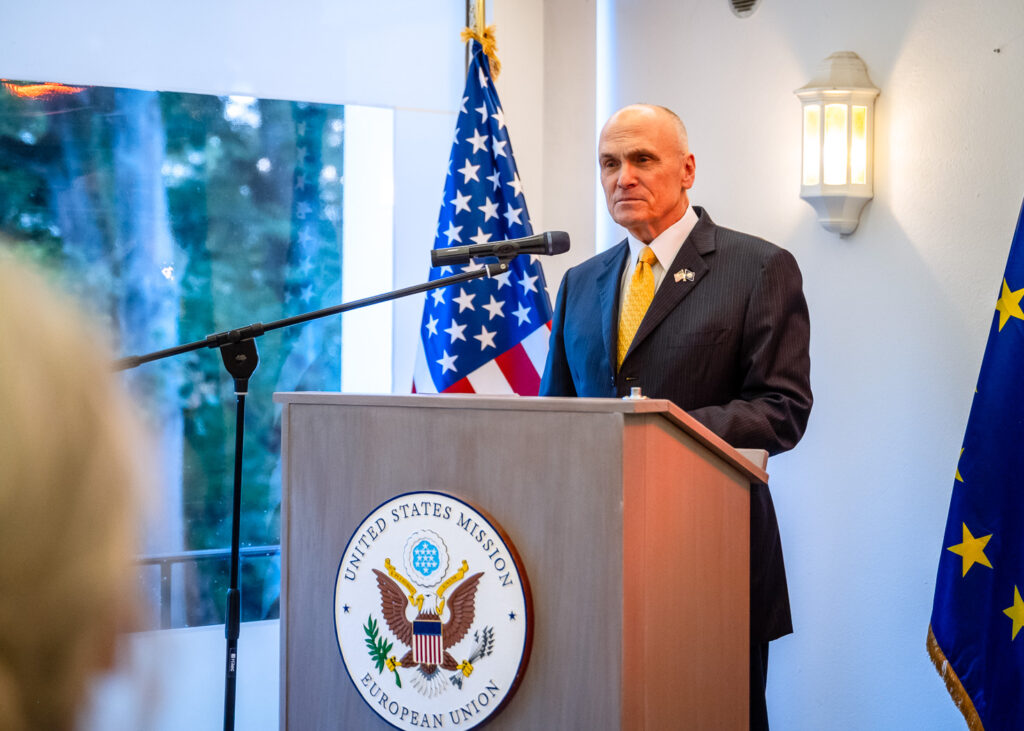
Washington’s new envoy to the EU says European officials have needed remarkably little “convincing” to adopt a tougher line on China, citing rare earth export controls and Beijing’s ties with Moscow as key drivers behind the shift.
“One of the things that really surprised me when I got to Europe was how aligned the EU has become with the US on the issue of China,” US Ambassador Andrew Puzder told Euractiv in an exclusive interview.
Puzder, a long-time Republican and major donor to Donald Trump’s campaign, officially took up his post in August. He said he had expected to “do more convincing” before EU officials came to view Beijing as “a strategic, political and economic adversary”.
Beijing’s export controls on rare earth elements – essential to smartphones, semiconductors and defence technologies – have alarmed EU policymakers and forced many of Europe’s already struggling industries to suspend production.
The measures, introduced shortly after Trump announced sweeping “reciprocal tariffs” in April, have deepened strains between Brussels and Beijing, already fraught since Russia’s 2022 invasion of Ukraine.
“China has been basically supporting Russia,” Puzder said, accusing Beijing of “financing the war” through expanded purchases of Russian oil.
Steel and the deal
His remarks came a day after the European Commission proposed doubling tariffs on EU steel imports to 50% – a move widely seen as targeting China, the world’s top producer.
Puzder said the measure could “make it easier” to negotiate adjustments to Trump’s own 50% blanket levy on EU steel and aluminium. “If what I’m reading is correct, it gives us more confidence that exported goods don’t contain Chinese steel,” he said. “Because now we’ll be more confident that they don’t contain the steel from China that we put a 50% tariff on. So I think it’s a good thing for both countries.”
The ambassador also defended the US–EU trade deal concluded in July, which many European leaders consider asymmetric. The agreement subjects most of the EU’s €532 billion in annual exports to a 15% tariff, while obliging Brussels to purchase $750 billion worth of US energy and invest $600 billion in “strategic” American sectors.
Puzder argued that Commission President Ursula von der Leyen struck a “very good deal,” noting that other close allies like Canada now face steeper tariffs. “The United States is no longer a low- or zero-tariff country,” he said. “That’s the new reality.”
The EU’s pledge to boost purchases of American energy is also necessary to reverse Europe’s industrial decline and meet the demands of energy-hungry data centres required to support the modern AI-driven economy, he said.
Russia’s unreliability as an energy provider further bolsters the case for purchasing more US energy, he suggested, adding that Trump was “laughed at” when he warned EU leaders about the bloc’s dependence on Moscow during his first presidential term.
“The war in Ukraine has been a wake-up call,” he said.
However, Puzder also echoed Trump’s remarks about the possibility of the US – if not necessarily the EU – normalising ties with Moscow once the war in Ukraine ends.
“I don’t think Europe will allow itself to become energy-dependent on Russia anytime in the foreseeable future,” he said. “But that doesn’t mean that Russia couldn’t play a role, depending upon how the war ends. The longer it goes on… the more difficult it’s going to be to reassimilate Russia back into the world economy.”
‘Give Trump a chance’
Trump’s economic, trade, and foreign policy have also caused many Europeans’ attitude towards the US to cool considerably over the past year.
Skepticism about the US has been especially pronounced in Denmark, where Trump’s repeated threats to annex Greenland, a mineral-rich Danish Arctic island, have caused attitudes toward Washington to plummet.
One YouGov survey published earlier this year found that just 20% of Danish citizens now have a favourable view of America, down from 48% in August 2024.
Puzder, however, said he hopes Europeans “give President Trump a chance”, adding that few American presidents are admired while in office.
“Even Ronald Reagan, who was an incredible president, had severe criticism while he was in office that dissipated afterwards,” he said.
“People will look at his (Trump’s) record and see the amazing things he’s accomplished. And this will be true in Europe as well as the United States.”
(cs)