

Polish social media was flooded with a wave of pro-Russian disinformation during the night of Sept. 10, as 19 Russian drones entered Polish airspace, cybersecurity experts said.
Many posts falsely blamed Ukraine or NATO, painting the drone flights as part of a “foreign provocation” aimed at dragging Poland into a global conflict, the French newspaper Le Monde reported.
Follow our coverage of the war on the @Kyivpost_official.
Experts described the online surge as a “tsunami of disinformation.” Michał Fedorowicz, head of research group Res Futura, said his team tracked roughly 200,000 posts, comments, and statuses in just a few hours – 200 to 300 messages every minute.
Similar campaigns appeared in French, German, and Romanian social media.
“In terms of scale, it’s the equivalent of what happens during an election night for a presidential vote,” Fedorowicz said.
The messages claimed NATO and the Polish army were powerless despite their massive resources, and accused authorities of hiding the truth from the public.
By morning, false information dominated the online conversation: 38% of posts blamed Ukraine, 34% blamed Russia, and many others blamed NATO.
Filip Głowacz of Poland’s National Cybersecurity Institute (NASK) said some posts contained kernels of truth but were twisted to mislead.
For example, Belarusian authorities did warn Poland of approaching drones – but the campaign spun it as evidence of Polish weakness and deceit.
Other Topics of Interest
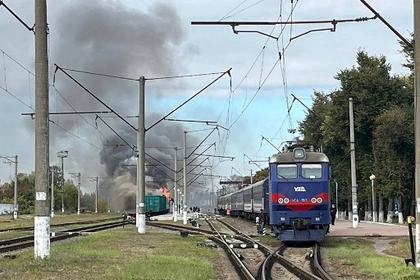
Russia Continues Its Assault on Ukraine’s Railways, Tries to Isolate Sumy and Chernihiv
Bus transfers are being organized to minimize the risk to passengers as Russia shows no sign of slowing its attacks on the regions’ railway infrastructure.
The attack marks a turning point in Europe’s information war, experts say. Fedorowicz warns that the goal is clear: sow doubt about NATO’s reliability and undermine public support for military spending.
Nineteen Russian drones violated Polish airspace on Sept. 10, temporarily shutting down at least four airports, including Rzeszów, Lublin, Warsaw, and Modlin.
The drone incursion itself was the most serious in a string of European airspace incidents this fall.
NATO aircraft, including Polish F-16s, Dutch F-35s, Italian AWACS reconnaissance planes, and refueling aircraft were sent to intercept the drones.
Elsewhere along the alliance’s eastern frontier, Latvia, Lithuania, and Romania have all reported Russian drone incursions.
In response, NATO countries elected to move troops and fighter jets eastwards as part of its Eastern Sentry mission to bolster the military alliance’s eastern flank after the incursion.
Poland’s Ministry of Digitalization issued an emergency warning about the scale of the disinformation on Sept. 11, but the full extent of the campaign remains unknown.