
Private UK company Tokamak Energy has signed a strategic collaboration with European green tech firm Gauss Fusion that will aim to advance transformative high temperature superconducting (HTS) magnets and accelerate commercial fusion technology.
Gauss Fusion is among the leaders in the industrialisation of fusion energy – having announced a series of tie ups with Italy, Spain, Germany, and France in July – while Tokamak Energy’s business division TE Magnetics has expertise in HTS technology.
The news coincided with Gauss Fusion unveiling its conceptual design report, which forecasts €15-18bn in costs to bring the first commercial fusion reactor by mid-2040s. The report outlines a pathway from lab to power plant, including cryogenic systems for superconducting magnets, as well as how high- and low-temperature superconductors can be manufactured at scale.
A commercial fusion plant would be fuelled using two isotopes of hydrogen – deuterium and tritium. The fuel would be heated to form a plasma – that is, an ionised gas comprised of charged particles which can be confined and controlled by powerful magnetic fields.
When superheated, the deuterium and tritium combine to produce helium and neutrons, releasing enormous amounts of energy.
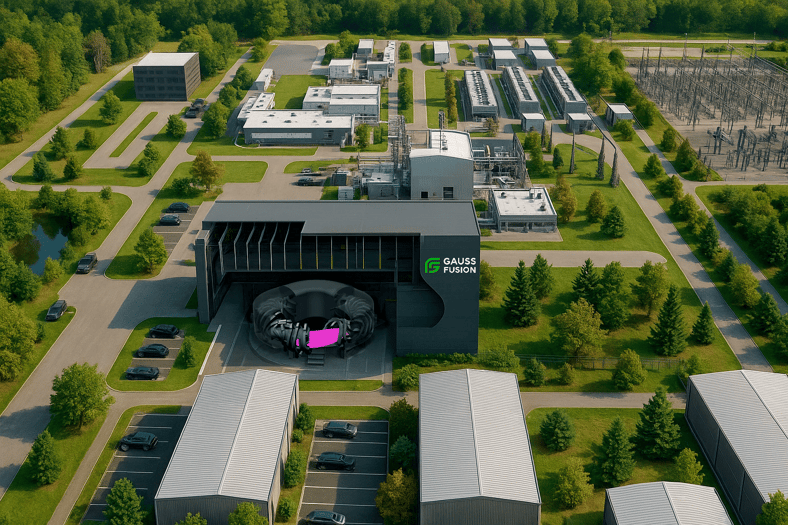
© Gauss Fusion
The potential of fusion energy is that it could directly replace fossil fuel sources to supply the thermal energy needed for industrial processes like metals, chemicals and hydrogen production, but it remains a long way from being commercialised despite the pace of projects picking up.
But not everyone is convinced. In his new book, Going Nuclear, nuclear chemist Tim Gregory referred to an experiment at the National Ignition Facility in 2022 which consumed 110 times more energy than it generated. He believes fusion is a ‘distraction that robs our attention from credible solutions’.
“Even if we ignore the 100,000 watt-hours used to charge the lasers, an energy gain of 310 watt-hours is tiny. It’s enough energy to boil water for a dozen cups of tea … I think we’ll have permanent human habitation on the surface of Mars before we can power the world with nuclear fusion (although I hope I’m wrong). Barring a miracle, it will not solve our energy woes anywhere close to our 2050 net zero deadline.”