
The October 12 local elections in 38 municipalities of Kosovo are expected to take place in a tense political climate: with the Assembly constituted only after six months of effort and with the Government still in office.
This situation, according to experts in political developments, gives this electoral process a broader dimension than simply local.
However, they do not expect the crisis at the central level to significantly affect voter behavior in Kosovo’s municipalities.
For them, local elections remain more related to specific names and the performance of candidates, rather than to party affiliation.
“The Kosovar voter has shown himself to be independent in the local elections”
Rrahman Paçarizi, a professor at the Department of Journalism at the University of Pristina, tells Radio Free Europe that past experiences show that central policy has rarely influenced local outcomes.
He recalls the case of the 2021 elections, when the Vetëvendosje Movement won over 50 percent of the vote in the parliamentary elections, but managed to secure only four municipalities at the local level.
“Local elections work quite differently and citizens, since they have to vote for a specific candidate, with a name and surname, who is not necessarily very attached to the party, then their decisions are quite independent. In this sense, the Kosovo voter has shown himself to be quite emancipated,” says Paçarizi.
Citizens skeptical of major changes
In Pristina, some citizens surveyed by Radio Free Europe say they do not expect major changes from these elections.
Vlora Kurtishaj says that, although the candidates’ campaigns promise to improve the lives of citizens, the main priority of the parties remains taking positions in local government.
“I’m just hoping that the citizens’ money, our taxes, are not misused and are returned to the welfare of the citizens,” she says.
Afrim Hyseni believes that changes can only happen in small municipalities.
“… because there, even if they lie, they lie more softly, because the municipality is small. In large municipalities, there is chaos. There has been local government for 25 years… and chaos, only chaos,” according to Hysen.
Agim Zymberi, from Vushtrri, believes that many citizens – tired of the hassle of forming institutions after the February 9 parliamentary elections – will invalidate their ballots in the October 12 elections.
“They are not managing to form a government, so what can we expect from the municipalities?” says Zymberi, adding that “the desperation is great.”
End of the “bastions”?
In Paçariz’s analysis, local elections will mark the end of the traditional concept of political “bastions”.
According to him, the voter will judge individuals more than party logos.”
“I do not believe that in Kosovo we can talk about bastions anymore, but about mayors who have performed well in the eyes of citizens or who can perform well,” says Paçarizi. Another political expert, Agon Maliqi, shares a similar position.
He estimates that the dynamics of local elections in Kosovo have often produced surprises and upheavals.
“In local elections, Kosovar voters have shown a greater tendency than at the central level to surprise and overthrow the bastions,” he tells Radio Free Europe.
Maliqi adds that this approach of Kosovar voters is closely related to the voting pattern in local elections, where often the candidates of the two strongest parties go to a runoff.
“The runoff then forces voters of other parties to choose between two candidates. This is often where reversals happen. For example, Vetëvendosje won Prishtina for the first time exactly like this – in a runoff and with the support of voters of other parties,” Maliqi explains.
Pristina and Mitrovica, the races that will weigh politically
According to analysts, although central developments are not expected to directly affect local elections, local results will be used as a positioning tool for parties at the national level.
This is especially evident in the race for Pristina, which is seen as a political barometer.
“Pristina is the place of upheavals between LDK and Vetëvendosje. The Democratic Party of Kosovo has already entered the race quite well and we do not have a dichotomous race, but we have a trinome race,” Paçarizi assesses. He adds that the expected runoff may also affect the creation of new political alliances, which may then be reflected in the next parliamentary elections.
Maliqi also sees the race for the capital as a “political test” that could determine the course of the upcoming parliamentary elections.
“Usually in Pristina, in some form, those first tendencies or signs of the broader national course appear,” says Maliqi.
According to him, another important competition is the one in South Mitrovica.
“…because the entire focus of Kurti’s government has been on the north, in this mandate. In a way, it makes the choice between Faton Peci [from the Guxo List, which at the central level is in coalition with Vetëvendosje] and Arian Tahiri (from the Democratic Party of Kosovo] a kind of mini-referendum on this political course. Any loss of Faton Peci would be very devaluing for central-level politics,” says Maliqi.
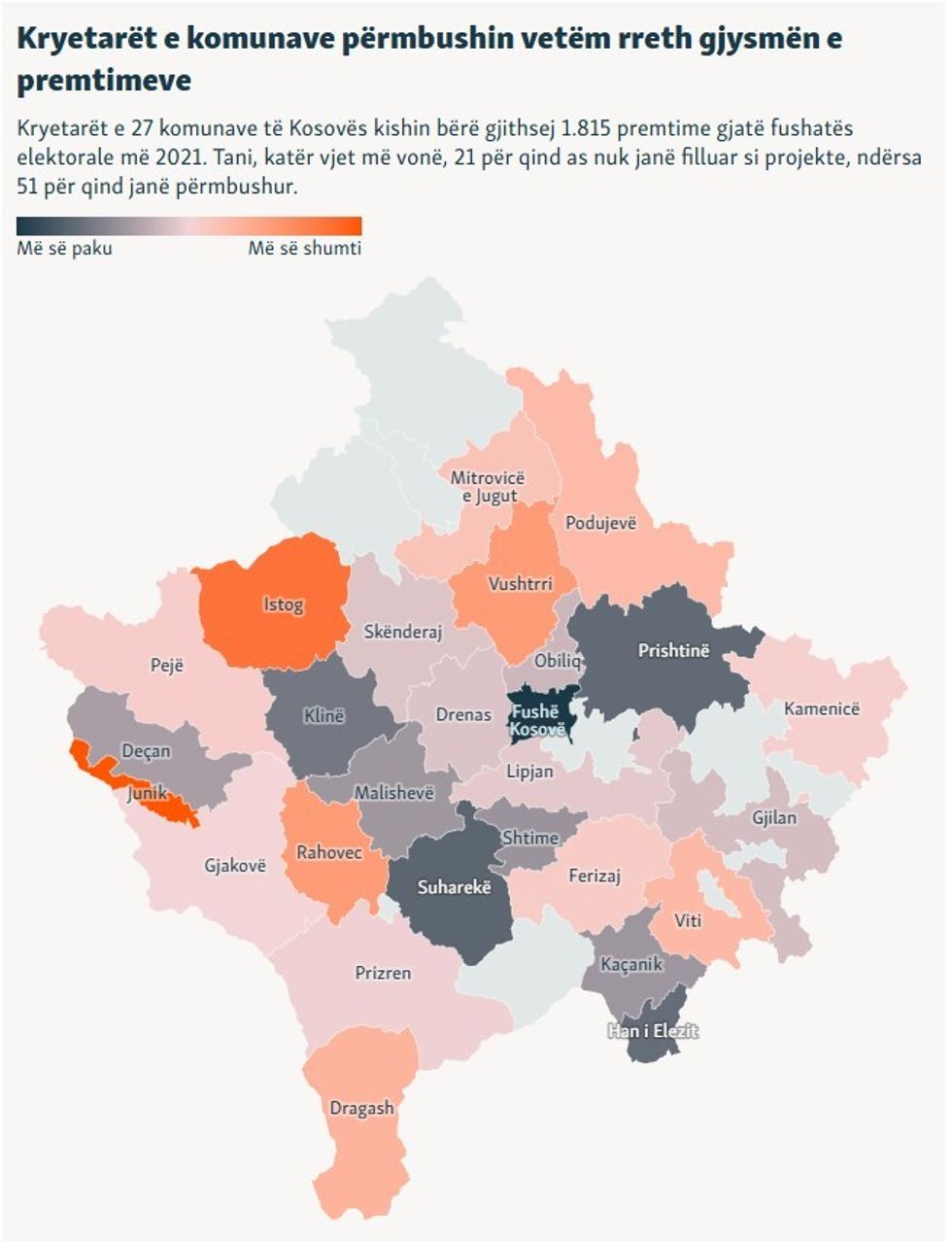 Note: Data for the ten municipalities with a Serb majority and Mamusha are not available as the GAP Institute did not record any election promises. For more details on other municipalities, click on the map. Map: Doruntina Baftiu Source: GAPT Institute Map data: © OSM
Both analysts agree that Albin Kurti’s incumbent government has made moves with electoral overtones in recent weeks, including the decision to subsidize all students with 100 euros.
These actions, according to them, may have an impact on the voting climate, but not necessarily on the final result.
Serbian List and limited pluralism in the north
In the northern part of Kosovo, inhabited by a Serb majority, the elections will take place in a different political reality.
For more than two years, the four municipalities in that area have been led by Albanian mayors, after the representatives of the Serbian List resigned from Kosovo institutions in November 2022 in reaction to the decision of the Kosovo authorities to remove Serbian car license plates.
This party – the only one supported by Belgrade – is expected to regain control of most Serb-majority municipalities, although this time the race will have more actors.
Miodrag Milićević from the “Aktiv” organization in North Mitrovica tells Radio Free Europe/Radio Liberty that in addition to the Serbian List, the Party for Freedom, Justice and Survival, Serbian Democracy, Serbian People’s Movement, the Kosovo Alliance, as well as several civic initiatives are also competing in some municipalities.
However, it is expected that the Serbian List will repeat the result of 2021, says Miličević, referring to the elections when this party won in all ten municipalities with a Serb majority.
He believes that the “stigmatization” of the Serbian List by the Kosovo Government in recent years has helped it maintain the support of Serbian voters.
“Simply put, this approach has strengthened the conviction of local Serbs that they should direct their votes and political orientation towards the most powerful party within the Serb community, and that is precisely the Serbian List,” says Milićević.Radio Free Europe/