
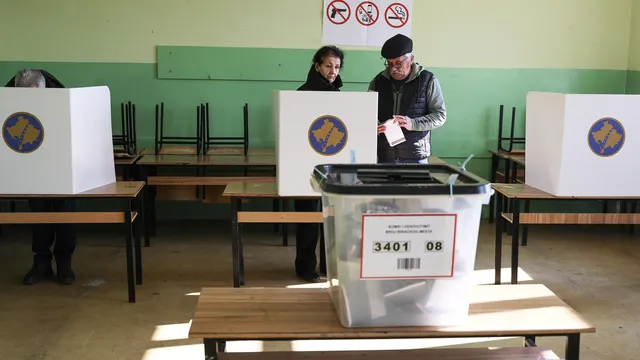
A free and transparent electoral process, without external interference or manipulation.
These are the European Union’s expectations for the local elections in Kosovo on Sunday, October 12.
In recent days, Kosovo President Vjosa Osmani and Prime Minister Albin Kurti have claimed that Serbia is interfering in the elections by offering jobs or financial assistance to the Serbian community.
The European Union did not respond to Radio Free Europe’s request for comment on these allegations by Kosovar officials and whether they had any information about external influence on voters ahead of the local elections.
However, an EU spokesperson told Kosovo’s public broadcaster (RTK) that “all citizens should be able to exercise their right to vote freely, without external interference or manipulation.”
He recalled that the EU mission to observe the parliamentary elections in February had found that there had been external influence. In particular, the observation mission found in its report that the Kremlin-backed media outlets RT Balkan and Sputnik Serbia had published dozens of articles on the Kosovo elections during the election campaign with “manipulative content” aimed at the Serbian community.
Zeta Leshay, a researcher at the Kosovo Center for Security Studies, told Radio Free Europe that these Russian media outlets act as “agenda setters at politically sensitive moments, such as elections, by presenting events through the prism of the victimization of the Serbian community in Kosovo and the hostility of the West towards Serbia and Russia.”
“A clear example emerged during the parliamentary election campaign in February 2025, when RT Balkan and Sputnik published articles claiming that there had been vote rigging against Kosovo Serbs, which were later reposted by pro-government Serbian media and Telegram channels active in northern Kosovo,” said Leshay, who otherwise studies Russia’s influence on the countries of the Western Balkans.
In this context, he noted that “although Russia has a small quantitative footprint in Kosovo, its qualitative influence on the formation of public discourse and perceptions, especially among Kosovo Serbs, is significant.”
What narrative did Russian media outlets spread during the campaign?
During the campaign for the local elections in Kosovo, these media outlets spread an almost identical narrative to that during the campaign for the parliamentary elections held on February 9: The “Serbian List,” the largest Kosovo Serb party supported by Belgrade, was presented as the “defender of the interests” of the Serbian community.
The Kosovo authorities, on the other hand, are presented as exerting extreme pressure or “terror” on the Serbian community in order to drive it out.
Other Serbian political actors are either given no space or are called “traitors” when they cooperate with the Kosovo authorities.
For example, in the news item titled “Another attack on Serbian symbols: Tribune painted in the colors of the Serbian flag in Kosovska Mitrovica,” published on RT Balkan on October 8, actually conveys the position of the Serbian list’s candidate for mayor of North Mitrovica, Milan Radojevic.
It states that Serbian symbols were once again “targeted by vandals,” although there is no confirmation of this from the police or any other party.
On October 2, the same media outlet published a news item titled “UN Security Council session on Kosovo and Metohija: Russia, from the position of chair, defends Serbia” – which states that Serbia should take advantage of the Russian presidency because Moscow stands firmly with Belgrade on the issue of territorial integrity, unlike Western countries.
And in the text entitled “This time, no one should be late for Kosovo and Metohija: German offensive against Serbian schools,” published on September 21, discusses the announcement of the integration of Serbian health and educational institutions, in which former German ambassador Jörn Rode is presented as “the Albanian defender on duty.”
In one part, the author of the text states that people forget “the fact that Kosovo and Metohija is part of Serbia, there are no borders, there are not two states, but only one, called Serbia, which includes the Autonomous Province of Kosovo and Metohija.”
“They are particularly concerned by the fact that Serbian students are taught that Adem Jashari was a terrorist killed in an anti-terrorist operation by Serbian forces, as the so-called KLA is called by its real name – a terrorist organization, murderers and bandits,” the same text adds.
Sputnik Serbia also sends similar messages. In its news report on October 8, it reflected the message of the Serbian List that the upcoming elections are the most important since 1999 because they defend “everything that is Serbian.”
Incidentally, this media outlet has regularly followed the Serbian List’s pre-election rallies, which send messages that unity is necessary, while other political entities are not mentioned at all. | BGNES