

You can read this exclusive content thanks to the FALATH & PARTNERS law firm, which assists American people with Slovak roots in obtaining Slovak citizenship and reconnecting them with the land of their ancestors.
There are several ways to travel from Bratislava, the capital of Slovakia, to Brezno. One option is to take the D1 highway north, passing through Donovaly or the Čertovica saddle to reach the Horehronie (Upper Hron) region.
Alternatively, you can travel through central Slovakia, either via Banská Bystrica or by heading north from Rimavská Sobota. The fastest route—about two and a half hours—runs along the Hron River valley, offering a picturesque journey through the mountainous heart of Slovakia.

To reach Banská Bystrica, visitors can take the R1 highway. Beyond this regional capital, however, the road narrows to local routes that often become congested during weekend rush hours. Despite the slower pace, the striking mountain scenery makes the drive worthwhile.
On the way to the centre of Horehronie — the town of Brezno — travellers pass the striking white castle of Slovenská Ľupča. The castle is privately owned by the proprietor of Železiarne Podbrezová, the largest factory in the Brezno district, but parts of it are open to the public and include a museum.
For those interested in World War II history, the nearby village of Nemecká is home to monuments commemorating the massacre of local residents by German and Slovak fascists, as well as the partisans who fought against them.
For more facts and information about Slovakia, see our travel guide to Slovakia.
Imagine a Slovak Semmering
Visitors arriving in Brezno in the evening often stay directly on the historic square named after General Milan Rastislav Štefánik. Hotel Ďumbier — named after the highest peak in the Low Tatras — was once a popular venue for Stužková (Ribbon Ceremony), the Slovak secondary-school pre-graduation party. Now owned by the city and undergoing gradual renovation, the building’s exterior has been carefully restored, earning it a place among the most attractive structures in Brezno.
On General M. R. Štefánik Square, the local museum, the church, and especially the city’s clock tower draw attention from visitors and locals alike.
A helping hand in the heart of Europe: our travel guide to Slovakia.
Brezno lies encircled by mountains: the Low Tatras rise to the north, the Veporské vrchy to the south, and the Muránska planina plateau extends to the southeast. This landscape makes the town an ideal base for winter sports enthusiasts as well as for hikers and cyclists during the summer months.
Several ski resorts are located nearby, including Tále and Mýto pod Ďumbierom, while the renowned biathlon area in Osrblie is only a short distance away.
Brezno holds the potential to become a “Slovak Semmering”. Achieving this vision, however, requires continued development and collaboration among local institutions and entrepreneurs with a shared ambition: to attract visitors to the region and encourage longer stays beyond a single weekend.
This challenge is being taken up by the regional tourism association, Horehronie Region. Its membership includes the city of Brezno as well as local business owners who operate hotels, chalets, restaurants, and ski lifts throughout the area.
“Initial doubts have faded, and local entrepreneurs are eager to cooperate, viewing one another not as competitors but as partners,” says Slávka Pančíková, coordinator for international cooperation at the Horehronie Region.

Sports car at the Car Museum in Brezno. (source: SME/Jozef Ryník)
For many foreigners tracing their Slovak heritage, finding the burial sites of their ancestors is a deeply personal journey. To aid in this quest, we have provided maps of the districts we visited, with every cemetery carefully marked. Here you can find cemeteries in the Brezno district.
From the office to the car museum
How can a former crane factory be transformed into a car museum? Entrepreneur Marcel Kolenička has achieved precisely that in Brezno. In addition to running a fashion business and owning a restaurant, Kolenička has nurtured a lifelong passion for sports cars, purchasing his first at the age of 20.
The result of that passion is the Double Red Cars Museum, which spans four floors and showcases dozens of high-performance vehicles. Visitors can admire well-known marques such as Porsche and Maserati, alongside lesser-known manufacturers that have long since disappeared from the market.
Several of the cars on display are truly unique — rare specimens that exist in only a single example worldwide, one of which can be found right here in Brezno.
The museum’s collection traces the evolution of automotive design from the 1960s to the early 2000s, offering a journey through decades of elegance, innovation, and engineering excellence. “Each era brought something unique — from elegance and technology to top performance and revolutionary design,” says Kolenička, who often leads guided tours of the museum himself.
He recounts stories about vehicles once owned by famous actors, athletes, and even underworld figures, revealing details about their manufacture, provenance, and the colourful lives of their previous owners.
Younger visitors will find entertainment as well, thanks to large Lego dioramas inspired by The Lord of the Rings, Harry Potter, and Pirates of the Caribbean.
After an hour or more exploring the exhibits, visitors can stop at the adjacent Red Horse restaurant. The venue is as distinctive as the museum itself, decorated with metal sculptures, automotive memorabilia, and eclectic artworks. Unique paintings and welded metal pieces also adorn the museum walls — details that reward those who take the time to look closely.
From Australia to Horehronie
Tomáš Gašperák had lived in Australia since 1986, when his parents emigrated there from Slovakia. On the other side of the world, he built a life, married, and raised two sons. He found success in business, dealing in cars, boats, and, above all, coffee. For two decades, he and his family ran a café and roastery in Brisbane, serving more than a thousand cups each day.
In 2021, the family decided to return to Slovakia — specifically to Brezno, the hometown of Gašperák’s parents. “It was an important step for me. After spending so long abroad, I felt it was time to bring my experiences and ideas back home,” says Gašperák, now the owner of Grinders Coffee Club.

Tomáš Gašperák Jr. in the coffee roastery in Brezno. (source: OOCR Región Horehronie)
A year later, the family converted an old garage in Brezno into a modern café and roastery. Although Gašperák prefers not to disclose the size of the investment, he notes that it was considerable — not only financially but also in terms of time and personal dedication. His wife and two sons, Tomáš and Gabriel, are also actively involved in the business.
“Everything we do requires a great deal of energy, but we approach it with enthusiasm because we believe that passion is reflected in the quality of the coffee and the atmosphere our guests experience,” he adds.
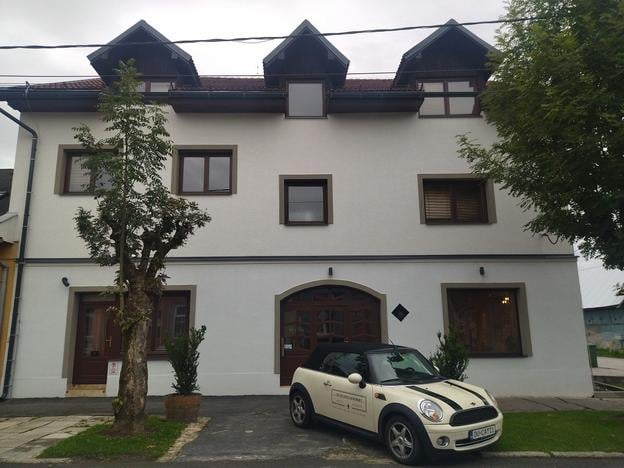
Pension of the Gašperák family in Brezno (source: SME/Jozef Ryník)
A guesthouse with a glimpse of history
The Gašperák family also operates a guesthouse in Brezno, offering modern apartments elegantly furnished with restored period pieces.
“We appreciate old items,” says Gašperák, describing his approach to interior design. “My wife and I often visit markets in Budapest to purchase antiques, which we then have renovated.”
Discover Slovakia with our Spectacular Slovakia travel guide.
Slovakia’s territory has been part of different monarchies throughout history, including the Austro-Hungarian Empire from 1867 until 1918. Until 1992, with the exception of the inter-war years 1939-1945 during which the Nazi-aligned Slovak state existed, the territory was a part of Czechoslovakia. As a result of being a part of the Empire, the current names of Slovak municipalities are different than during that era.
-
Brezno – Breznóbánya
-
Čierny Balog – Feketebalog
-
Heľpa – Helpa
-
Nemecká – Garamnémetfalva
-
Pohorelá – Koháryháza
-
Pohronská Polhora – Erdőköz
-
Podbrezová – Lopér
-
Polomka – Garamszécs
-
Valaská – Garamolaszka
-
Závadka nad Hronom – Ágostonlak
The full list of all Slovak municipalities, including their historical names, can be found at www.geni.sk (in Slovak only).
In addition to creating an inviting atmosphere, Gašperák places great emphasis on guest comfort, investing in high-quality mattresses to ensure a restful night’s sleep.
“A guest who doesn’t sleep well at our guesthouse is unlikely to return,” he notes, underscoring his commitment to comfort and attention to detail.
At the Grinders Coffee Club, the focus on quality extends beyond accommodation. Visitors can expect expertly prepared coffee and attentive service from knowledgeable staff, who are happy to recommend the ideal blend or roast. The café is often filled with locals and travellers alike, serving as a lively meeting point for families and friends — just as described on its website.
Future plans
The Gašperák family is now preparing to open a new roastery in Mýto pod Ďumbierom, a popular mountain resort near Brezno that features a ski lift. The new facility will be located directly beside the ski slopes.
“Our long-term goal is for the roastery and café to become recognised throughout Slovakia,” says Gašperák. “In time, we also hope to expand our coffee offerings beyond the country’s borders.”
More than just a shepherd’s hut
In the Brezno district lies the Zbojská shepherd’s hut (salaš), situated just beyond the village of Pohronská Polhora. The village takes its name from its location — nestled between the regions of Gemer and Horehronie — which once formed part of the historic Zvolen County. Today, Zbojská marks the boundary between the districts of Rimavská Sobota and Brezno.
The name Zbojská carries a touch of folklore, linked to the legendary bandit Jakub Surovec, who was said to have carried out robberies in this mountainous area.

Salaš Zbojská, a traditional shepherd’s hut in central Slovakia (source: OOCR Región Horehronie)
Although the weather sometimes refuses to cooperate — autumn rain and fog often shrouding the views — the valley nestled between the mountains remains picturesque, with its patchwork of meadows and pastures.
A short walk from the shepherd’s hut, which also houses a restaurant, leads to a small hill above the meadow crowned by a wooden observation tower. Even in foggy conditions, the climb is worthwhile for the quiet perspective it offers over the surrounding countryside.
Inside the rustic, hut-style restaurant, traditional dishes such as potato dumplings with sheep’s cheese (bryndza) are served alongside the local plum brandy, slivovica. Hearty soups round out the menu, and shelves are stocked with sheep’s cheese specialities to take away, including braided string cheese (korbáčiky) and rolled steamed sheep’s cheese (parenica). Outside, visitors can glide down the grassy bank on inflatable wheels or rent bicycles to explore the nearby trails.
After a warm welcome, the owner, Igor Vlček, invites guests to visit the wellness area and his small-scale sausage production. Sampling the homemade sausages and the traditional cold meat terrine (tlačenka) is an experience not to be missed — accompanied, of course, by a glass of slivovitz or pear brandy.
The hospitality of Horehronie seems to have no limits — but it is something best experienced firsthand.
Spectacular Slovakia travel guide
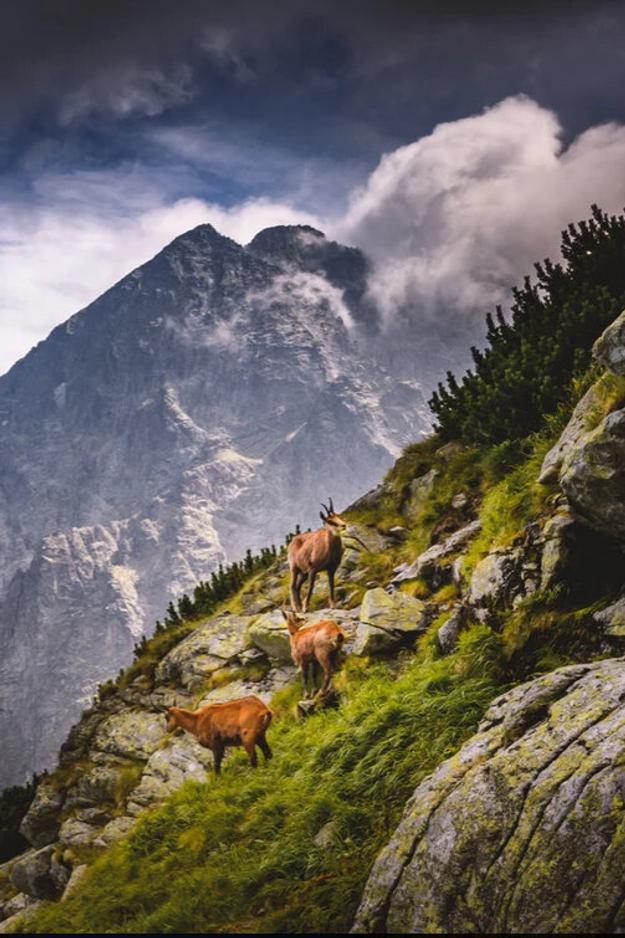
Spectacular Slovakia Travel Guide: The High Tatras (source: LUKÁŠ KUCEJ)