
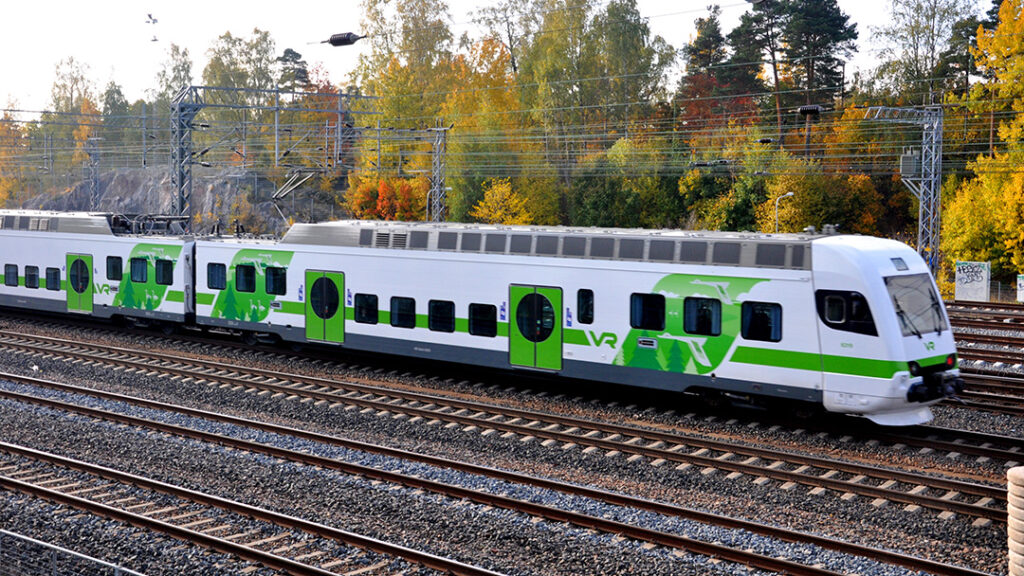
In a move to prepare for upcoming rail competition, Finland will take full ownership of Suomen Ostoliikennekalusto Oy, a rolling stock company (ROSCO) established for this purpose by state operator VR Group. The transfer will be implemented on 1 November 2025, under the ownership control of the Prime Minister’s Office.
A similar model to Norske Tog in Norway, the company will manage state-funded rolling stock, including commuter trains, rail buses, and night train carriages, next to overseeing investment planning. VR and the rolling stock company are preparing a business transaction to transfer the rolling stock currently used in state-ordered traffic to Suomen Ostoliikennekalusto Oy in early 2026.
The state company’s trains will be used for subsidised passenger traffic under PSO (public service obligations), which will later be put out to tender, in line with EU legislation. VR Group CEO Elisa Markula detailed earlier that rolling stock related to market-based passenger train traffic or freight traffic will not be transferred to the rolling stock company.
Around 84% of long-distance traffic in Finland (measured in terms of the number of passengers) consists of VR’s market-based train traffic. Regional trains in Southern Finland, night train and railbus traffic as well as individual IC/Pendolino services are commercially unprofitable, and the rolling stock used for those will be part of the new ROSCO.
Different gauge, less flexibility
Because Finland’s wide track gauge differs from the rest of Europe, foreign rail transport operators do not have suitable rolling stock ready. The rolling stock company will enable the provision of rental rolling stock, which lowers the threshold for entering the market.
The rolling stock company has been established as a subsidiary of VR Group during a preparation phase in 2024, and VR Group has provided it with initial capital of approximately 15 million euros. The company will now be transferred to direct state ownership as was the plan, under the ownership control of the Prime Minister’s Office. VR will no longer hold any ownership or participate in decision-making, allowing the company to operate independently as a neutral party.
Promoting competition
The current services agreement with VR will expire at the end of 2030. The Finnish Ministry emphasises that the current purchase service agreement between VR and the Ministry of Transport and Communications will continue until then, with no impact on the scope or quality of passenger services. After the current contract period, future state-funded services will be put out to tender in line with EU regulations.
The Finnish government has been preparing the establishment of a neutral rolling stock company since summer 2024, in cooperation with VR, the Transport Ministry, and the Prime Minister’s Office.
As part of the tendering process for purchasing transport, it will also possible to acquire new commuter rail services. For example, urban areas and work areas would have the opportunity to acquire additional transport, which would be financed by the municipalities in the area. Municipalities must make decisions on the procurement of commuter rail services by early 2026.
One of the operators that is preparing to launch competitive services is Suomen Lähijunat, founded in 2021. “The decision-making power over the development of commuter rail services now truly lies with the municipalities”, said Antero Alku from the private operator last July. In 2024, municipalities showed strong interest in restoring local train services when the Ministry of Transport and Communications announced that municipalities could organize regional train services themselves if they wished, according to the operator.
Leasing, fleet management and more
The state-owned company will have its Board of Directors appointed by the Prime Minister’s Office and the Ministry of Transport and Communications. Kai-Petteri Purhonen will serve as the Board Chair, and Joakim Metten will assume the role of CEO starting August 2025. The company will be responsible for leasing, fleet management, and planning and implementing investments necessary to maintain service levels.
The costs of state-subsidised passenger rail transport will increase significantly in the future compared to current levels, according to the Finnish ministry, primarily due to ageing rolling stock. The state has committed to covering the necessary rolling stock investments so that the current scale of purchased rail transport can be continued also in the 2030s.
Minister for European Affairs and Ownership Steering Joakim Strand highlighted the goal of enabling “all operators to have equal access to purchasing transport equipment,” while Minister of Transport and Communications Lulu Ranne added that the new company will “enable competition in the passenger rail transport market” and support market-based operations where possible.

Read more:
Already have a subscription? Log in.
Or
Want to read this article for free?
You can read one free article per month. Enter your email and we’ll send you a free link to access the full article. No payment required.