
Last week, Israel and Hamas agreed to an open-ended ceasefire based on a sweeping 20-point plan presented by President Trump, who traveled to Egypt on Monday to sign the agreement in person.
The first phase of the ceasefire — exchanging the 20 remaining Israeli hostages in Gaza for nearly 2,000 Palestinian prisoners — was mostly completed on Monday.
But now comes the hard part. Hamas has released Israeli hostages before; more than 130 had been turned over by the time Trump took office in January. There was a ceasefire in effect then too. (It had been negotiated by Trump’s predecessor, President Joe Biden.)
Yet lasting peace has proven elusive, with neither side willing to agree on a thorny set of “day after” details: Hamas’s disarmament, Israel’s withdrawal and Gaza’s postwar governance and security.
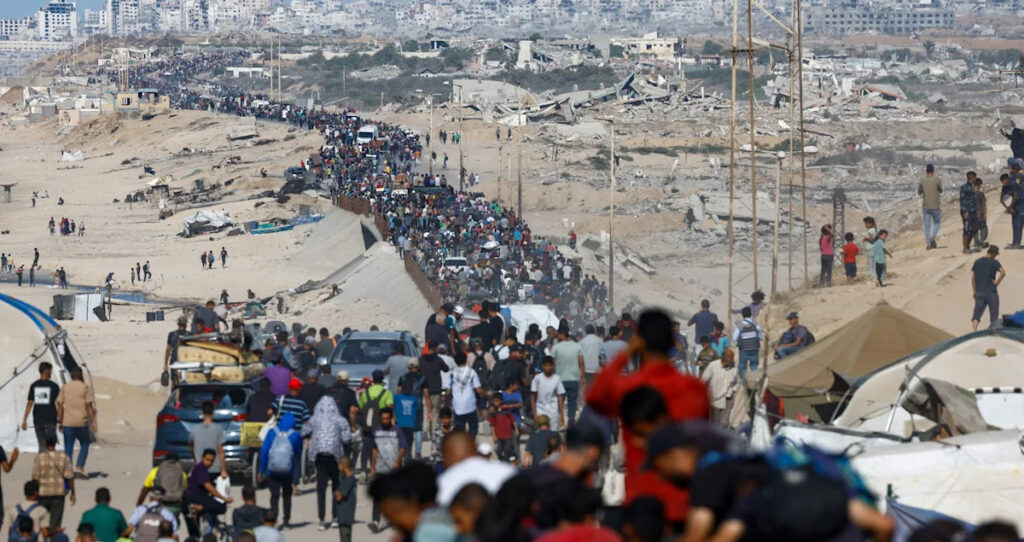
Negotiators temporarily set aside such issues in order to finalize this week’s hostage swap. Now they must be revisited. The goal is to permanently end the two-year war that started when Hamas attacked Israel on Oct. 7, 2023, killing 1,200 people and taking about 250 hostages. Since then, the Israeli military has reduced much of the Gaza Strip to rubble and killed more than 67,000 Palestinians, according to the Gaza Health Ministry. Roughly 1,000 Israeli soldiers have also died in the fighting.
On Monday night in Egypt, Trump tried to build momentum for future talks, telling dozens of world leaders that “Phase 2 has started” while predicting “tremendous progress.”
“It’s peace in the Middle East,” the president insisted. “Everyone said it’s not possible to do. And it’s going to happen.”
Here’s how the president’s vision could become a reality — or how it could collapse.
Step 1: Hostage-prisoner exchange
After both sides signed the ceasefire deal last Thursday in Egypt, it went to the Israeli Cabinet for formal approval. That approval was granted Friday morning local time and military operations were suspended. The U.S. verified that Israeli soldiers had withdrawn to an agreed-upon “yellow line” in Gaza, which left Israel in control of 53% of Gaza, according to a spokesperson for Prime Minister Benjamin Netanyahu.
In turn, these developments triggered a 72-hour window for Hamas to return all 20 hostages still thought to be alive (while also attempting to deliver the bodies of 28 others who died in Gaza).
By noon Monday, Hamas had mostly held up its end of the bargain, and Israel released about 250 Palestinian prisoners serving life sentences in Israeli jails along with 1,722 detainees from Gaza who were not involved in the Oct. 7 attacks.
But in one respect, the swap fell short. Hamas had also agreed to turn over the bodies of at least 28 hostages who died in captivity. Yet so far, only four coffins have been received by the Israeli military, sparking outrage among some Israelis.
Both sides have known that recovering the rest of the bodies could take longer than expected. But how long remains to be seen. As soon as Israel verifies the identities of the four bodies it has already received, a joint multinational task force — which will include investigators from Turkey, Israel, Qatar, Egypt and the U.S. — will start to scour the Gaza Strip for the others.
After that, Hamas and Israel say they will continue to exchange any deceased hostages and prisoners they can find. According to Trump’s plan, the bodies of 15 Gazans would be returned for the remains of each Israeli.
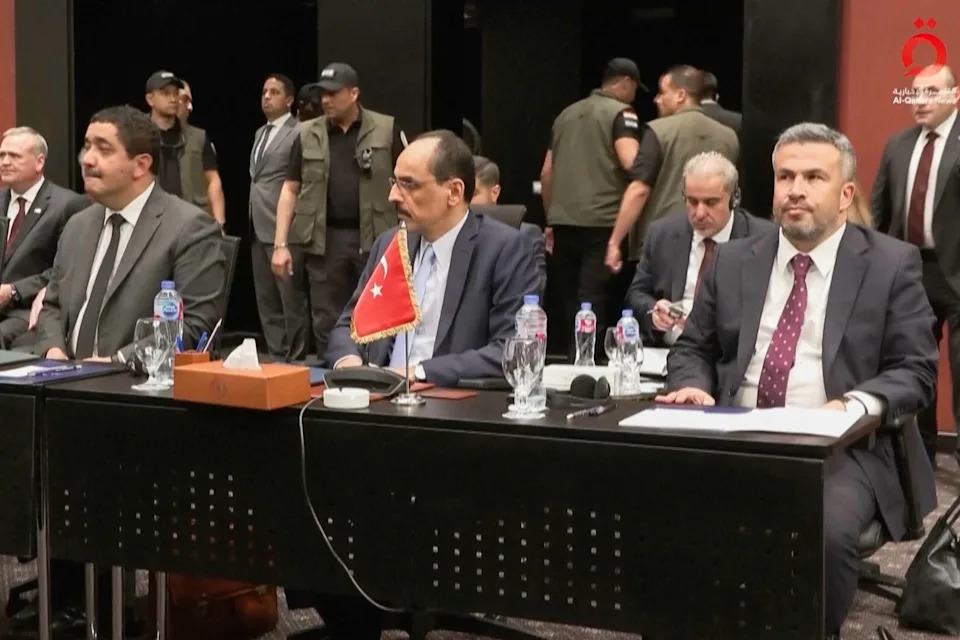
Director of the National Intelligence Organization of Turkey İbrahim Kalın, center, at a meeting Thursday in Sharm el-Sheikh, Egypt, after part of a ceasefire plan advanced by the Trump administration was accepted by Israel and Hamas. (Al-Qahera News via AP)
Step 2: Aid
As part of last week’s deal, some restrictions on the delivery of food, medicine and other relief to Gaza have been lifted. In August, experts backed by the United Nations declared for the first time that half a million Gazans were facing famine, with “catastrophic” conditions characterized by “starvation, destitution and death.” Israel has repeatedly denied claims of starvation and insisted that it has not limited aid; instead, the Israeli government has accused Hamas of stealing aid meant for civilians (which Hamas denies).
About 600 humanitarian aid trucks are expected to enter Gaza daily, up from an estimated 40 to 50.
“These are trucks that have just been blocked, sitting outside of Gaza ready to go in,” Joseph Belliveau, executive director of the NGO MedGlobal, told ABC News on Friday. “The minute that we get approval and can cross in, we’ll be sending these trucks in as we are super hopeful that the U.N. and many others will do.”
The United Nations’ top humanitarian official told reporters on Thursday that the organization has plans in place to deliver food and other supplies over the first 60 days of the ceasefire. On Sunday, the U.N. said in a statement that it was making “real progress” and that aid efforts were “well underway.” Cooking oil has entered Gaza for the first time since March; tents, flour, frozen meat, fresh fruit and medicine have been delivered as well. Going forward, the U.N. said it had secured Israeli approval for more aid, including water, shelter, medicine and other supplies.
But in a preview of potential issues to come, the Times of Israel reported Tuesday that the Israeli government had “decided not to reopen the Rafah border crossing between the Gaza Strip and Egypt tomorrow, as demanded by the ceasefire deal, sanctioning Hamas over its failure to stand by its commitment to return the bodies of all dead hostages it is still holding in the Strip.”
The Rafah crossing was expected to open on Oct. 14, enabling more aid to enter under European Union supervision.
Step 3: Disarmament and withdrawal
The current ceasefire deal doesn’t cover anything beyond steps one and two — meaning negotiators will have to hammer out postwar details at a later date. Potential sticking points abound.
But Trump’s plan does spell out a path forward. Under the terms of that proposal, Hamas would have to disarm — something the group has refused to do in the past because it views “armed struggle as a legitimate form of resistance against Israeli control over Palestinian lands,” according to the New York Times. The Times has also reported, however, that Arab mediators believe Hamas could be convinced to “hand over some of its weapons” if Trump “can guarantee Israel will not resume fighting.”
On Thursday, Israeli Foreign Minister Gideon Saar told Fox News that “we don’t have any intention to renew the war,” and chief Hamas negotiator Khalil al-Hayya said he had “received guarantees from the mediators and the Americans that the war has ended indefinitely.”
World leaders such as French President Emmanuel Macron have called Hamas’s disarmament “essential,” and Israel has long insisted on it as a precondition for peace.
“This will happen either diplomatically, according to Trump’s plan, or militarily — at our hands,” Netanyahu said last Saturday. “This will be achieved the easy way or the hard way, but it will be achieved.”
On the flip side, Trump’s plan also calls on Israel to withdraw from Gaza in three stages. The first stage has already occurred; the question is when — and if — Israel will keep pulling back. Continued pressure from Trump could force Netanyahu’s hand, but for now, the president has not put forward a specific timeline or a clear set of conditions for withdrawal.

People in Tel Aviv react following the announcement Thursday that Israel and Hamas have agreed to the first phase of a peace plan to pause the fighting. (Emilio Morenatti/AP)
Step 4: Gaza governance and security
The future of Gaza is another big question mark. The U.S. framework says a “temporary international stabilization force” should handle security after the war, yet some reporting suggests that Hamas leaders could reject such a force — even one involving Arab and Muslim states — as a “new form of occupation.” At the same time, Israel is likely to object to the conditions that most countries will put on their participation: full withdrawal from Gaza and a political horizon for Palestinian statehood.
Assuming security is established, how will Gaza be governed? Trump’s plan says a technocratic Palestinian committee will take over from Hamas, and both Israel and Hamas have seemingly agreed to this idea. But the Palestinian Authority, which ran Gaza before Hamas, is still angling for a role — a change Israel has long refused to consider. And will Hamas really surrender all influence?
“Hamas is willing to offer some concessions to enable the rehabilitation of Gaza, but it will not evaporate,” Ibrahim al-Madhoun, a Palestinian analyst close to Hamas, told the New York Times. “Its focus is on quiet. It wants to be part of the solution.”