
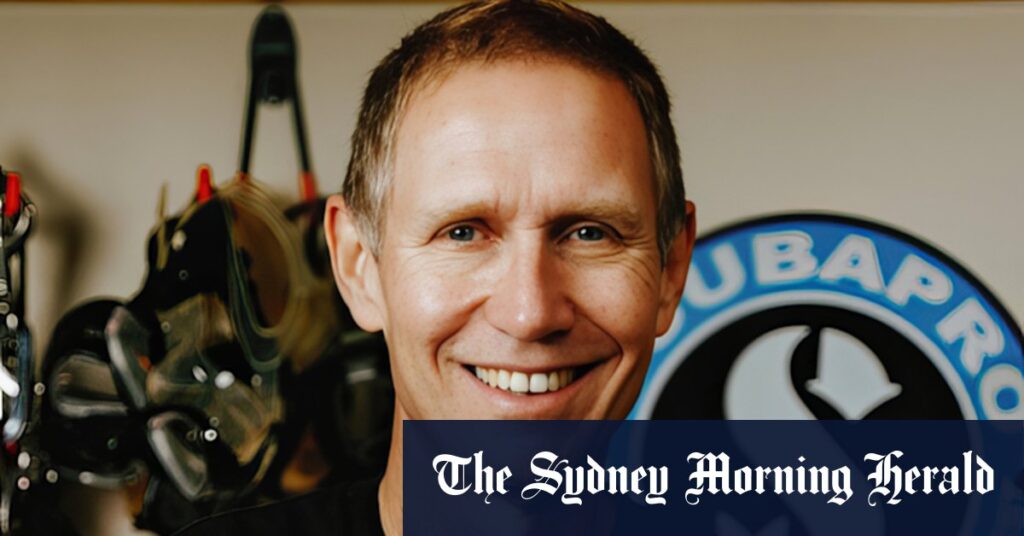
“I’ve got a lot of friends who are far tougher, more robust individuals than I am. I know for a fact they can endure more suffering, more stuff that intimidates me a lot. I know that some people look at me and go, ‘Well, you must be brave to do this stuff’, but I feel quite frightened when I do a lot of these things.
“When I’m talking to young people, [I say that] for me courage perhaps is being afraid and doing it anyway. So I try to be brave.”
Richard Harris: “I know that some people look at me and go, ‘Well, you must be brave to do this stuff’, but I feel quite frightened when I do a lot of these things.”Credit: Madman
After the dive, Harris decided that he didn’t want to put his wife, Dr Fiona Harris, through the anxiety of any more expeditions to an area where he would be uncontactable for days.
“When you’re lining up for these awards, they talk about this imposter syndrome and that everyone will feel it,” Harris says. “I think Craig would share this view that doing one thing in our lives that had such a spectacularly good outcome and was such a global event, it didn’t really deserve an award like [Australian of the year].
“For me, those awards should always be given to people who have spent their lives working towards a solution for something that’s changing lives for so many people, like a cure for cancer or a campaign to save the environment. We really felt like one-trick ponies.”
Harris says he and Challen just hoped their cave rescue training would help the trapped boys.
“Quite frankly, my expectation was that all these kids would die,” he says. “I’m pretty confident that if any of those children had died, I wouldn’t be receiving an award. We could have just as easily been Australia’s greatest villains as Australia’s heroes of the day.”
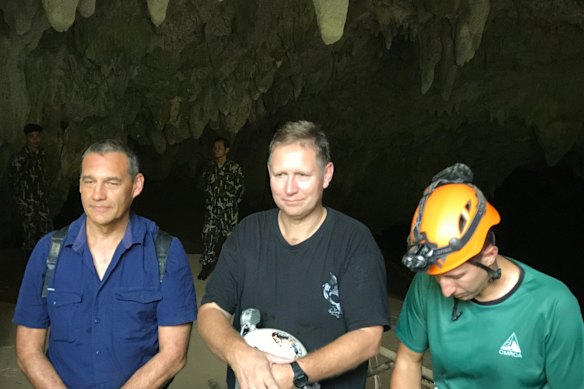
Triumphant return: Craig Challen (left), Harris and American Joshua David Morris at the entrance to Tham Luang Cave in Thailand in 2019.Credit: James Massola
While he saw the New Zealand dive as a logical extension of his decades of cave diving, Harris understood why it looked terrifying to outsiders. “The two top-side cinematographers who came on that expedition were constantly in a state of horror and fear and worry for our sakes,” he says.
Peedom, best known for the documentaries Sherpa, Mountain and River, is in post-production for Tenzing, her coming film about the first ascent of Mount Everest, in 1953 by Edmund Hillary (Tom Hiddleston) and Sherpa Tenzing Norgay (Genden Phuntsok).
Relieved after a first screening for one of her producers went well, she calls Harris’ hydrogen dive unbelievably dangerous. “They’re incredibly rational people, yet there’s this irrational component to it,” she says.
Peedom initially rejected Harris’ invitation to direct the film because of a number of deaths while filming her earlier documentaries, including kayaker Andrew McAuley in 2008’s Solo and 16 Sherpas during 2015’s Sherpa. It’s an often-forgotten aspect of making adventure documentaries: dealing with the awful consequences if it goes wrong.
“I was there with Vicki McAuley, waiting for [husband] Andrew’s heroic arrival, which never came,” she says. “That feeling of just having no control and no communication, it was the most traumatic thing I’ve ever been through.
“Just that feeling I might be sitting there on the edge of that cave and that ‘Harry’ might not come back out again, it really brought all of that back up to me. I did actually say to ‘Harry’, have you watched my films? Everything I touch there seems to be death.”
Harris went ahead with the expedition anyway and then approached Peedom when he was back in Australia to ask if she would look at the footage and reconsider.
Loading
Liking what she saw, Peedom returned to the Pearse Resurgence for a week of shooting then interviewed Harris and other participants to focus on the emotion and the philosophical questions about extreme cave diving.
“That he was prepared to talk about his vulnerability to the extent that he did surprised me,” she says. “For somebody who has done one of the most heroic things a person can do, to learn that they have that level of self-doubt and anxiety and battle with self-esteem issues, that, to me, was really the heart and soul of the film.”
Harris, who says reinventing himself since retiring as an anaesthetist is the best decision he has ever made, has stopped the most extreme cave diving after a final hydrogen expedition with Challen in South Africa.
“Unfortunately I got decompression sickness on one of those dives, so that was the final nail in the coffin,” he says. “I said, yep, that’s definitely it. I’m turning 60 now and it’s time to grow up.”
Richard Harris will appear at Deeper preview Q&A sessions at Sydney’s Cremorne Orpheum, with Jennifer Peedom, on October 20 and Melbourne’s Cinema Nova on October 21. The film opens on October 30.