
The ongoing Ukrainian-Russian war, which started in February 2022, served as an intense catalyst, vitally restructuring NATO’s strategic calculus.
For the Alliance, Russian violence is a real, high-intensity risk, compelling a historic turning point toward strengthened eastern flank defences, intensified readiness, and an improved emphasis on common security.
This new challenge has broadened the strategic necessity for regional stability, recognising that conflicts in Eastern Europe can significantly affect neighbouring areas, while bordering zones like the Balkans are crucial to the continent’s overall security structure.
In a transformed security area, NATO’s resilience mainly relies on credible burden-sharing and agile leadership from its most capable members. With its significant military capacity and unique geopolitical position, Türkiye is essential for handling contested zones and mitigating alliance burden. The challenge extends well beyond conventional warfare, including a complex blend of hybrid threats: from cyber-attacks and disinformation to energy coercion.
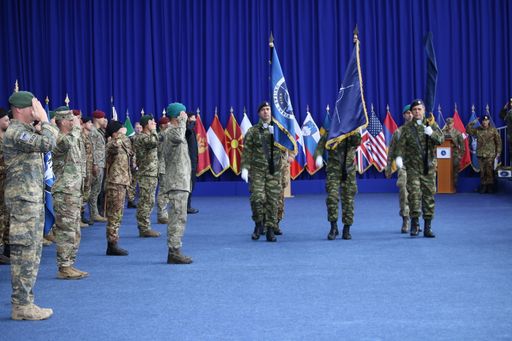
Regarding this multidimensional context, Türkiye’s assumption of the KFOR command is far more than a routine rotation, representing a strategic maneuver at the nexus of deterrence, alliance credibility, and diplomatic influence in an era of persistent global contestation.
Serbia-Kosovo relations are crucial for Balkan stability and are closely aligned with NATO and EU interests. Even though EU dialogue efforts have slowed down, normalisation has been hindered, leading to increased political mistrust amid local crises.
This ongoing conflict has created a strategic vacuum exploited by external actors, particularly Russia, which supports Serbia’s stance on Kosovo to maintain influence in Southeastern Europe and hinder Euro-Atlantic unity.
However, Russia’s direct intervention is limited; its use of disinformation and hybrid tactics in the Balkans fosters anti-Western narratives and hinders political reform. For this reason, in the Balkans, the prospects for EU integration have more strategic importance.
The EU faces several challenges that could weaken its role as a leading actor in regional security and governance. These include enlargement fatigue, inconsistent reform efforts, and resistance from local political elites.
While the EU’s transformative influence is diminishing, NATO, through KFOR and regional partnerships, provides security. The Balkans will continue to fluctuate between fragile stability and external manipulation without common institutional approaches, combining NATO’s deterrent presence with a credible pathway to EU membership. This lack of a common approach puts the region at risk of the security architecture that both the Alliance and Europe aim to maintain.
Türkiye’s renewed command of KFOR positions it as an indispensable actor for regional stability in a geopolitical environment reshaped by the Russia-Ukraine conflict.
Bulent Durgun
Türkiye’s renewed command of KFOR positions it as an indispensable actor for regional stability in a geopolitical environment reshaped by the Russia-Ukraine conflict.
Moreover, it significantly reinforces NATO’s commitment to maintaining peace in the Balkans. It also reveals the Alliance’s ability to manage security challenges beyond its immediate eastern flank, emphasising the unity of Balkan and broader European security.
Ankara’s leadership reaffirms its commitment to collective security as a NATO member with significant military capacity. Meanwhile, Türkiye maintains a nuanced relationship with Russia, which is beneficial for steering diverse regional interests. This unique blend makes Türkiye a vital stabilising force in the Balkans.
NATO validates the Turkish contribution and signals a clear message that it is fully engaged in securing the entire European area by entrusting Türkiye with leadership.
While ensuring stability for a region vital to the future of Europe, Türkiye’s robust association contributes to the strategic goal of mitigating external political intrigues within the Balkans.