
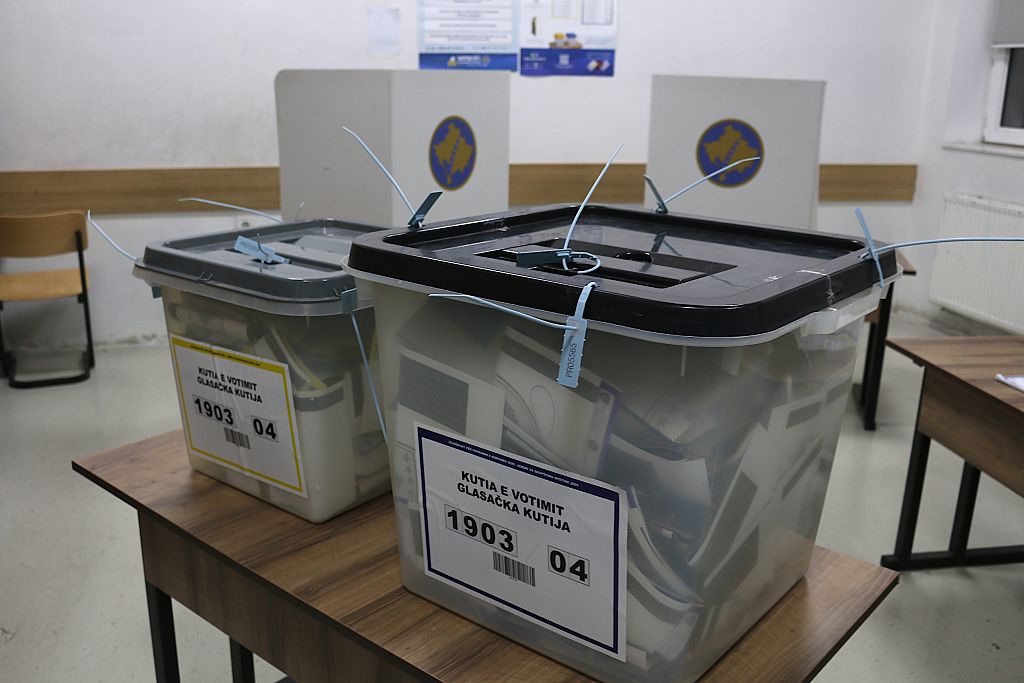
PRISTINA – Kosovo’s local election results are complicating Prime Minister Albin Kurti’s political strategies and potentially giving the European Union fresh leverage to push for stalled normalisation with Serbia.
The vote, held last Sunday, saw the Albanian ruling party, Vetëvendosje, struggle in key urban centres such as Pristina, Prizren, and Mitrovica, where it will face runoffs in November.
Meanwhile, the Belgrade-backed Serbian List made a strong comeback after boycotting the last elections, winning nine Serbian majority municipalities outright and likely heading to a run-off against another Serbian rival party in the tenth.
Overall turnout, however, was low, with only 39.07% of voters casting a ballot.
Tense background
Local elections took place against the backdrop of deep institutional gridlock stemming from the February 2025 parliamentary elections and years of acrimony between Kosovo’s ethnic Albanian majority and ethnic Serb minority.
Kosovo, previously an autonomous province of Serbia, unilaterally declared independence from Belgrade in 2008.
Nearly two decades later, the Serbian government still refuses to recognise Pristina’s independence. The European Union has taken the lead in pushing for so-called normalisation agreements to regulate the economic and administrative ties between the two neighbours, as well as the rights of Kosovo’s ethnic Serb minority.
Kurti and his ruling nationalist Vetëvendosje party, however, have frequently sparred with the political leaders of Serb-majority regions in Kosovo, such as Mitrovica in the north.
A return to power
The re-emergence of the Serbian List during last weekend’s elections – which Kurti had previously described as a ‘political branch of Serbian state terrorism’ – marks a significant reversal in the northern municipalities where Vetëvendosje had attempted to assert control in recent years.
The last local elections saw most Serb voters boycott the polls, resulting in ethnic Albanian mayors elected with as little as 3% turnout. Violent protests followed, injuring several KFOR/NATO soldiers in June 2022.
Since then, Kurti’s government has pursued a policy of “sovereignty” in the predominantly Serbian north, closing Serbian-linked municipal institutions, deploying militarised police to Serb-majority areas, and largely bypassing the EU-led Kosovo–Serbia dialogue.
However, with Serbian List now reinstated locally, these strategies will become more challenging to enforce.
Institutions and constitutional constraints
Pristina recently announced plans to integrate Serbian education and healthcare systems into the rest of Kosovo, even though the constitution pledges to safeguard the independence of Serbian institutions. Without cooperation from locally elected officials, such plans may prove unworkable and force a recalibration of Vetëvendosje’s policy.
For Brussels, Serbian List’s return presents an opportunity to pressure Pristina on compliance and institutional inclusion.
Augustin Palokaj, Brussels correspondent for the Kosovar news outlet Koha, noted that there is particular EU interest in northern Kosovo, where they expect “the return of Kosovo Serbs to Kosovo institutions.”
Previous efforts by Vetëvendosje to de-certify Serbian List and to restrict Serbian-language media from covering the elections drew a direct rebuke from Brussels.
“Any exclusion of political actors goes against the fundamental principle of meaningful democratic participation of all communities in the electoral process,” the European Union’s External Action Service said in a statement at the time.
International pressure builds
Kosovo has remained for more than two years under punitive EU measures that limit financial support in response to the government’s treatment of the Serb minority and unilateral actions in the north. The United States last month suspended Strategic Dialogue talks due to similar concerns, demanding de-escalation from Pristina.
Despite mounting international pressure, Kurti has shown little willingness to alter course.
Meanwhile, Kurti is facing mounting political problems in Pristina. During the last parliamentary elections, Vetëvendosje secured a plurality but fell short of a majority, leading to months of failed coalition negotiations and repeated unsuccessful attempts to elect parliamentary leadership, including the speaker and deputy speakers representing minority communities such as the Serbs.
Kosovo still doesn’t have a fully formed government after eight months of political deadlock. Kosovo’s Constitutional Court intervened to grant Vetëvendosje a mandate to form a coalition, but both major Albanian opposition parties have refused to cooperate.
Still, Kurti has remained defiant.
“If there is no Kurti III government, we are undoubtedly ready for new parliamentary elections”, he said on Monday.
EU leverage remains uncertain
With run-offs approaching in strategic municipalities and institutional control in the north now contested, the EU faces a renewed opportunity to push for Serb participation in Kosovo institutions and a return to dialogue.
Whether this translates into substantive policy change in Pristina, however, will depend on both international pressure and domestic coalition arithmetic, and on whether the fragile balance in the north holds.
The EU and the Kosovo government did not respond to requests for comment at the time of publication.
While the results present Brussels with new political realities on the ground, analysts remain cautious about immediate shifts in policy.
Aleksandar Sljuka, a researcher at the Mitrovica-based organization New Social Initiative, argued that Kurti is unlikely to concede without clear consequences.
“Kurti has little incentive to change course unless there is a clear and consistent signal from Brussels that his current approach carries real political costs,” he said.
(cs, cm)