
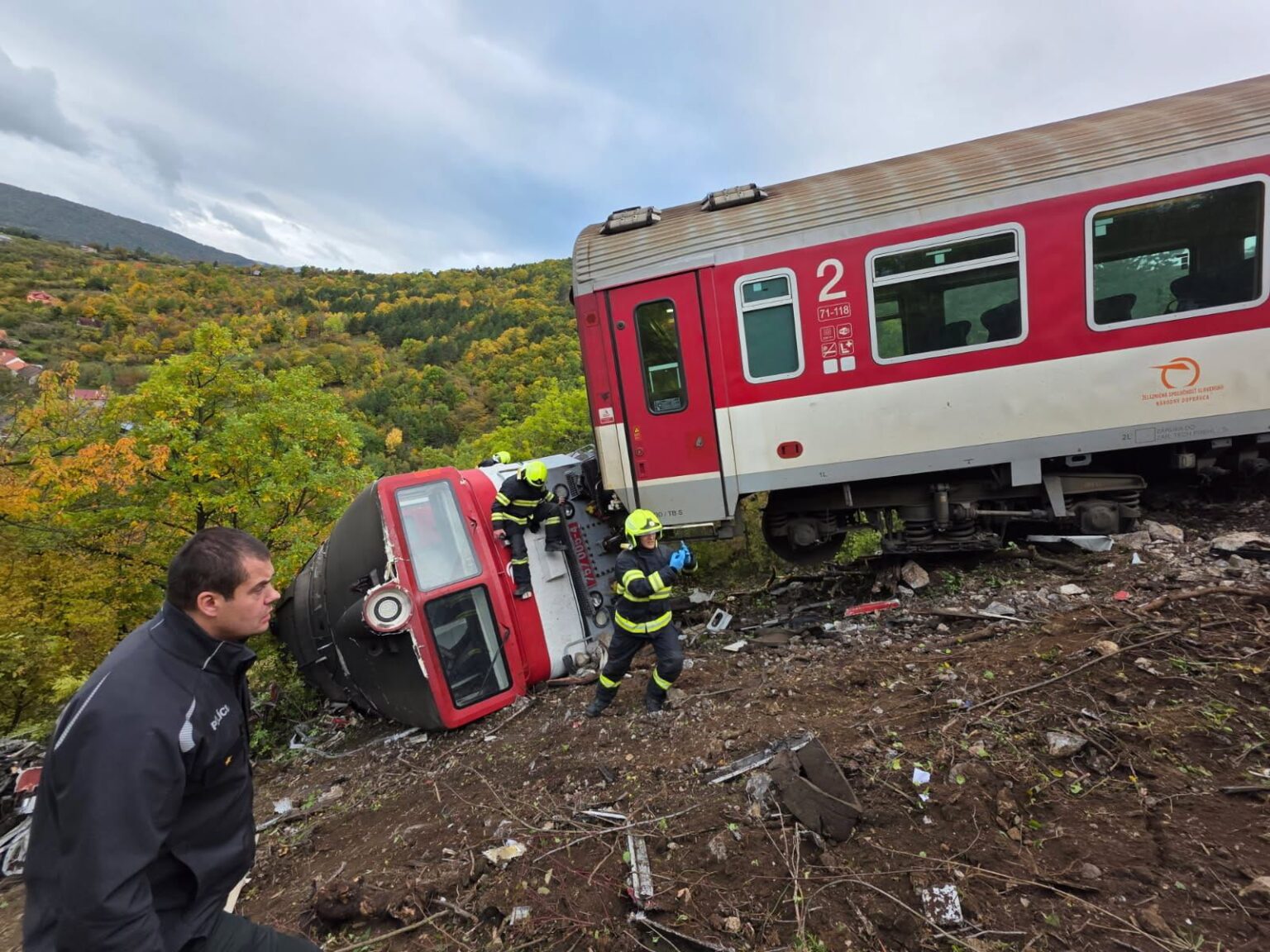
This week’s frontal train collision in Slovakia, leaving 62 people injured and 7 in critical condition, has sparked sharp criticism of the country’s rail safety systems. Only 7% of the country’s 3,600-kilometer rail network are protected by the modern European Train Control System (ETCS) — with modernisation going way too slow, according to the country’s Association of Industrial Unions and Transport (APZD).
The tragedy occurred when two express trains collided at a single-track section on Monday 13 October. While the (yet) unofficial cause is believed to be human error, experts emphasise that modern safety systems like ETCS could have prevented the crash entirely. “If the human factor fails and the train driver passes a stop signal, nothing can prevent a collision, only modern safety systems,” said Andrej Lasz, General Secretary of APZD.
93% of Slovakia’s tracks — including the site of Monday’s train collision near Jablonov nad Turnou — rely on outdated signalling and human vigilance. The country’s has only two ETCS-equipped sections: Bratislava–Žilina and Žilina–Čadca, totalling 250km. They stand as exceptions in an otherwise outdated 3,600 km network, however.
‘We are lagging behind’
Slovakia’s rail infrastructure suffers from chronic underinvestment and a lack of modernisation, according to the Transport association. Just 11% of tracks are dispatcher-controlled, i.e. remotely controlled, meaning most operations depend on manual processes prone to human error.
“We are lagging behind in digitisation and automation,” Lasz stated. “We lack predictable financing, a plan of priorities, and sanctions for non-compliance.” The APZD, alongside the Association of Railway Carriers of Slovakia (AROS), has drafted a new law on national transport infrastructure to address these failures. The proposed legislation aims to secure stable funding, establish a binding list of investment priorities, and introduce penalties for missed deadlines.
A call for accountability after tragedy
The collision has reignited criticism of Slovakia’s rail policies. “For years, we’ve heard about billions in railway investments, about modernisations, and ecological transport,” said the chairman of the Slovak Railways Council Rastislav Trnka, as reported by Slovak news site Topky. “And then this happens—on one of the main lines in eastern Slovakia. It’s not just an accident. It’s a symbol of the state of Slovak railways.”
While visions of high-speed lines are being drawn in Bratislava, people in the east are praying that the train will reach its destination safely,” Trnka stated, wishing all the injured a speedy recovery.
Unions demand action: ‘We can’t wait for another disaster’
The APZD and transport experts argue that systemic change is the only way to prevent future tragedies. The organisation, together with the Association of Railway Carriers of Slovakia and transport experts, have prepared a draft law on national transport infrastructure, which is intended to eliminate long-term system failures. According to Lasz, the law is intended to ensure predictable and stable financing of transport infrastructure, its transparent and targeted use at the national, regional and local levels, and a binding list of transport investment priorities with clearly defined responsibilities and sanctions for failure to meet deadlines.
The Jablonov nad Turnou collision is a grim reminder of what happens when modern safety systems are not in place. Similarly, in Greece after the Tempi train disaster which killed 57 people, the collision has caused a large backlash and calls for increased investments in railway safety. The message is clear: “If we want to prevent similar tragedies, it simply won’t work without a long-term vision and strategic planning,” the General Secretary of APZD Lasz emphasised. “We can’t wait for another disaster to happen.”
Read more:
Already have a subscription? Log in.
Or
Want to read this article for free?
You can read one free article per month. Enter your email and we’ll send you a free link to access the full article. No payment required.