
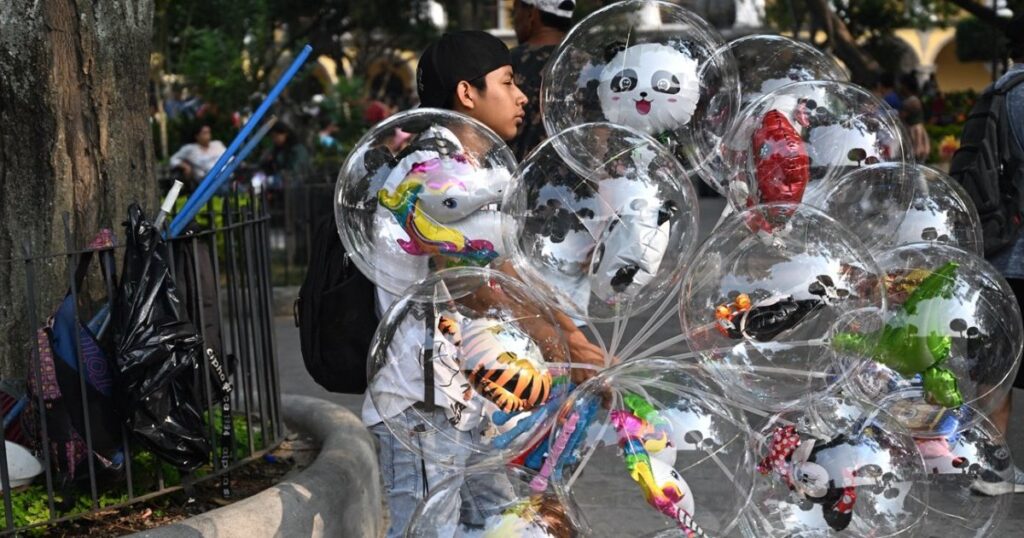
Almost three decades have gone by since the end of the civil war in Guatemala (1960-1996), but widespread precarious employment, particularly affecting younger people, continues to cloud the prospects for much of the population, as it did for previous generations. Seven governments have come and gone so far this century, without any notable improvement in the everyday lives of Guatemalan citizens, whose perception of their frail democracy is such that, according to a report from 2021 with the most recent data on the subject, only 52 per cent of them considered it the best possible form of government. Five years ago, support for a hypothetical coup, justified by excessive corruption within the government, reached 51 per cent. The 2023 elections, thanks to crucial support from young people and the Indigenous population, brought sociologist Bernardo Arévalo and his Semilla Movement to power with a pledge to fight Guatemala’s endemic corruption, defend human rights and strengthen the rule of law in this country with the largest population in Central America.
The hope sparked by this victory has gradually faded over the 21 months during which the Arévalo government has been in office. True, it is under relentless attack by a justice system controlled by the ‘Pact of the Corrupt’, an alliance of institutionalised corruption involving parliamentarians accused of various crimes, far-right politicians, members of the business elite and drug trafficking organisations, whose flagship is Public Prosecutor Consuelo Porras, the main instigator of the harassment and demolition tactics that have tied the executive’s hands. But the Arévalo government has also shown a lack of creativity, teamwork and ability to implement its plans and mobilise popular support. This is all the more regrettable knowing that the failure of his government will open the door to demagoguery and greater interference by business leaders in public decisions.
A ‘trapped’ economy
A snapshot of the country’s macroeconomic situation could lead to hasty conclusions. Over the last 15 years, the average growth rate for gross domestic product (GDP) has been 3.5 per cent. But to reduce poverty and provide decent work, a sustained rate of 7 per cent is required. In addition, this GDP growth is mainly driven by consumption, and the country’s macroeconomic stability rests on the vigour of Guatemala’s main ‘export’: migrants. In 2024, their remittances grew by 8.6 per cent, year-on-year, to US$21.51 billion. And if these payments were to stop, or fall sharply, there would be a balance of payments crisis, an international reserves crisis and an exchange rate crisis would hit the quetzal.
A few years ago, when the Japanese ambassador visited ASIES – the research centre where I work – he asked me why, given Guatemala’s wealth of natural resources, and its numerous comparative and competitive advantages, there was so much poverty. I replied that, in my view, there were several decisive factors: the inequality, the weakness of our fiscal system and public institutions, the fragility of the rule of law and the corruption.
Juan Alberto Fuentes Knight, a prominent economist, former public finance minister and former chairman of Oxfam, also took part in the founding of Semilla and has been the target of judicial persecution by a Special Prosecutor’s Office Against Impunity that is controlled by the ‘Pact of the Corrupt’. In his book La economía atrapada (The Trapped Economy), he explains that the large family-owned conglomerates that dominate the Guatemalan economy, control its growth and, I would add, that of small- and medium-sized enterprises, through their oligopolistic practices.
The business elite is the dominant force in Guatemala, much more so than in any other Latin American or Caribbean country, and its ‘deals’ with the state do not promote inclusive growth but “result in an economy trapped in a trajectory of slow and uneven growth, with limited job creation”.
Fuentes Knight notes that the development strategy adopted since 1986 has created a state that is heavily chained to economic power, with little or no leeway to promote the interests of society as a whole, leading to “widespread unemployment, inequality and poverty, mass migration and illicit activities made attractive by the lack of alternatives”.
Development limited by the brain drain
This shackled state offers negligible opportunities to young people, in a country where 32 per cent of the population is under 15 and another 28 per cent is between 15 and 29. With 60 per cent of its inhabitants under the age of 30, Guatemala has the largest demographic dividend on the continent: a working-age population that outnumbers the economically dependent population, which represents a great demographic opportunity for the country’s development. Yet, this phenomenon, which began in 1977 and is expected to end in 2069, is already over half way through its expected duration and, still, very little is being done to take advantage of it.
Confirmation of this can be found in the latest International Organization for Migration (IOM) Survey on International Migration of Guatemalans and Remittances, conducted in 2022. It indicates that 88 per cent of those sending remittances from abroad migrated while of working age, and that 49 per cent of them were between 15 and 24 years old when they embarked on the arduous and dangerous journey north. The migrant population in the US has an average of nine years of schooling, compared to Guatemala’s national average of 6.6 years, which shows a significant loss of relatively educated young people.
The job prospects in the country are not very encouraging, particularly for young people. Unemployment is low but informal employment is extremely high (in 2023, 78 per cent of those in work were not registered with the social security system) and productivity is quite low (the informal economy only generated 20 per cent of GDP in 2023).
The average income of the employed population was US$309 per month, well below the minimum of US$466 required to cover the basic food basket that year.
In 2022, the year before the elections, ASIES presented a series of proposals – Guatemala Camina – to contribute to the development of the participating parties’ plans for government. One of these proposals, by Carmen Ortiz, entitled Young People and Political Participation: Two Trends and One Challenge, already highlighted the apparent apathy, disinterest and even rejection felt by young Guatemalans towards politics and politicians. Ortiz notes that their needs revolve around access to decent employment, a safe environment, feeling a sense of belonging, making progress and finding purpose in life, and that they see migration as the only option, based on the firm belief that Guatemala has nothing to offer them.
In 2023, the Ministry of Labour and Social Welfare announced that it would review the National Policy on Decent Employment (PNED) adopted in 2017. The current government has continued this process but, a year and a half later, it is still incomplete. As a result, only isolated actions of limited scope have been implemented.
Decent work proposals
The proposals we developed in the document Decent Work for Young People, as part of Guatemala Camina 2022, fall within two main areas: improving access to quality education and facilitating the entry of young people into the labour market.
The proposals to improve access to quality education include: increasing coverage of the upper secondary school diversified cycle, to which only one in four young people of that age currently has access; reducing school failure, which affects one in four students in the diversified cycle and is exacerbated by the refusal to admit repeat students in state schools; reviewing the diversified cycle courses, to adapt them to the occupational families prioritised in the National Policy on Decent Employment (PNED); offering secondary school students more work experience or internship opportunities, and raising companies’ awareness of the need to provide genuine work experience, not assign them irrelevant tasks; ensuring that the education system provides guidance on career choices and labour rights; increasing public resources – which are currently insignificant – for secondary school scholarships and expanding the coverage of vocational training, in short courses and complementary courses; and increasing the funds allocated to the ‘My First Job’ grant, ensuring it is backed by an apprenticeship contract – that includes mentoring and monitoring mechanisms to guarantee the educational value of this initiative, which subsidises 51 per cent of the wage costs of young new recruits for a period of four months, to promote their entry into the labour market as apprentices.
The proposals to facilitate the entry of young people into the labour market include conducting awareness campaigns to encourage employers and recruitment agencies to eradicate the practice of discriminating against young people based on where they live, the type of school they attended, their clothing or their sexual orientation, along with forms of discrimination that stigmatise and exclude many young people from access to formal employment. We also propose strengthening the national employment service by incorporating training in soft skills and labour rights, as well as strengthening labour inspection to better protect workers’ rights, particularly the most fundamental, such as the right to freedom of association and collective bargaining.
Can Guatemala afford to turn its back on its young people… the very people who are among those who most value democracy and were instrumental in Arévalo’s victory? For how much longer is it going to pass up on the opportunity that the demographic dividend presents for the country’s immediate and future growth?