
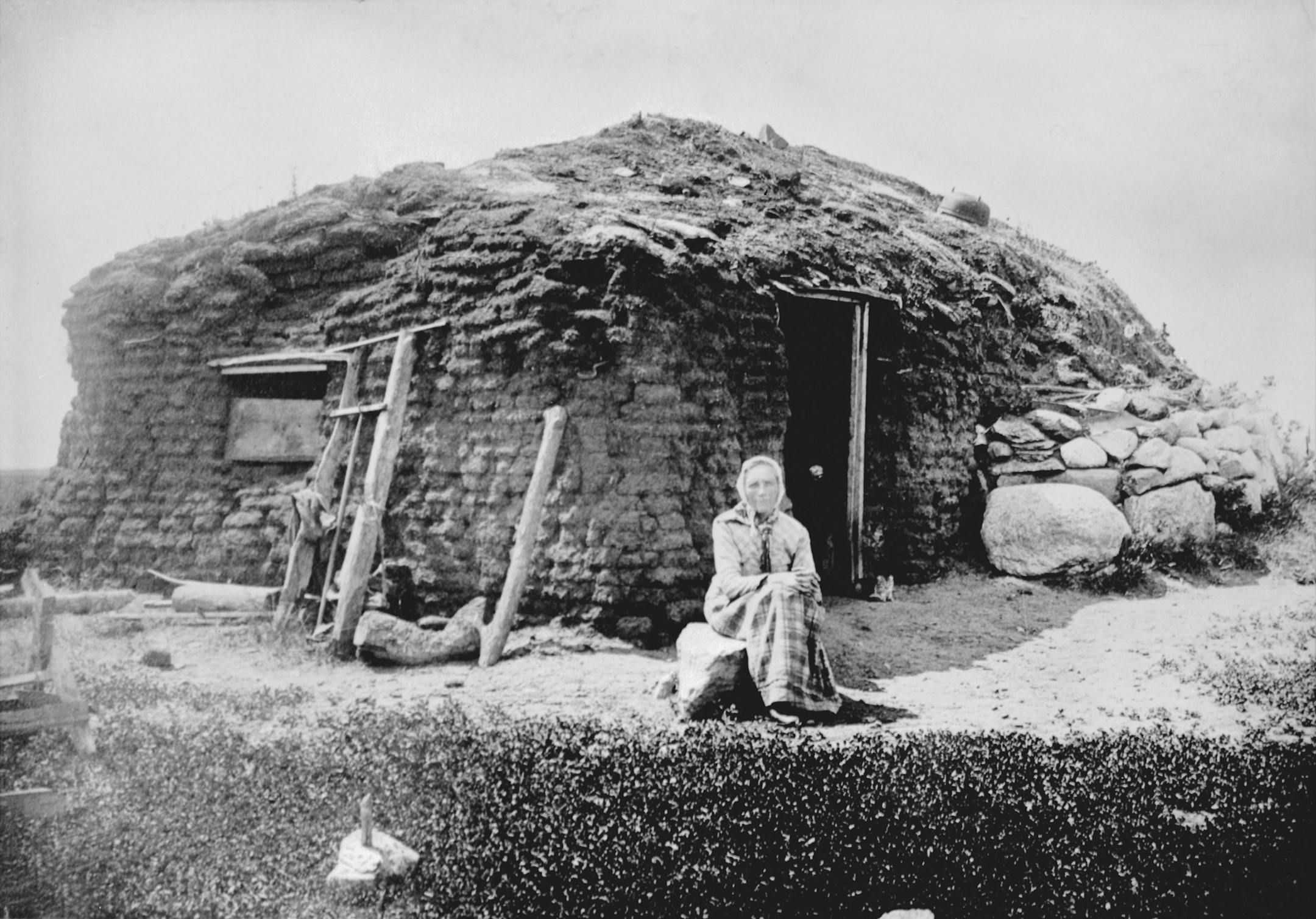
A Norwegian settler named Mrs. Beret Olesdater Hagebak is photographed sitting in front of her sod home in Lac qui Parle County in 1896. (Lac qui Parle Historical Society)
In many ways, the Upper Midwest seemed suited for Norwegians, said Benjamin Bigelow, director of undergraduate studies at the University of Minnesota’s department of German, Nordic, Slavic and Dutch. “It replicated some of those conditions of Scandinavia” — including the sparse population and the cold.
But while it’s often thought that the many Scandinavians — Norwegians, especially — who settled in Minnesota did so because the landscape looked familiar, Sackrison said that land availability, not similarity, disproportionally drove immigration to Minnesota and the Dakotas. Some traditional trades like farming, fishing and logging were similar, she said, but the agricultural scale “was just so different.”
This scale offered opportunity — but also isolation, which was one of the themes of “Giants in the Earth,” a landmark novel of the Norwegian-immigrant experience that is marking its own centennial. First published in Norwegian, the English version, which was once required reading for some Minnesota students, came out two years later.
Written by St. Olaf’s Ole Edvart Rølvaag, himself a Norwegian immigrant, the book made a splash on both sides of the Atlantic as “a very different perspective on the rosier picture that some imagine of the immigrant experience,” said Sackrison.
The novel “was incredibly impactful” for Norwegians and especially Americans, she said, adding that while the reception seemed assured in Norway, it was uncertain if somehow its resonance would be lost in translation.
It wasn’t, and the way it reflected resilience helped mythologize Nordic immigration, albeit in a 19th-century time frame, both Bigelow and Sackrison suggested.