
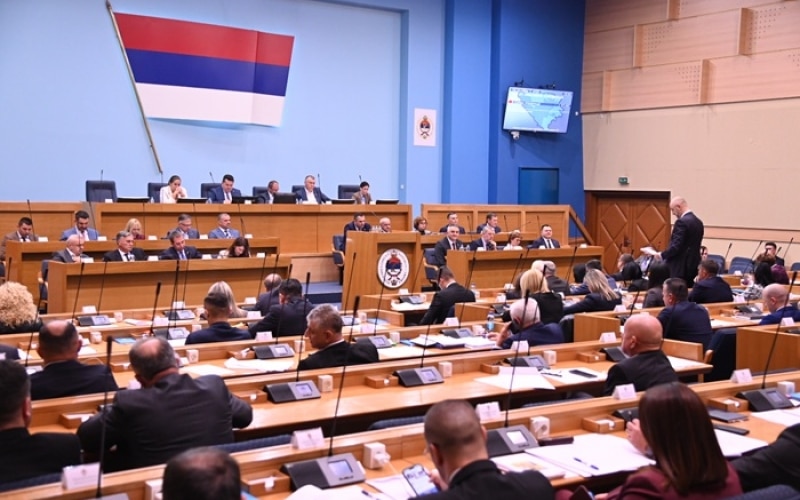
The National Assembly of Republika Srpska. Photo: NSRS.
In a late-night vote on Saturday, lawmakers in the National Assembly of Republika Srpska, the Serb-run political entity in Bosnia and Herzegovina, appointed Ana Trisic Babic as acting president until elections are held next month.
The appointment comes after the presidential mandate of Milorad Dodik was finally revoked in August following a court verdict sentencing him to one year in prison and imposing a six-year ban on holding presidential office for defying decisions made by the High Representative, Bosnia’s international peace overseer. However, even after that, Dodik will not be able to return to the leadership, as Bosnian law specifies that anyone sentenced to more than six months in prison can’t hold any public office in perpetuity.
The head of Dodik’s Alliance of Independent Social Democrats, SNSD caucus in the National Assembly of Republika Srpska, Srdjan Mazalica, emphasised that the party remains loyal to Dodik.
“Milorad Dodik will always be our president, and we fought with all our strength to defend this position,” Mazalica said.
He acknowledged that the SNSD had not been able to overcome the judicial power of the state court or launch a successful boycott of the upcoming vote for a new president of Republika Srpska.
“We missed a historic opportunity to bring the court and the prosecutor’s office of Bosnia and Herzegovina under control and to boycott the elections, but the opposition rejected that,” he said.
He described Ana Trisic Babic as an “exceptional patriot” who prevented Republika Srpska and Bosnia and Herzegovina from moving toward NATO membership.
“She took part in many important processes, and any insinuations about her patriotism make no sense,” Mazalica added.
Trisic Babic worked for the Office of the High Representative and the US aid agency USAID before going into politics – both of which are seen by Dodik and the SNSD as politically suspicious or anti-Serb.
From 2010 to 2014, she also served as deputy minister of foreign affairs. During that period, in accordance with decisions made by the authorities of Republika Srpska, she participated in negotiations on strengthening cooperation with other countries in the region, and on Bosnia and Herzegovina’s cooperation with NATO.
Opposition lawmakers however described Trisic Babic as a NATO lobbyist. Forty-eight out of 83 deputies voted in favour of making her acting president, while four voted against. She will hold the office until the new president is elected at the elections scheduled for November 23.
Born and educated in Banja Luka, Republika Srpska’s administrative centre, Trisic Babic has a degree in International Relations and worked at the Ministry of Foreign Affairs of Bosnia and Herzegovina from 2001. For the past 15 years, she has been one of Dodik’s closest advisers.
During the same National Assembly session, deputies voted to retract six entity-level laws that had already annulled by the state-level Constitutional Court.
Among them was the law on immovable property used by the authorities of Republika Srpska, which assigned ownership over state property in the entity to the entity authorities. Dodik had described this issue as a “red line not to be crossed”.
Also repealed were the Law on the Non-Implementation of Laws and the Prohibition of Actions by Unconstitutional Bosnia and Herzegovina Institutions – which the Republika Srpska authorities claimed would prevent the national police agency SIPA and the state-level Prosecutor’s Office from operating in the entity.
The other laws that were repealed were the Law on Non-Implementation of Decisions of the Constitutional Court of Bosnia and Herzegovina, the Republika Srpska Election Law, the Law on Amendments to the entity’s Criminal Code and the Law on the High Judicial and Prosecutorial Council of Republika Srpska.
The National Assembly also decided to repeal a total of 13 resolutions related to the Dayton peace accords, which ended the 1992-95 war in the country.
These resolutions criticised the actions of the High Representative, called for the annulling of his decrees, described state-level judicial institutions as “unconstitutional entities”, and urged Republika Srpska representatives in state-level institutions to halt their decision-making activities.
The resolutions were originally adopted by the National Assembly in December last year when proceedings were ongoing at the state-level court against the then-president Dodik and acting director of the entity’s Official Gazette, Millos Lukic.