
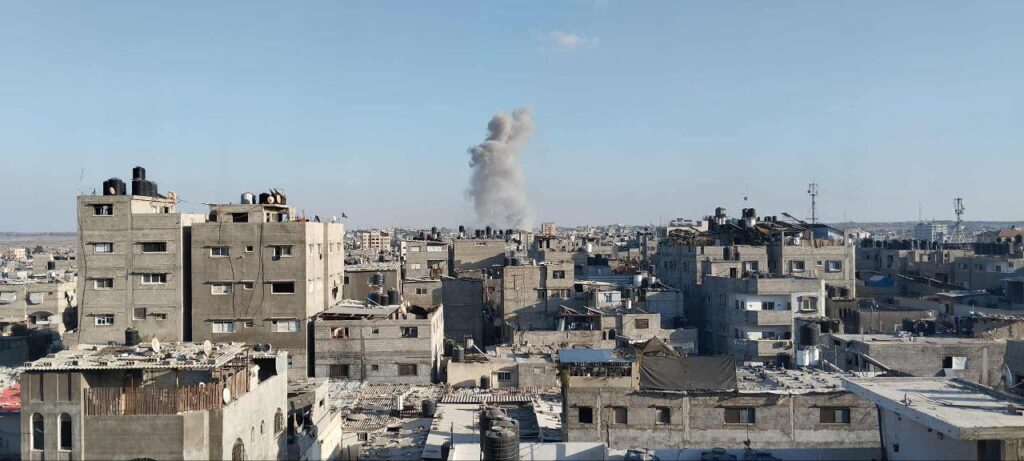
Israeli aircraft target the home of the Abdul Hadi family in Bureij camp, central Gaza. Courtesy of Quds Feed on X.
Israeli officials began once again to threaten a military escalation against Palestinians in the Gaza Strip on Sunday, launching a wave of airstrikes and baring the fragility of their commitment to a ceasefire that has lasted no longer than two weeks and which has been fractured already by dozens of Israeli bombings.
The Israeli military justified the assault by claiming it was a response to “terrorists” who had fired toward Israeli troops.
Hamas issued a statement denying knowledge of and responsibility for the incident. “We are unaware of any events or clashes taking place in the Rafah area, as these are red zones under the control of the Occupation,” the group said on Sunday afternoon.
“Contact with our remaining groups there has been cut off since the resumption of war in March of this year,” Hamas said. The group also reaffirmed its commitment to the ceasefire agreement in the statement.
Rafah remains one of the zones still occupied by Israel’s military, which still holds control over around 50 percent of the strip.
Israel’s military said its troops were in the area “operating to dismantle terrorist infrastructure in the area in southern Gaza in accordance with the ceasefire agreement.”
Israeli officials were quick to point to the incident as a Hamas violation, however, and to argue that it provided grounds to resume the war.
Defense Minister Israel Katz threatened that “Hamas will pay a heavy price for any shooting and violation of the ceasefire.” Settlements Minister Orit Strook said the explosion was a “declaration” that “there is no [ceasefire] agreement” and that “the war must be renewed.”
Soon after, Prime Minister Benjamin Netanyahu’s office issued a statement condemning what it called Hamas’s “barbaric and irresponsible actions” and threatening that Israel “will respond forcefully against their brutal rule and thwart their weakening grip on Gaza.”
At least six Palestinians were killed by Israeli shelling west of the town of Zuwayda in central Gaza. An eyewitness, Yahya Shehab, told Mada Masr he saw a drone flying at a low altitude near the beach in Zuwayda before striking a group of civilians, causing a large explosion.
Two more were killed by an Israeli airstrike on Jabalia. Attacks were also reported in the Bureij camp in central Gaza and in Khan Younis in the south.
At least 19 Palestinians were killed today across Gaza, eyewitnesses told Palestinian outlet Sawa.
Though the ceasefire is less than 10 days old, Israeli forces have already violated the agreement multiple times beginning on the first day that hostilities were due to come to a halt, as Hamas pointed out in a follow-up statement.
Gaza Health Ministry director of public relations Iyad Qudeih told Mada Masr that the Occupation has committed about 47 documented violations of the ceasefire since it was announced, killing at least 38 people and injuring 143 more so far. The violations range from direct fire on civilians to deliberate airstrikes and the arrest of a number of civilians across the strip.
Many of those killed have been targeted as they tried to return to homes they were displaced from throughout Israel’s genocidal war, which it resumed in March when the first ceasefire collapsed.
Gaza Civil Defense spokesperson Mahmoud Basal told Mada Masr that an Israeli strike on a civilian vehicle on Friday killed 11 members of the Abu Shaaban family, mostly children, while returning from the south to their home in Zeitoun neighborhood in Gaza City. Occupation forces prevented civil defense teams from approaching the family until after they coordinated with the Red Cross, Basal added.
Another eyewitness, Mahmoud Baraka, told Mada Masr he was trying to return home in eastern Gaza City after the withdrawal of Occupation forces, only to find himself facing heavy Israeli fire along with other civilians.
“I laid on the ground and started crawling backwards until I was a little outside the range of gunfire, but many citizens were wounded before my eyes, even though they had not crossed the yellow line,” Baraka said.
In its follow-up statement, Hamas cited additional Israeli violations of the ceasefire since it took effect, including: Occupation forces operating beyond the designated yellow line, using gunfire and drones to prevent displaced people from returning home, restricting the entry of food, fuel, reconstruction materials, equipments and funds into Gaza, and delaying the release of Palestinian women and children captives under the prisoner exchange deal.