
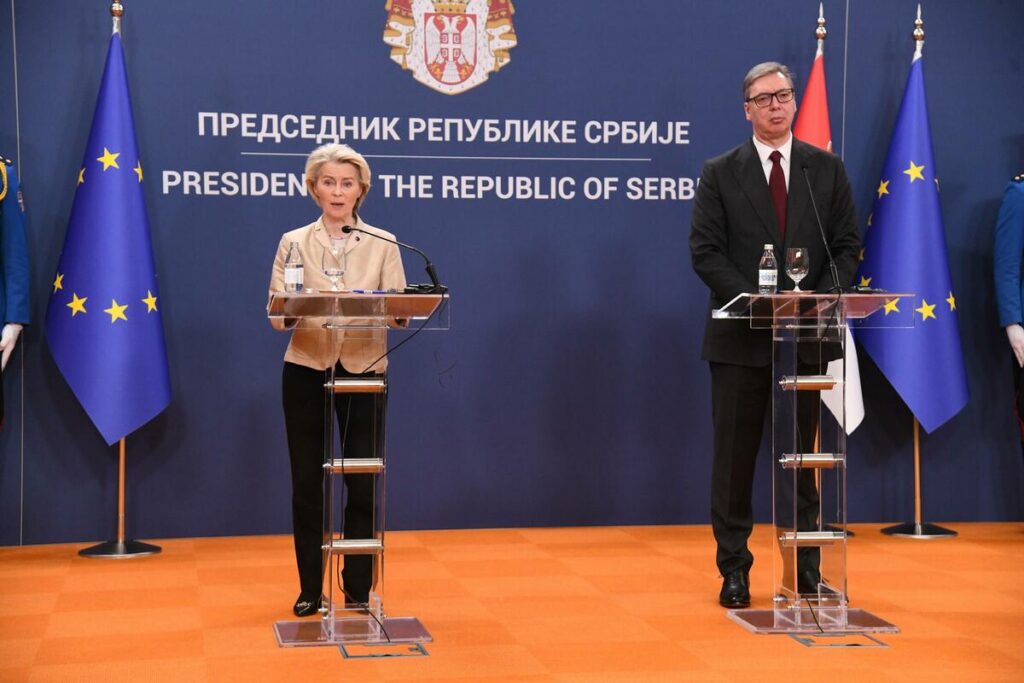
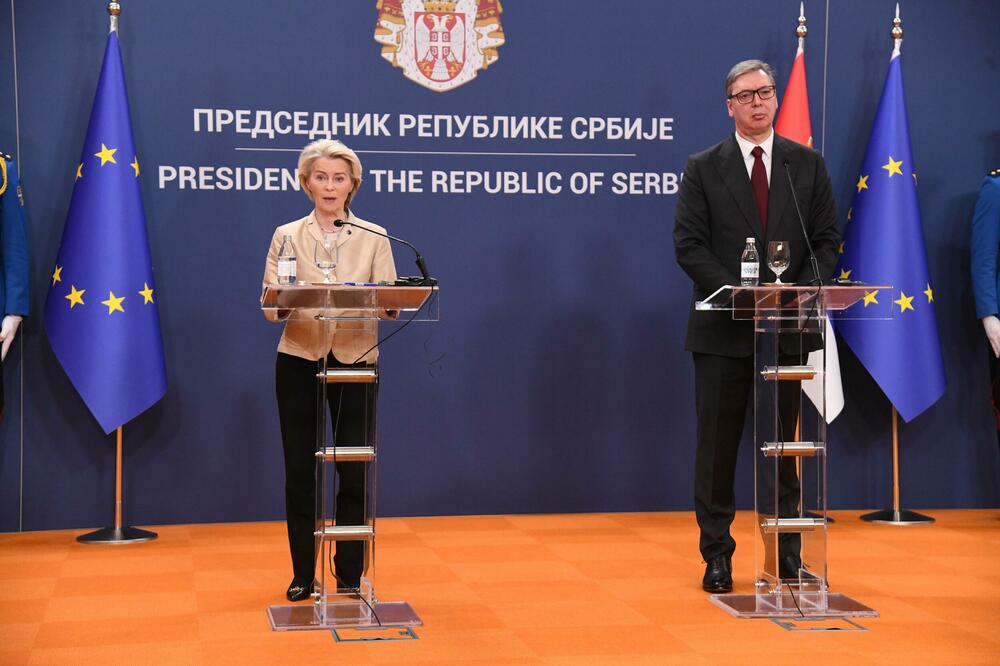
Von der Leyen and Vučić, Photo: BETAPHOTO
It is unclear whether the criticisms voiced in Belgrade by European Commission (EC) President Ursula von der Leyen signal a tougher course for the European Union (EU) towards Serbia, but European integration requires Belgrade to fulfill specific tasks, primarily sanctions against Russia, writes the Berlin daily Taz (Tageszeitung) today.
Western Balkans expert, political scientist and long-time associate of the United Nations (UN), EU, NATO, OSCE and OHR in the region, Alexander Rotert, writes in an article for Taz that during her recent stay in Belgrade, von der Leyen first sounded more critical tones about Serbia, but that these statements should be followed by actions, for example in Belgrade’s policy towards Russia.
“The facts speak for themselves – all indices related to democracy, the rule of law and the perception of corruption have been deteriorating in Serbia for years. The regime of autocratic President Aleksandar Vučić is increasingly brutally cracking down on the mass democratic movement that has been courageously demonstrating against corruption and the dissolution of democracy for a year. The European Commission (EC) has so far ignored this,” writes Taz.
The newspaper writes that the list of other problematic issues in Serbia is also long, such as violating sanctions against Russia, long-term armament without any real external threat, as well as relations with Kosovo, which “have not been worse since 1999.”
Stating that Bosnia and Herzegovina (BiH) and Kosovo have warned the UN Security Council about Serbia’s territorial claims, the German daily writes that at the same time, Serbia’s relations with Russia, China, Belarus and Iran are becoming increasingly close.
“Ursula von der Leyen has now indirectly criticized Vučić for the first time in Belgrade (whom she no longer addressed as “dear Aleksandar”) – she pointed out the need for reforms in the area of the rule of law, in the media and electoral law. She also met with representatives of non-governmental organizations for the first time,” writes Rotert.
Taz reminds us that “paradoxically” Vučić was until recently considered the guarantor of stability in the Balkans and that it is unclear whether Ursula von der Leyen’s latest change in tone means some kind of “course correction” towards Serbia, or whether “the EU, after Vučić’s verbal concessions, will return to its old policy of appeasement.”
“In order to integrate Serbia more closely into the EU, Belgrade would have to fulfill specific tasks before relations between Brussels and Belgrade can deepen. This should primarily be the implementation of sanctions against Russia. And this is something that Von der Leyen can build on during her return visit (to Vučić) in November,” writes Taz.

News