

A night light for €40, a miniature golf club for the Christmas tree for €20, a desk clock – €70 and, of course, countless shirts and jumpers: Taylor Swift’s online shop is full of such items, many of which sell out quickly.
The US megastar has taken fan merchandise to a whole new level. Swifties often spend big on these products – but it’s not just them.
US R&B singer-songwriter SZA has offered a neon yellow safety vest for about €109 while on tour with Kendrick Lamar, and British pop star Adele sells a varsity jacket online for €196.
For many major artists, fan merchandise – merch for short – is no longer a cheap souvenir but a premium product – sometimes nearly as costly as a concert ticket. Why are prices rising, and why are fans willing to pay?
Why merch is getting more expensive?
The term merchandising items covers everything from mugs and T-shirts to high-end collectibles.
Around 90% of the business is handled by licensors or agencies that market product rights, explains Ute Stauss, managing director of Licensing International Germany.
These agencies ensure artists receive their share of the profits. But rising costs also play a role.
“Merch is becoming more expensive because supply chains have changed due to global problems,” Stauss says. Most products come from Asia, where raw material prices are higher.
Music as a growth market
Johannes Everke, managing director of the BDKV industry group for live events, says that “significant price increases in the merchandising sector” aren’t rising beyond normal levels.
“As general increases in production costs and inflation have led to price rises in all areas of social life, it can be assumed that the merchandising sector is also affected,” he notes.
This means that products are becoming more expensive overall – and this also applies to merchandise.
Stauss, who is also a lecturer at Germany’s Popakademie for music and creative industries, says music products and concerts are profitable.
Using the German market as an example, she notes that “music is a very large and growing sector.”
“This is certainly also driven by the concert summer of 2024, when Adele, Taylor Swift and Coldplay played concerts in Germany,” she says. Adele set new standards in Munich with a specially constructed pop-up stadium and a kind of folk festival.
Swift did the same with her monumental “Eras” tour. Merchandise is an important additional source of income for artists, according to Stauss.
Merch as a lifestyle
In Stauss’ view, however, the main source of income is still concerts, fees, ticket sales and, to some extent, streaming revenues. This is also shown by a study on the music industry in Germany in 2024.
Artists earn around half of their income from live performances and studio recordings, while streaming and the sale of recordings account for just 5% of their income, the study shows.
“In addition to concerts as the most important source of income, further income can be generated through merchandising,” the BDKV says.
For many fans, merch has long been part of their lifestyle and concert-going experience. Tour shirts, caps with the album title and sweaters printed with the faces of stars are a fashionable sight in everyday life.
Artists often offer a range of standard products such as mugs or T-shirts. Swift is an extreme example with her extensive shop.
When the pop icon released her album “Folklore” with the single “Cardigan” in 2020, fans could even buy a matching cardigan on her website.
Nowadays, it’s the community spirit that counts, says Stauss. “Many fans today also use merch as an expression of belonging and identification.” In addition, many, certainly driven by the pandemic, have an “insane pent-up demand.”
Consumers are happy to spend money at events such as concerts. “They are generous with their money, and perhaps prices don’t necessarily play a role here because they are in a great mood and simply spend more money”
DIY alternatives and fan culture
However, some fans also find their own ways. At Tokio Hotel’s recent concert in Berlin, some fans were seen making their own fan shirts. This was also a way to have something unique that stood out from the crowd. “No one else has one,” said one woman.
Fan merchandise has been around for a long time. Some people may have had posters of the film “Titanic” hanging in their bedrooms, while others slept in bedding featuring a boy band or football club.
You could even go further back in human history, says fan researcher Harald Lange of saints honoured in churches with relics in the past.
Seen in this light, today’s fan merchandise is, in a sense, a modern interpretation of this, says Lange, a sports scientist who focuses particularly on fan culture in sport.
Basically, fans collect items from people they admire in a special way. Many are willing to dig deeper into their pockets for merch in order to be closer to their idols or to build a bond, he notes.
A woman attending the Tokio Hotel concert in Berlin says that if she has the money, she likes to buy something – and is even willing to spend a little extra.
But she notes that such items are generally more expensive today. “Not everyone can afford them anymore, unfortunately.”
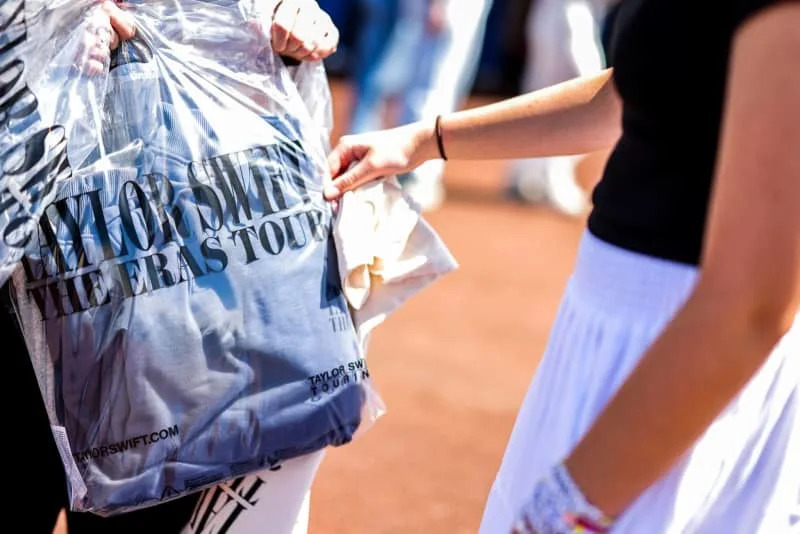
Why fans are paying big for more than just music – here ahead of Taylor Swift’s first concert in Germany. Christoph Reichwein/dpa