
Published on
October 21, 2025

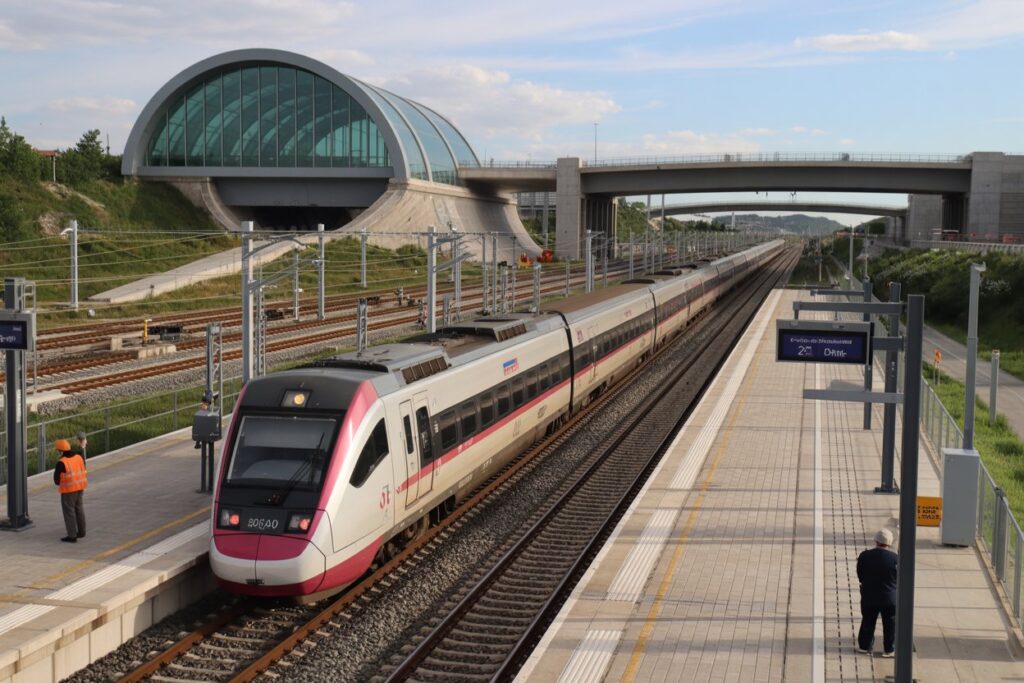
On October 3, Serbia’s President Aleksandar Vučić inaugurated the newly upgraded Novi Sad – Subotica railway line, a key section of the larger Belgrade – Budapest main line. With this milestone, trains on the 108 km stretch connecting Novi Sad and Subotica are now capable of reaching speeds of 200 km/h, significantly improving travel times and boosting rail transport efficiency between Serbia and Hungary.
Modernising Serbia’s Rail Infrastructure
The revitalisation of the Novi Sad – Subotica rail line is part of an ambitious project to modernise Serbia’s rail network. The construction work was carried out by China Civil Engineering and China Railway 11th Bureau, who were awarded the contract in 2021. The project, which officially commenced in 2022, focused on not only modernising the tracks but also enhancing the infrastructure and operational capacity of the route.
Key features of the project included the double-tracking of the line, the electrification of the entire stretch, and the integration of the ERTMS (European Rail Traffic Management System) for advanced signalling. The project also aimed to eliminate level crossings and enhance safety by elevating the tracks at intersections with roads and pedestrian paths.
Major Infrastructure Upgrades
Along with the track enhancements, the Novi Sad – Subotica line upgrade also involved the construction of new structures to support the high-speed rail system. Over 120 new structures were built, including four bridges, two viaducts totalling 2330 meters in length, five tunnels, 15 underpasses, and 27 overpasses. Additionally, for the first time in Serbia, three eco-ducts were created, each 46 meters long, allowing animals to safely cross the railway, an initiative reflecting the country’s commitment to sustainable development.
This project is also historically significant as it is the first European project to use Chinese-developed railway technology independently certified to meet EU’s Technical Specifications for Interoperability (TSI). This technology, designed and built by China Railway, marks a key step towards greater interoperability across Europe’s rail network, ensuring that Serbia’s rail system is future-proof and capable of meeting the demands of modern rail traffic.
Improved Speeds and Travel Times
Before the reconstruction, the Belgrade – Novi Sad – Subotica line only had 35 km of double track, and the average train speed was 45 km/h, leading to long travel times. The journey from Novi Sad to Subotica used to take approximately 4 hours and 35 minutes, but with the completion of the upgrades, this travel time has been reduced to just 42 minutes. The upgraded Novi Sad – Subotica line now enables the Belgrade – Subotica journey to be completed in 1 hour and 20 minutes, down from 2 hours and 50 minutes previously.
Future Plans and Regional Connectivity
Following this success, Serbia is pushing forward with further rail modernisation projects. President Vučić expressed the importance of building a comprehensive railway network across the country, not just focusing on high-speed lines but also improving regional services. Ongoing negotiations are underway for the construction of the Belgrade – Niš line and the Valjevo – Vrbnica route, which will extend to Montenegro.
Vučić also highlighted the future construction of rail connections between Pančevo, Opovo, Zrenjanin, and Kikinda, as well as a new link between Subotica and Sombor. These investments aim to improve rail transport and ensure Serbia’s strategic position in Europe’s rail network.
Conclusion
The completion of the Novi Sad – Subotica rail line upgrade is a major step in modernising Serbia’s railway system. By increasing speeds to 200 km/h and reducing journey times, the new line enhances the country’s rail connectivity with Hungary and improves overall transportation efficiency. With additional projects on the horizon, Serbia is positioning itself as a key player in the European rail network.
