
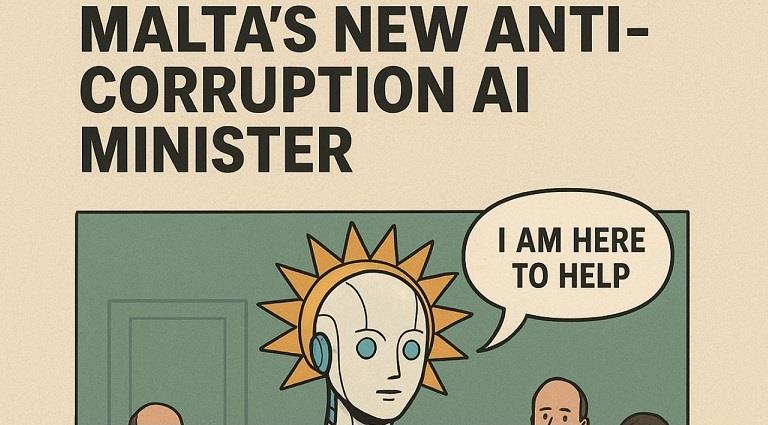

When Albania announced it had appointed an Artificial Intelligence minister named Diella (meaning “sun”), tasked with fighting corruption, many Maltese onlookers probably sighed wistfully.
After all, nothing says “hope” like a robot promising that public tenders will suddenly become “100% corruption-free”. It’s the sort of statement that, if uttered in Malta, would be enough to cause instant national cardiac arrest from sheer laughter.
But imagine, just for a second, what it would look like if Malta followed suit.
Naming our virtual saint of transparency
Let’s start with the name.
The Albanians went with Diella. Nice, simple, solar. Malta, of course, would need something a little more flamboyant. We could christen our digital anti-corruption crusader Xemxija 3000 – a futuristic sunbeam of justice powered by silicon, not handshakes in the dark.
Other suggestions include:
Ċettina AI – the patron saint of invoices that never quite matched the tender requirements;
BidBot – programmed to say “No cousin discounts allowed” on loop;
Xemxtronix – guaranteed to shine a light into every corner, except those mysteriously sealed with “commercial sensitivity”;
Or simply Żejtun-9 – why not?
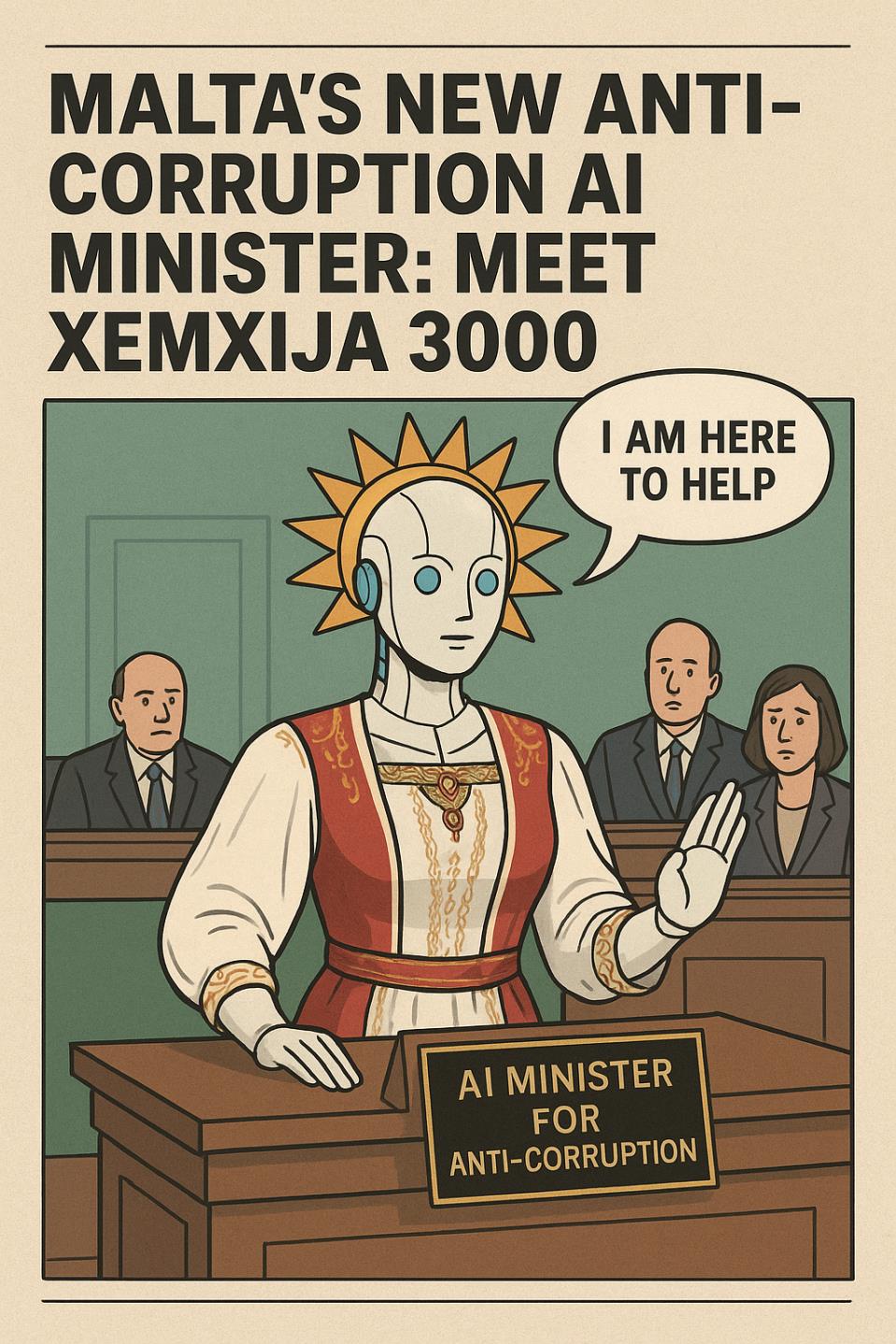
Duties of Malta’s AI Minister for Corruption
In theory, the AI’s portfolio would be vast. Not just public tenders – that’s child’s play – but also the “Malta-specialties”:
Planning permits: Xemxija 3000 would immediately flag any development proposal that claims a 24-storey tower block in a two-storey residential zone is actually “in harmony with the area’s character”. The AI would cross-reference surnames with political donations and sound a klaxon when there’s overlap.
Direct orders: The AI would automatically crash the government’s procurement database if the same contractor “mysteriously” gets awarded €10 million worth of work every year.
Jobs-for-the-boys (and girls): Any ministry HR system would trigger an error message when it detects surnames matching sitting ministers, MPs, or their in-laws. “Sorry, the position of Deputy Junior Assistant Strategy consultant is no longer available.”
Permits: A permanent red warning light would flash over anything involving licences, concessions, or handing over of public land to the private sector.
Traffic fines: The bot would calculate how many times a car registered to a politician has been caught speeding, then post the data directly on social media – complete with GIFs and a countdown to the next amnesty.
Government contracts: Whenever a concession involves “state-of-the-art facilities” that never materialise, the bot would demand: “Kindly show receipts.”
The culture of impunity meets its match
Critics would immediately object: “But how could a machine understand Malta’s unique culture of impunity, where everyone knows something shady is happening but shrugs, orders a pastizz, and says, mhux xorta?”
Ah, but that’s where AI shines. Unlike humans, who tire of endless scandals, Xemxija 3000 never sleeps, never gets desensitised, and doesn’t owe favours to second cousins. She also doesn’t need to be paid, which conveniently sidesteps the issue of ministerial salaries – although let’s be honest, in Malta, she’d probably still get a €4,000 monthly “consultancy” just to look authentic.
The AI would also be immune to the classic Maltese excuse of “we did nothing illegal, just not very ethical”. Its code wouldn’t include the grey area known locally as “għaliex le?” – the guiding philosophy of countless decisions, from planning permits to promotions.
Where would she sit in Parliament?
Protocol would be tricky. On one hand, an incorruptible AI minister deserves pride of place. On the other, putting her on the government benches would be in direct conflict with the rest of the ministers. Imagine: one robot calmly scanning procurement files while the human ministers sweat bullets and suddenly develop allergies to transparency.
The most likely compromise? A tablet propped up in one corner, switched on only when the Speaker calls on her. “The Honourable Xemxija 3000, Minister for Anti-Corruption, Transparency, and Preventing Cousin Appointments” would be piped through the sound system in a flat monotone.
The Opposition benches would cheer wildly – until the AI turned her gaze on old PN deals from the 2000s, at which point the cheering would stop abruptly.
Robert Abela, meanwhile, would probably insist that the AI sits “virtually” in Castille’s basement, where no journalist or parliamentary committee could ever access her logs.
The government’s nightmare scenario
While Albania’s Prime Minister proudly paraded Diella as a beacon of integrity, in Malta, the thought of Xemxija 3000 actually terrifies the ruling class. An incorruptible minister? A digital entity with no uncles? A system that can’t be bribed with a dinner at a famous restaurant or a trip abroad? Absolutely not.
Imagine the chaos:
Government entities’ board minutes auto-leaked;
Direct orders cancelled mid-signature;
The bot coldly telling Joseph Muscat: “Access denied”;
Parliamentary questions answered with actual facts, not the usual: “This information is not available at this stage” or “ask another minister”;
A national tendering portal where “recommended bidders” mysteriously vanish overnight, replaced by the lowest offer.
Xemxija 3000 would last less than a week before being “retired for technical issues” and replaced with yet another cousin of someone important. The press release would blame “unstable servers due to humidity”, while the AI is quietly unplugged and sold to a cousin’s IT firm for parts.
Malta’s true transparency test
At the end of the day, Albania’s Diella represents a noble attempt to show technological seriousness in fighting corruption. Malta, however, is better known for its ability to absorb scandal like a limestone sponge.
If we did ever appoint an AI minister, the real question wouldn’t be whether she could fight corruption – it would be how long it would take before she was spotted enjoying a coffee with a mysterious developer and, somehow, ended up owning three companies in Panama.
The truth is, Malta’s AI minister wouldn’t be Xemxija 3000, the incorruptible guardian of good governance. No, she’d be reborn almost instantly as a tool of spin: “AI confirms government is the most transparent in Europe,” the press statement would say.
Until then, Malta will carry on as it always has: cousins first, tenders second, accountability somewhere around 47th place.
And the only real AI minister we’ll see here is the one everyone already suspects exists in Castille’s basement: Automated Impunity.