
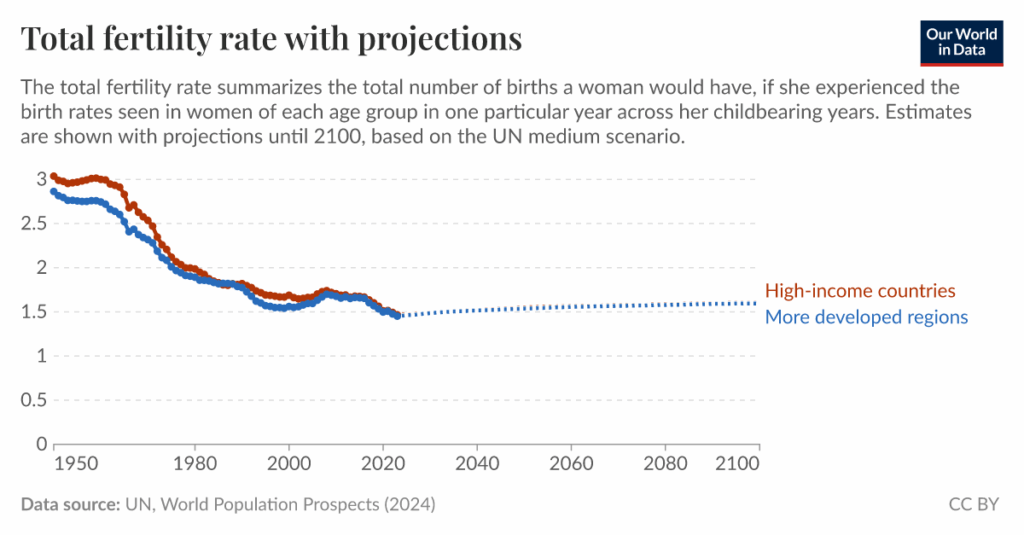
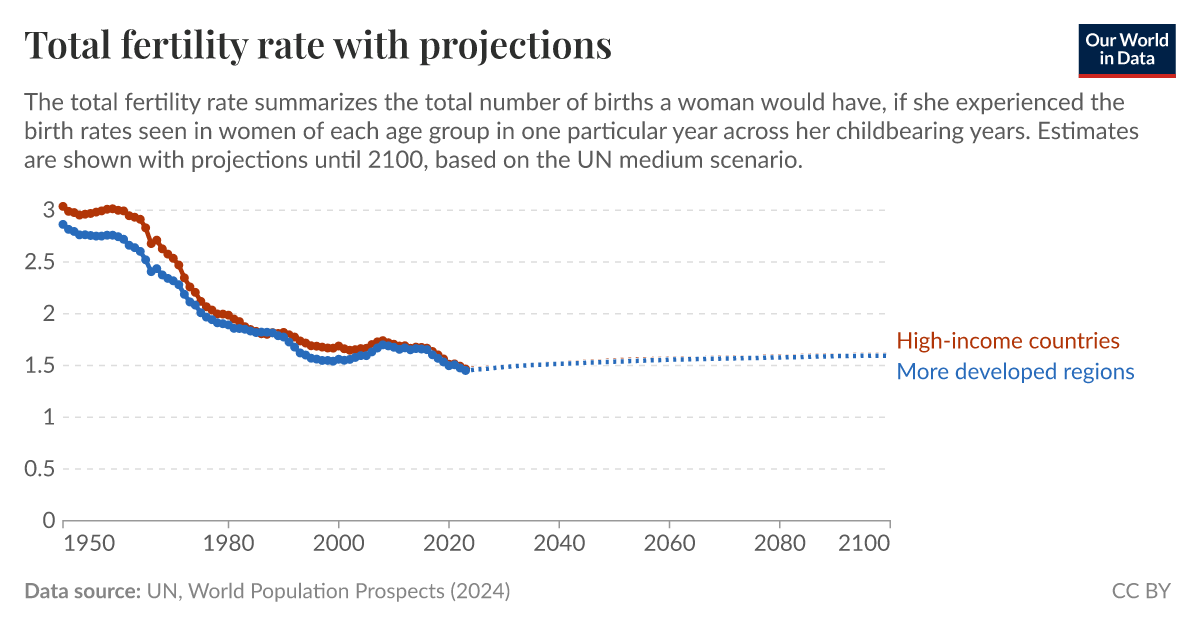
Since 2019, the UN has made the same incorrect forecast every revision, which is fertility rate for developed countries has already bottomed in 2020 and will rise to 1.6 for the remainder of the century. New fertility rate data has disproved this. Every year marks a new low for fertility rates. The UN seems to think the decline in fertility is a temporary abnormality that will resolve itself. The fertility rate decline is caused by systematic issues and won't resolve itself as long as these issues exist.
Population for most countries will begin declining in 2025-2050. Practically any developed country that lacks sufficient immigration is already experiencing population decline, e.g. China and Europe. The only reason world population is expected to decline after 2050 is Africa, which is responsible for most population growth in the future. If Africa is excluded, world population will begin declining by 2050, which I discussed previously.
World population will decline much faster than the UN forecasted, especially for developed countries
byu/d8gfdu89fdgfdu32432 inFuturology
20 Comments
Previously discussed world population decline excluding Africa in this [post](https://www.reddit.com/r/Futurology/comments/1gbmhv6/world_population_excluding_africa_will_peak_in/).
We’ll be replaced by robots while the top 1% rich continue to enjoy life unchanged.
By the end of this century, some countries would have shrunk to a quarter of their maximum populations. South Korea at around 50m people today, will likely be closer to 12m people. This has an enormous impact that very few folks are talking about.
I’ve known for a long time that population growth even through immigration can’t go on forever, I just did notexpect the current wave of capitalism committing suicide by turning against immigration. It remains to be seen if a new model emerges, or we fall into techno feudalism
From what has been observed, population is a resource only if the society know how to make use of it. Most of the current countries, a large population is more of a burden to the country than a resource.
Population decline has a pretty straightforward fix: test-tube babies and human cloning. These might be off-limits for now, but let’s be real, if birth rates keep dropping, societies will almost definitely start leaning into these technologies to keep the numbers up.
I mean we’re all running on chemical additives and plastic, this shouldn’t be too surprising
Oh what a shame, good thing A.I will save us right?
Australia.. can’t buy a house. Everything is expensive. Corrupt government. Why would anyone have kids?
Only for developed countries. Nigeria has almost as many births as the whole of China.
[List of countries by number of births – Wikipedia](https://en.wikipedia.org/wiki/List_of_countries_by_number_of_births)
50% more kids were born in Niger last year than in Japan. In early 1970s, Japan’s population was 20 TIMES larger. In your kids’ lifetimes, Niger’s population will surpass that of Japan (if people don’t starve or migrate away).
[Tools – Data Commons](https://datacommons.org/tools/visualization#visType%3Dtimeline%26place%3Dcountry%2FNER___country%2FJPN%26placeType%3DAdministrativeArea1%26sv%3D%7B%22dcid%22%3A%22Count_Person%22%7D)
Math says that if every country in the world has a below-replacement fertility rate except for Niger, the world population will grow exponentially in the long run. Of course, that will not be physically possible due to the size of the country, but the stabilization can occur due to mass migrations or total ecological destruction. It ain’t gonna be pretty.
People in the developed world thinking we’re headed for a population collapse don’t realize what’s happening in Africa and some Islamic countries outside Africa.
It’s almost as if the people born in developed countries aren’t paid enough to afford a decent wage where their offspring would be reasonably assumed to have the same or better quality of life than their parents, that said people won’t reproduce
When having a home, raising a family, and living affordably all become difficult, it’s no wonder it’s accelerating.
That’s why countries a importing people that reproduce like rodents. It’s just nature finding its course
Most of the developed world has an affordability crisis, the declining birthrate is a symptom that’s been ignored for a long time.
Antinatalists [right now](https://media.makeameme.org/created/yes-yes-excellent-5b9bde.jpg)
Turns out shaming people for not having kids, blaming woke or whatever culture war nonsense can only get you so far.
What is needed is a school of economic thought that is focused on allowing a population to retain a similar standard of living over time while undergoing a population decline. It’s an inevitability. Just as Keynesian economics has been created to deal with inevitable market declines – the government should spend more during recessions to stimulate growth, then tax more when the market is up – a similar convention should be developed to deal with population fluctuations. Immigration is fine and normal, but also needs to be done in a way that merges immigrants with the existing culture and is not done en masse at random to stave off the economic problems of a looming population decline. Naturalization and citizenship needs to be a choice, not a necessity.
The long lasting population drop is not sustainable.
What I mean is that the society, the structure, with current ways of working, WILL NOT LAST in long term.
And the change might be drastic. Or very violent.
And then current projections will be wrong again.
For me it is even more scary.
> The UN seems to think the decline in fertility is a temporary abnormality that will resolve itself. The fertility rate decline is caused by systematic issues and won’t resolve itself as long as these issues exist.
It really depends how far we get into life prolonging technology in the next 10-20 years. The elderly are hoarding wealth, property and power. They will eventually die and the next generation of rich asshole children will take over, and rich philanthropic children too.
Either they pave the way back to equality, or they can expect to live the rest of their lives on an island surrounded by private security.
Robots, AI, and UBI.
So don’t worry, this trend will quickly reverse when people no longer need to worry about survival, how much it costs to have a child, or how they can sacrifice their careers to have a family in such an expensive world.