
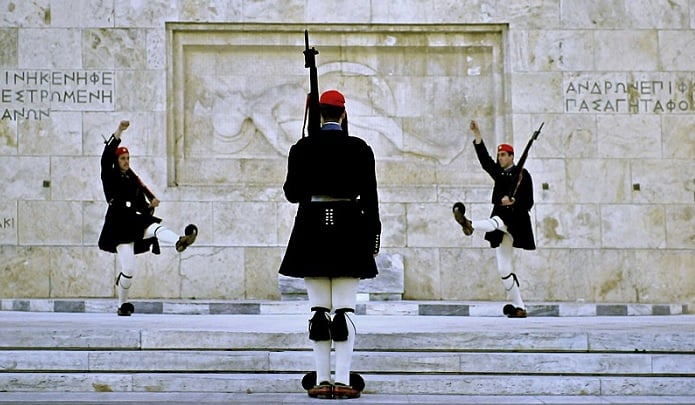
 Changing of the Greek Presidential Guard at Syntagma, Athens. Credit: Wikipedia
The conservative government in Greece is moving to formalize security measures around the Monument of the Unknown Soldier at Syntagma Square, a move that will likely lead to the re-erection of physical barriers or the introduction of strict new regulations limiting protest activity at the site.
This action follows the recent transfer of the monument’s operational control to the Ministry of Defense. It comes in the immediate wake of controversy over a makeshift memorial for the victims of the Tempi train disaster placed at the site.
The government’s stance: Protection and respect for the Monument of the Unknown Soldier
Government spokesman Pavlos Marinakis strongly defended the forthcoming amendment that will regulate activity around the Tomb, rejecting claims that the government is seeking to suppress democratic expression.
Marinakis insisted the goal is not to divide the public but to ensure respect for a sacred monument dedicated to the nation’s fallen heroes. Addressing the emotional memorial of the Tempi victims, which included names inscribed in red paint near the monument, he stated that authorities would not make an “aggressive move” a priori, but future measures are essential.
“The question is simple: do we agree that such a monument should be protected – yes or no?” Marinakis reiterated. He stressed that the new amendment would define a limited area around the monument where only acts of respect for national heroes will be permitted, explicitly stating that “the whole country is not that space, nor is the entire Syntagma Square.”
The new provisions, Marinakis confirmed, will be “immediately enforceable” by competent authorities. He noted the law is needed for those who do not understand the necessity of respect, including political parties, and clarified that authorities will be obliged to enforce a regulation that will likely prohibit graffiti, spray paint, and banners.
Related: Greece’s Witness to History: The Unknown Soldier Monument
Opposition rebuttal: Military over democracy
The government’s decision to transfer previously vague responsibilities to the Ministry of National Defense and the Army has drawn sharp criticism. For many citizens and opposition figures, the square is Greece’s most vital space for the right to public assembly, and any barriers or restrictions are seen as symbolically isolating the Hellenic Parliament from its people.
PASOK representative Michalis Katrinis questioned the move:
“What does Mr. Mitsotakis mean by saying that the protection of the Monument of the Unknown Soldier is being transferred to the Ministry of National Defense? Does he realize what this means and what its ramifications are?”
Katrinis asserted that maintaining order in the center of Athens is the job of the Police, not the Armed Forces. The Communist Party of Greece (KKE) commented that the involvement of the Ministry of National Defense, meaning the Armed Forces, “creates serious questions about the jurisdiction they assume regarding popular mobilization.”
SYRIZA emphasized that “the Monument of the Unknown Soldier belongs to the people,” with party member Alexis Haritsis characterizing the Prime Minister as the “official representative” of the “most extreme Trumpism in Europe.”
The opposition argues that by involving the military and imposing legal restrictions, the government is not simply protecting a monument but is symbolically militarizing the public space and curtailing the fundamental right to protest at the very center of the nation’s democratic life.
Related: Outrage as Protester Steps on Athens’ Tomb of the Unknown Soldier