
Newswise — In the field of deep-sea exploration, environment-friendly manipulators using water or seawater as the working medium have become a research focus due to their advantages of zero pollution and low cost. However, the core component—water hydraulic proportional valves—faces significant technical bottlenecks. Traditional mineral oil hydraulic valves cannot be directly applied to water hydraulic systems due to water’s low viscosity, poor lubricity, and strong corrosiveness, leading to severe leakage and wear. Existing water hydraulic valves, such as two-way two-position poppet valves, require multiple combinations to control manipulator cylinders, resulting in excessive volume and weight. Rotary valves, on the other hand, lack pressure compensation capabilities; under ultra-high deep-sea pressure (up to 65 MPa at 6500 m), structural deformation causes valve port gaps, failing to meet sealing requirements and limiting their application in deep-sea manipulators.
Therefore, a research team consisting of researchers from the School of Mechanical Science and Engineering at Huazhong University of Science and Technology, the 719 Institute of China Shipbuilding Industry Corporation, and Wuhan Huaxi Special Hydraulic Equipment Co., Ltd. has conducted a study entitled “Numerical Analysis and Experimental Verification of a Novel Water Hydraulic Rotary Proportional Valve for an Environment-Friendly Manipulator”.
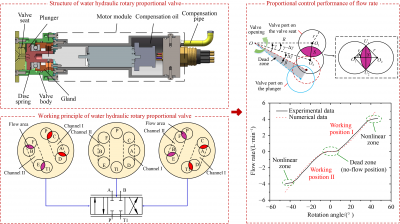
This study invents a novel four-way three-position water hydraulic rotary proportional valve with a plane sealing method, specifically designed for deep-sea environment-friendly manipulators. The valve’s core structure includes a valve seat, valve body, plunger, disc spring, gland, and motor module. The plunger (made of corrosion-resistant carbon fiber-reinforced polyether ether ketone, PEEK-CF30) and motor shaft are fixed, and the disc spring exerts pre-pressure to ensure tight contact between the plunger and valve seat (stainless steel 316L), achieving zero leakage. Four circular valve ports on the valve seat (A, B, P, T1) and corresponding ports on the plunger (C, D, E, F) form two internal channels; by controlling the plunger’s rotation direction and angle, the valve realizes three working positions (working position I, zero position, working position II) to regulate flow direction and rate. Additionally, the motor module is filled with compensation mineral oil and equipped with a plastic compensation pipe, which deforms with environmental pressure changes to balance internal and external pressure, compensating for structural deformation and adapting to ultra-high deep-sea pressure.
The paper “Numerical analysis and experimental verification of a novel water hydraulic rotary proportional valve for an environment-friendly manipulator” is authored by Zhenyao WANG, Yinshui LIU, Xi WANG, Yong LIU, Xuemei PAN, Chuanqi GAO, and Defa WU. Full text of the open access paper: https://doi.org/10.1007/s11465-025-0820-z.