
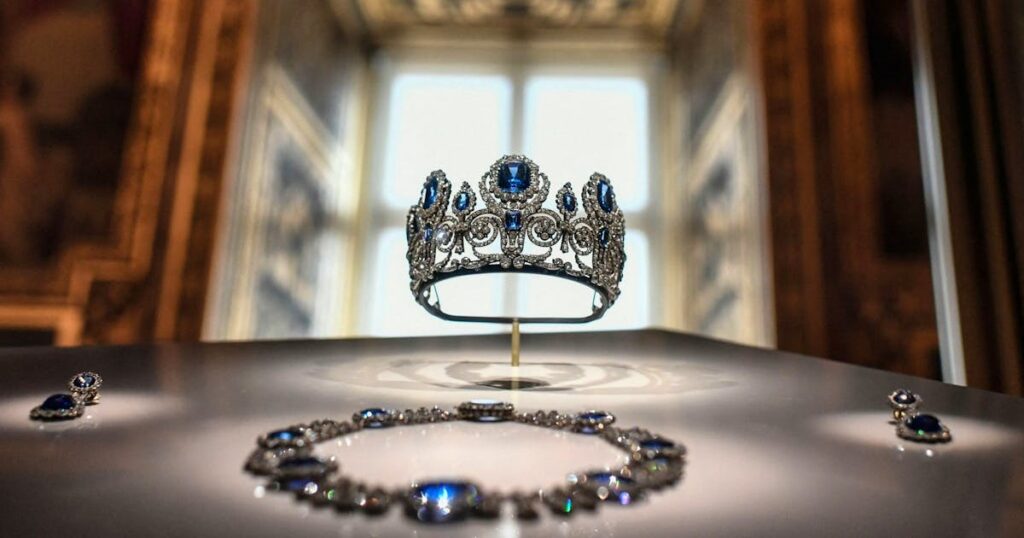
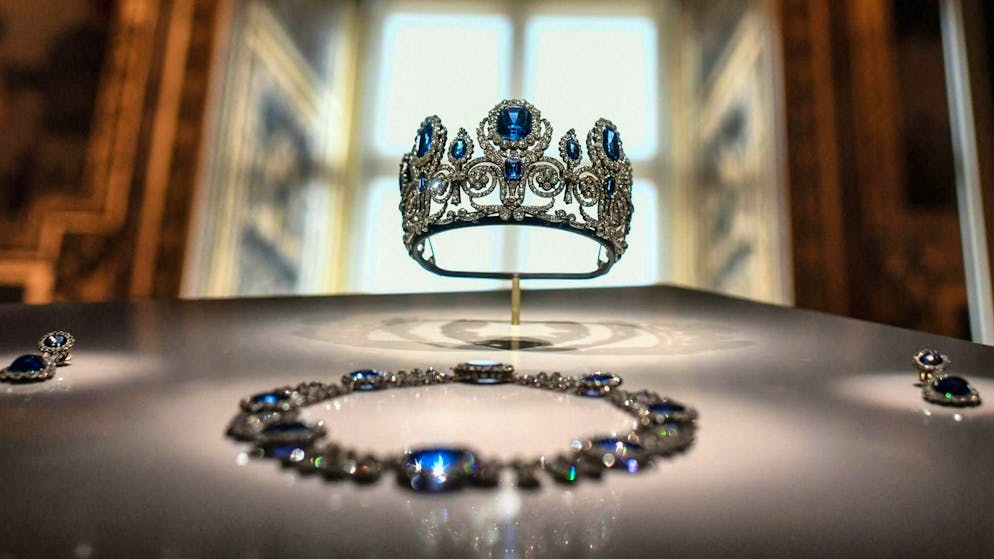
The burglars were after France’s crown jewels (archive photo).
Bild: Stephane De Sakutin/AFP/dpa
The robbery at the Louvre in Paris is not only keeping the French police on their toes. Swiss museums are also putting their security concepts to the test after the spectacular coup – with one major difference.
- After the spectacular theft at the Louvre in Paris, there is still no trace of the perpetrators.
- The coup is also affecting Swiss museums: according to expert Oliver Class, the robbery in France is also “the talk of the art scene” here in Switzerland.
- According to Class, such an act is also conceivable in Switzerland, although he pointed out a crucial difference.
If the spectacular heist at the Louvre were part of a Hollywood blockbuster, the movie would probably be accused of being unrealistic: Thanks to a truck with a lifting platform, the perpetrators relieved the museum of valuable pieces of jewelry in just four minutes.
What’s more, the theft took place in broad daylight. And there is no trace of the perpetrators: as of Monday evening, the police are still poking around in the dark.
The cinematic coup is not only keeping the French authorities on their toes, but is also causing museums all over the world to question their security concepts. This is also the case in Switzerland, as Oliver Class confirmed to “20min”.
“It’s currently the topic of conversation in the art scene,” the art historian and security expert reported. “The case has shocked many – and at best, it’s a wake-up call.”
“Such a theft would also be conceivable in Switzerland”
The expert rated the security measures in Swiss museums as generally good. However, a seamless system is not guaranteed anywhere. “Such a theft would also be conceivable in Switzerland,” emphasized Class. However, everything would have to fall into place for this to happen, the expert qualified.
“Only professionals can pull off a coup like this,” he explained. “Special circumstances, such as construction work, increase the chances even more, as security concepts are often not fully adapted.”
Class was unable to go into more detail about the situation in museums in this country – and the museums themselves withheld more precise information “for security reasons”. But this much is clear, according to Oliver Class: “The larger the museum, the more valuable the works are and the better they are protected.”
Nevertheless, Class drew attention to a small but important difference between Switzerland and France. While a state insurance system in France can certainly have gaps, artworks in Switzerland are “mostly privately insured”. According to Class, this has the following consequence: “These insurers naturally have a great interest in ensuring that the works are protected in the best possible way.”
Expert attests that police are “racing against time”
Meanwhile, according to Dutch art detective Arthur Brand, the thieves still have a difficult task ahead of them. “Nobody wants to burn their fingers on these pieces,” he told the Deutsche Presse-Agentur in Amsterdam about a possible sale of the stolen goods. A buyer of the stolen objects would also be liable to prosecution.
Brand is an international expert in the investigation of art thefts. Among other things, he also worked with the Dutch authorities following the spectacular jewelry heist at the Tefaf 2022 art and antiques fair in Maastricht.
According to the expert, the diamonds and other precious stones are very likely to be removed from the jewelry and sold individually. “Then they will no longer be found.” The search for the jewels will be a “race against time”, said Brand. “The thieves will certainly be caught, but the loot will have long since been sold.” It is very doubtful that the people behind the thefts will ever be caught.