
The UAV industry is poised to dramatically reshape our world in transformative and disruptive ways, supported by advances in the fields of electric propulsion, sensors, navigation and AI. Drones today are capable of mapping remote landscapes, monitoring critical infrastructure, and delivering vital supplies. Yet, behind these dazzling innovations lies a stubborn obstacle that limits what UAVs can achieve:
energy storage.
No matter how sophisticated a UAV’s design or software, its potential is ultimately constrained by one basic question: how long can it stay airborne before its power runs out? Across countless missions, from environmental surveillance to disaster relief, this invisible countdown determines success or failure. And all too often, drones are forced to abandon tasks or cut flights short, not because of design flaws,
but because their batteries simply can’t go any further.
Energy storage is one of the biggest constraints – and opportunities – for UAV advancement. The performance, range, payload capacity, and even the commercial viability of UAVs hinge heavily on energy storage.
Why Batteries Are Running Out
Most drones today are powered by lithium-ion or lithium-polymer batteries. Even under the best conditions, these batteries typically provide less than an hour of flight time. When carrying heavy or mission-critical payloads, many UAVs manage merely minutes in the air. Even fixed-wing vertical takeoff and landing (VTOL) systems, which gain endurance from aerodynamic advantages, achieve only modest
improvements unless they turn to internal combustion engines — a solution largely restricted to military drones, not commercial or industrial models.
On top of short flight durations, the ground-side limitations are just as painful. Battery recharge cycles of 60 to 90 minutes stall operations, while swapping batteries in the field demands a costly inventory of spares and mobile charging stations — often diesel-powered, adding weight and complexity to missions in remote areas. Batteries also degrade with use, shrinking their effective lifespan and forcing constant
replacements. Every kilogram dedicated to batteries takes away from the payload, forcing a painful choice between how far a drone can fly and how much it can carry.
Hydrogen Fuel Cells: A Tempting Yet Unfulfilled Promise
For years, hydrogen fuel cells have offered a powerful alternative, promising higher energy density, rapid refueling, and far better environmental performance compared to conventional batteries. But the promise has remained largely unfulfilled.
The core challenge has never been the fuel cell itself, but rather how to store hydrogen onboard UAVs efficiently. Compressed hydrogen, even at extreme pressures of the order of 700 times the atmospheric pressure (700 bar), offers poor volumetric efficiency and demands multi-stage compression systems that consume roughly 15 percent of the stored energy. Building and maintaining this infrastructure adds steep capital and operational costs and jurisdictional compliance issues.
Liquid hydrogen, while denser, requires energy-hungry liquefaction processes that consume nearly 40 percent of the energy content just to store it, and boil-off losses during storage and transfer remain significant drawbacks. Meanwhile, metal hydride storage systems are extremely heavy and require heating to temperatures as high as 300 degrees Celsius to unlock their stored energy — a thermal and weight burden UAVs can ill afford.
A Game-Changer: Solid-State Hydrogen Storage Based on Reticular Materials
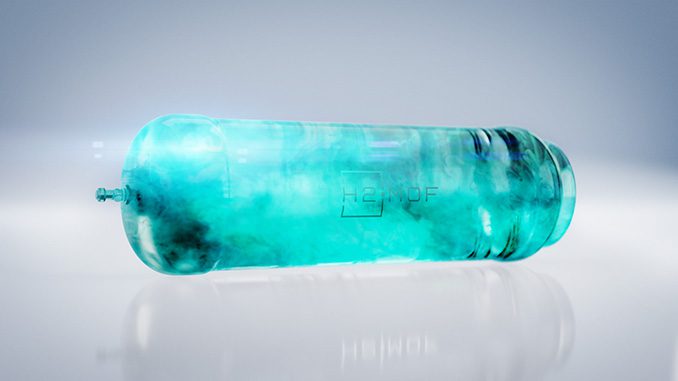
A breakthrough is now reshaping the hydrogen storage landscape: solid-state storage based on nano-engineered reticular materials. This innovation transforms how UAVs store and access hydrogen, addressing many of the challenges that have held the industry back.
By safely storing hydrogen at low pressures and near-ambient temperatures, these materials eliminate the need for bulky tanks, expensive multi-stage compression, or cryogenic cooling. The result is a lightweight, compact storage system with exceptional performance. Compared to today’s standard 300 and 700-bar tanks, this offers about 30 percent better weight efficiency and nearly twice the volumetric efficiency.
For UAV operators, the benefits are immediate and profound. Solid-state hydrogen storage translates into longer flight durations, greater payload capacity, and faster recharge and mission turnaround. Drones can carry more sophisticated equipment or heavier cargo without sacrificing airtime. Because the storage materials can be shaped to fit the airframe’s contours, they also offer packaging flexibility that improves aerodynamics and overall design efficiency. Crucially, the materials enable rapid hydrogen adsorption and release, ensuring a steady fuel supply in real time, matched to mission demands.
Economic and Operational Advantages
The economic advantages of this technology are just as compelling. Solid-state storage can reduce hydrogen delivery costs by as much as 50 percent compared to conventional compressed systems and by nearly 80 percent relative to liquid hydrogen approaches. Without the need for heavy, high-pressure tanks or complex liquefaction infrastructure, the cost and complexity of UAV operations decline sharply. Low-pressure systems also face fewer regulatory challenges, making them easier to integrate into commercial fleets.
Scalability is another major win. Whether supplying lightweight drones with as little as 100 grams of hydrogen or equipping heavy-lift UAVs with integrated storage systems holding up to 40 kilograms, the technology adapts smoothly to a range of mission profiles. Portable cartridges or embedded subsystems can meet the demands of commercial, industrial, or defense applications alike, unlocking new
possibilities across numerous sectors.
A New Horizon for UAV Energy Systems
What’s emerging is not just an incremental improvement, but a fundamental shift in UAV energy system configuration. The arrival of solid-state hydrogen storage, built on nano-engineered materials, allows drones to break free from the compromises that have long defined battery-powered flight.
For UAV system architects, manufacturers, and operators, the message is clear: the time has come to embrace next-generation energy solutions. By overcoming the long-standing hurdles of hydrogen storage, the industry is poised to unlock longer- range flights, heavier payloads, faster deployments, and safer, more reliable aerial systems.
In an era where UAVs are expected to do more — to carry out more complex missions, over greater distances, with more demanding payloads — the limits imposed by battery technologies can no longer be acceptable. With solid-state hydrogen storage, the path forward is open, and the future of high-performance, long-endurance UAVs is ready to take flight.
- Authored by Dr. Neel Sirosh, CTO at H2MOF