
In case you missed it, Malta prepares once more to rescue European civilisation.
Just as we held the line in 1565 and earned our George Cross in 1942, we now step forward to enlighten the continent on the subtler points of democracy and free expression. We are refining the right to free speech itself.
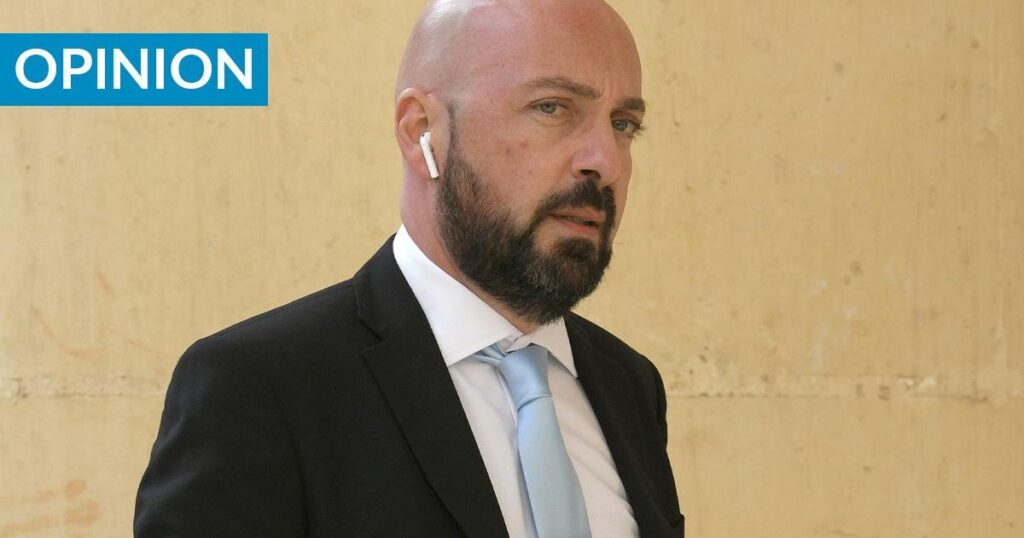
Betraying a fundamental misunderstanding, the embassies of the Netherlands, Germany and Ireland have made certain insinuations about Neville Gafà, the customer care coordinator at the Office of the Prime Minister.
Just because their memorial flowers, in remembrance of Daphne Caruana Galizia, ended up in a bin, they impertinently suggest he is a petty vandal bent on suppressing her memory and inconvenient revelations.
The embassies seem to think the issue is one of ethics and institutional dignity – the ethics of a government defending an appointee who does such things. How quaint to view this as a question of doing the right thing, rather than exercising the right to do what the law permits.
We have tried before to instruct Europeans on these fundamentals. In 2018, Jason Micallef, then chair of Valletta 2018, mocked protestors who quoted Daphne’s final words. The Dutch then refused to participate. To no avail did the culture minister, Owen Bonnici, channel his inner Voltaire.
Let us learn from past mistakes: skip the foundations, now obsolete, and immediately pass to Malta’s refinements, which consist of three elegant elements.
First, the distinction between personal and official capacity. In 2017, shortly after the assassination, the late Tony Zarb – adviser at the ministry of tourism – called the women protesting outside Castille whores. An intemperate judgement, perhaps, but held purely in a personal capacity. In his official capacity, he remained one with the self-styled “most feminist government in history”. It naturally retained his services.
The second element represents our true innovation: protected candour. Free speech is not merely about protecting everyone’s right to expression, especially those lacking official platforms. It primarily protects the candour of political appointees. Glenn Bedingfield, while a communications aide at OPM, ran an anti-Daphne website – but he was only expressing himself. Gafà stalked Daphne the day before her death and uploaded photos of her conducting private business – but his photos issued from a candid camera.
Here lies the beauty of protected candour over old-fashioned free speech: by letting public officials express what they genuinely think about members of the public and government critics, they display full transparency.
It is in this spirit that Gafà has returned to public life, as an OPM official in the secretariat of social dialogue. That much maligned man illustrates the flowering of free speech. Some might find him deplorable, offensive and shocking – but these are protected characteristics according to the European Court of Human Rights. The lotus flower of free speech grows most splendidly in mud.
Gafà’s boss, Andy Ellul, assures us that Gafà’s free speech rights are not absolute. If he disparaged Daphne, Ellul would be first to object. Hence why Gafà has not crossed the line, restricting himself to calling Daphne innocuous epithets like hate blogger and tax evader (much to the surprise of the tax department, which settled her bill at the amount she never disputed). However, should Gafà go over the line and claim she bit her nails, we can rely on Ellul to chide him for getting personal.
The third element: rebalancing separate powers. In 2020, the Maltese courts, represented by Joseph Zammit McKeon, then a sitting judge, decided that protestors may use the Great Siege memorial to demand justice for Daphne; that the site forms an intrinsic part of their message and cannot be censored; and that claims to clear it for heritage protection are bogus.
Meanwhile, the Strasbourg court has proclaimed that freedom of expression cannot interfere with the rights of others – no private individual can censor others and claim he’s exercising his own freedom of expression.
Naturally, even judges enjoy freedom of expression. They are free to opine but that shouldn’t mean that court sentences must constrain ordinary citizens, who have an equal right to an opinion.
Gafà has the right to defy the court sentence without enduring the tedious niceties of litigation. And the government is standing by his right to take the law into his own hands and clear the protest signs and flowers to protect our heritage.
Nor should the fact that he’s a public official curtail his right to call Zammit McKeon a partisan showboat. Indeed, given that Zammit McKeon is now the ombudsman, Gafà strikes an anti-Establishment blow on behalf of us all – by putting not one but two high offices of state in their place.
Gafà’s quest for the people’s liberation from the Establishment continues apace. His blog now characterises the European Parliament debate on Malta’s rule of law as Nazi: he’s uploaded an image of the EU flag with a swastika emblazoned between the stars.
Some readers might have trouble keeping up with all this subtlety. They might wonder why the government contradicts free speech jurisprudence. They might even ask if the government has anything to say about a public official who defies the public service code of conduct, unilaterally aggravates three EU member state embassies, depicts an EU institution as Nazi, disparages a court’s judgment, takes the law into his own hands and calls the current ombudsman a partisan hack.
But this misses the forest for the trees. In defending Gafà’s self-expression, protecting his candour and abiding his rebalancing of powers, the government champions transparency and democracy. Small wonder the prime minister cannot fathom why our European partners fail to appreciate the Great Leap Forward on his watch.
Reader, keep your eye on the ball. The true villain in this saga remains David Casa, the MEP who called for a debate on Malta. The audacity: he didn’t act in a personal capacity but his official one.
Frankly, this is unacceptable.