
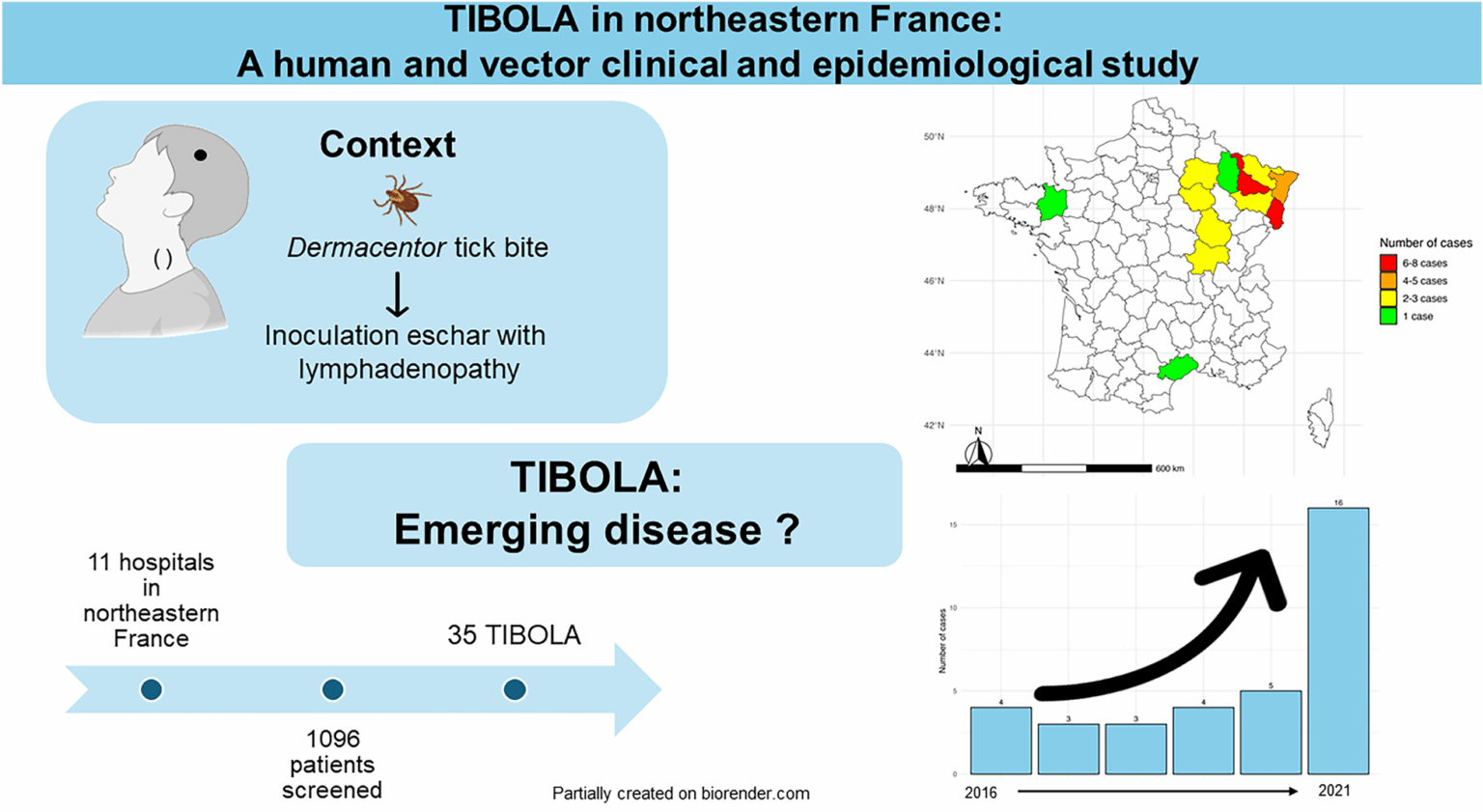
This study highlights an increase in the number of TIBOLA cases in 2021 in northeastern France as well as an increase in the Dermacentor tick population. These results support the view that TIBOLA is a seasonal disease that occurs primarily in the spring [8]. TIBOLA patients are mainly female, young, and live in rural areas.
TIBOLA is a rare disease that is usually not reported in this region of France. Cases of TIBOLA also appear to have increased in other European countries, as shown in a recent Italian study [20]: the authors described ten cases on the basis of clinical and epidemiological criteria over a period of 7 years (2015–2022) in Tuscany, a region where TIBOLA was rarely found before.
Epidemiological changes also seem to occur in other tick-borne diseases. For example, tick-borne encephalitis, once found almost exclusively in a limited part of northeastern France, now seems to affect a wider area across the eastern half of France [12]. This increase in incidence has also been reported for tularemia by the European Center for Disease Prevention and Control [13, 14]. However, the incidence of Lyme borreliosis has been stable in France over the past few years [21, 22], and the incidence of Mediterranean spotted fever varies depending on the year [23].
The real challenge lies in the current lack of awareness and knowledge about TIBOLA among many physicians and its frequent confusion with Lyme disease [15], leading to inappropriate antibiotic therapy, such as amoxicillin. However, Rickettsiae are intracellular bacteria that are naturally resistant to beta-lactams [24]. One of the reasons why doxycycline has become the first-line treatment for Lyme borreliosis since 2018 is that it is effective against other tick-borne diseases [21]. This was confirmed by the 2025 guidelines [25].
There are few large-scale studies about TIBOLA in the scientific literature. Several case series, retrospective studies, and a few prospective studies can be found. Most of these studies are listed in Table 4. The seasonal fluctuations observed in this work, with the main peak in the spring and a smaller peak in the autumn, are consistent with those reported in previous studies [4, 16, 20, 26,27,28]. In this study, the median patient age was 32.5 years. In the literature, most patients diagnosed with TIBOLA are younger than 40 years old [3, 8, 29, 30]. Individuals who are minors represented a substantial proportion of the patients in the present study (34%), as observed in several other studies [4, 31]. There is no convincing pathophysiological hypothesis to explain why children are more affected by TIBOLA than adults are. The same predominance of children can be observed in Lyme borreliosis [32]. With respect to clinical features, 17% of patients reported a disseminated skin rash, which is far greater than what has been described in the literature: between 2% [8] and 5% of patients [30]. With respect to fever, the data in the literature are discordant: from 25% [8] to 80% of patients [20]. In the present study, half of the patients reported fever. Fewer cases of alopecia were reported here than in the literature: 14%, while previous studies reported 19% [8]. This finding could be explained by the retrospective design of this study, with a lack of standardized follow-up.
TIBOLA diagnostic criteria are not well defined. Some studies are based on clinical signs following a tick bite [27], whereas others require microbiological documentation [3]. In the present study, certain and probable cases of TIBOLA were distinguished. In most cases, a TIBOLA diagnosis is based on a combination of demographic, epidemiological, and clinical factors. Microbiological documentation is particularly difficult and frequently not essential, especially in primary care units, where biological analyses are usually not performed. The absence of microbiological documentation is frequent in the literature, as was the case in the present study. Studies performed in National Reference Centers (Marseille in France, La Rioja in Spain), which routinely perform specific Rickettsia serology and PCR, have a higher microbiological documentation rate [3, 4, 26, 27, 30] since they include referred patients with a higher probability of TIBOLA.
TIBOLA is a local or regional disease with an inconsistent blood phase; this may explain why the serology is often negative, with a sensitivity of 12% [26]. Furthermore, recommendations suggest that serological tests should be repeated to observe seroconversion, which was rarely performed in the present study [17]. In addition, R. raoultii is difficult to identify in humans. Some studies suggest that D. reticulatus primarily harbors R. raoultii and that D. marginatus harbors R. slovaca [10, 33]. Dermacentor reticulatus is predominant in northeastern France [8]; this could explain the low proportion of microbiologically confirmed cases in this study.
A question arises as to the factors determining the possible expansion of TIBOLA. Global warming could be one of the causes of this increase via a change in the geographical and seasonal distribution of Dermacentor ticks, as evidenced by the detection of this tick as early as January [34, 35]. Global warming could also induce behavioral changes in hosts, including humans, increasing their outdoor activities and potentially their exposure to arthropod bites. Human activities impacting tick biotopes are also likely to favor vector expansion [18] through the evolution of agriculture over recent decades, through the reforestation and importation of animals, and through a reduction in the use of pesticides (even if this behavior change could have other advantages for human health). In Germany, a participatory citizen study (ticks sent by citizens, collection of geographical information) performed from 2020–2021 revealed the spatial spread of Dermacentor [36]. Entomological studies are currently being conducted to document the spread of Dermacentor ticks in nature and to explain the determining factors (Borrelia National Reference Center, Strasbourg, France). Preliminary data show that in northeastern France, 19% of D. reticulatus are infected by R. raoultii, whereas R. slovaca is rarely detected (1%). Interannual variations rather than real increases in Dermacentor were observed, and these ticks are present in specific ecosystems (N. Boulanger, personal communication).
Furthermore, a greater number of TIBOLA might be not only a consequence of an emergence, but also of a better awareness of tick-borne diseases by medical professionals in France.
This study combining human and tick epidemiological data is original but has several limitations linked to its retrospective design, particularly missing data and memory bias among clinicians. To control these biases, microbiological data were extracted to identify cases that the clinicians could not remember. Wide screening based on prescribed tests and careful examination of medical files helped to contain them. This strategy led to the inclusion of several types of tularemia. This disease matches the predefined inclusion criteria: inoculation eschar with regional lymphadenopathy after a tick bite. Hence, a question arises about whether TIBOLA is a disease or a syndrome.
TIBOLA is benign and usually has no systemic complications. In most cases, patients do not seek specialized hospital care. This study estimated the number of cases of TIBOLA diagnosed in hospitals in northeastern France, but most of the cases were probably met in primary care, resulting in selection bias. Thus, the number of cases must have been underestimated. The inclusion of outpatients is methodologically and financially complex, and most of the time, patients seen in primary care units do not have microbiological tests. Thus, in an outpatient study, the microbiological documentation rate would have been even lower. Another limitation is that the screening was performed in a limited number of hospitals. In addition, two cases were diagnosed in northeastern France after a tick bite in another region. In terms of entomological data, there were only four collection sites in Alsace, a region that is nevertheless endemic for ticks and tick-borne diseases, whereas the clinical inclusion zone was wider in northeastern France. Work is in progress to complete vector epidemiology.