
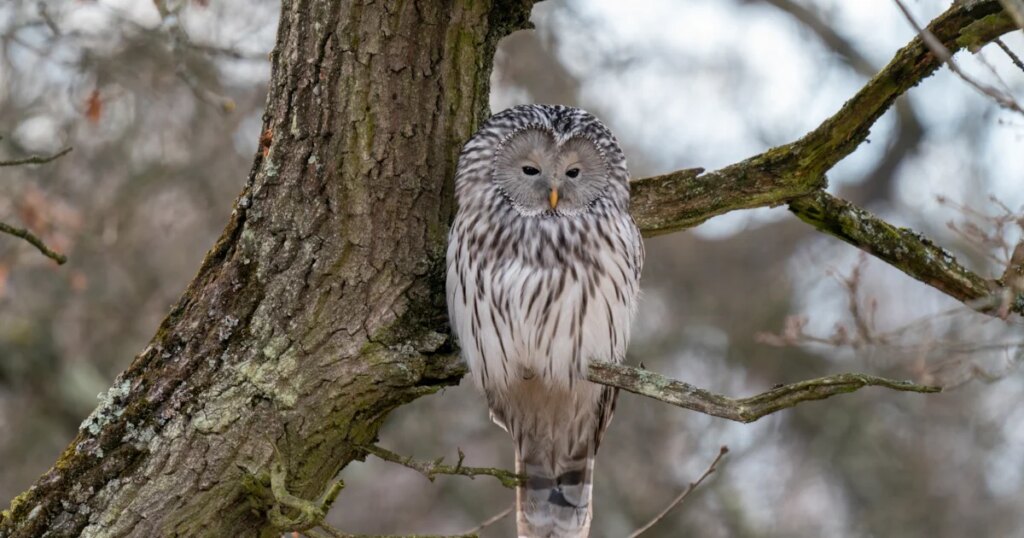
A long-term nestbox campaign in Norway has brought encouraging signs for Ural Owl, showing a clear increase in occupied nest sites.
Only first recorded nesting in Norway in 1886, the Ural Owl has persisted in the country’s south-east, particularly along the border with Sweden. Until the year 2000, only 16 nesting events were recorded throughout the country, with most occurring in the county of Hedmark. Occupation of more than two nests per year was almost unheard of.
In response, the initiative known as Prosjekt Slagugle launched a large-scale installation of nestboxes from 2000 onwards in Hedmark, Norway, and adjacent Swedish counties of Värmland and Dalarne. More than 451 nestboxes were monitored from 2000-2022 across a total of 5,425 inspections, as per Ornithomedia.
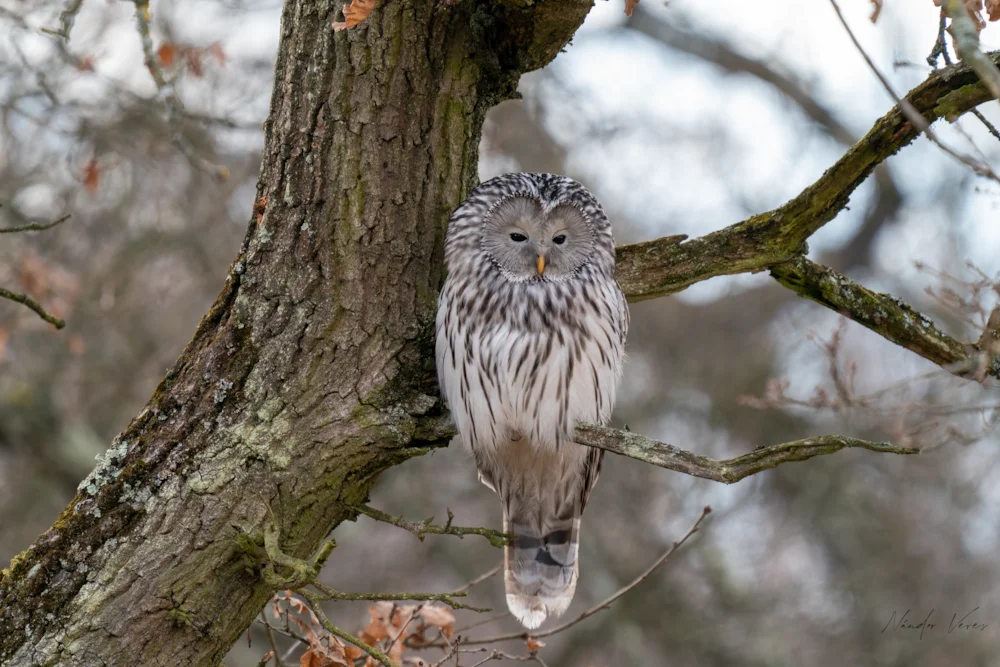
Nestboxes have helped Ural Owl increase as a breeding bird in Norway (Nándor Veres-Szászka).
Boxes help breeding
The results are striking. In Hedmark the number of occupied boxes rose from three in 2007 to nine in 2011, 14 in 2014 and ultimately 23 in 2022. Numbers clearly fluctuate in response to rodent prey cycles, but the upward trend is firmly established.
Occupancy patterns reveal strong site fidelity: the oldest territories, established before 2008, have been reused on average eight times by three or four different females. Territories typically span 600 ha for females and males respectively, according to radiotelemetry studies. Most occupied boxes lie below 400 m altitude and favour old-growth woodland with peat-bog and marsh edges.
Despite these gains, BirdLife Norge emphasise that the Ural Owl’s Norwegian population remains fragile and dependent on high prey densities – especially voles. They caution that while nestbox provision has improved breeding opportunities, forest-management practices and prey fluctuations continue to pose significant risks.
Glimmer of hope
The nestbox campaign has also echoed across the border in Sweden. Some of the ringed females in Norway originated from Sweden, underscoring the value of cross-border collaboration for this transnational population.
“There is a genuine glimmer of hope here,” said a representative of the project in the recent BirdLife Norge report, “but the species remains dependent on intact forest mosaics and rich prey bases.”
The story of Norway’s re-emerging Ural Owl offers a welcome example of how targeted nestbox programmes can aid rare species – especially when combined with habitat protection and long-term monitoring.
The species’ presence on Norway’s borderlands remains a conservation achievement worth celebrating, while reminding us that maintenance of forest and prey habitat is just as important as placing boxes.