
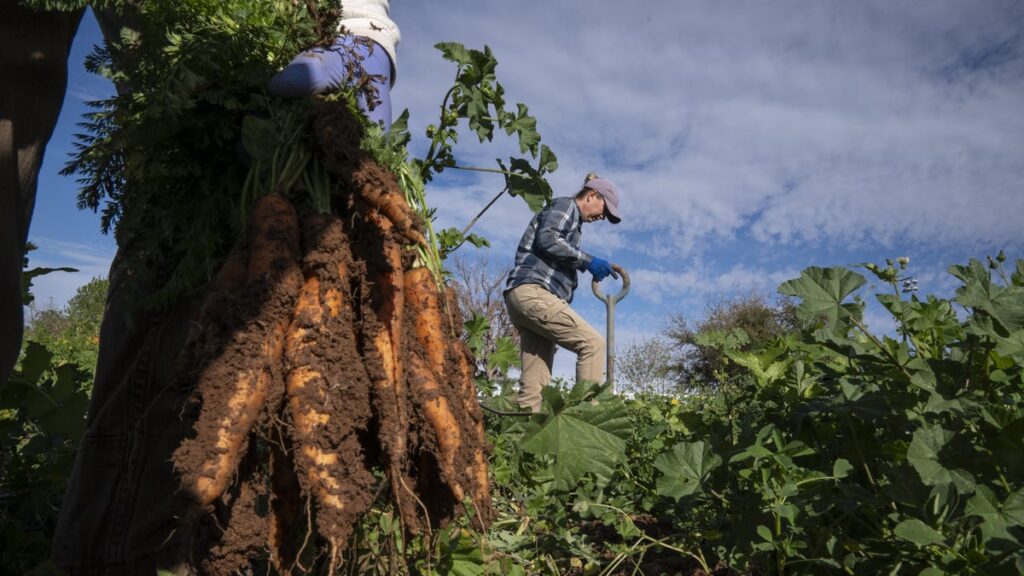
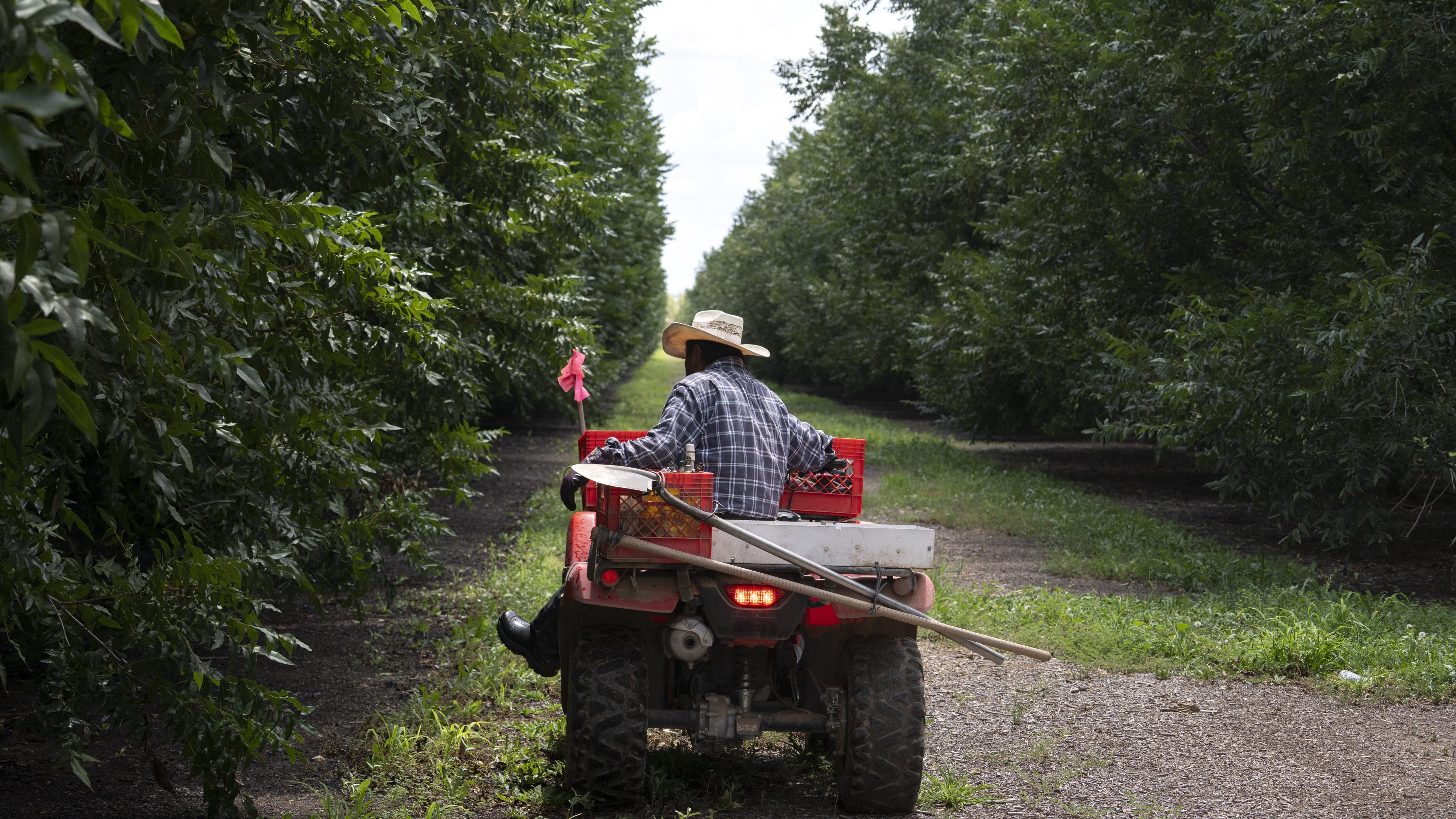

Pecan farm worker at Arizona’s San Simon Farm replaces irrigation heads
Adolfo Romero, a Farmers Investment Co. worker, checks and replaces broken irrigation heads in a pecan orchard on the FICO San Simon Farm in Arizona.
- The state agriculture department will award $1.8 million under a new program to help farmers conserve water by improving soil health.
- The money will fund projects that use specific methods or non-manufactured products to improve soil health and water efficiency.
- The state will monitor land where the improvements are made and compare it with land where no changes have occurred.
The Arizona Department of Agriculture has announced a $1.8 million pilot program to improve water efficiency in farmland by investing on soil health.
Farmland owners and leasers, and irrigation districts can apply for funding to pay for novel technologies and regenerative agriculture practices for a two-year period. They must collect data and show results on how those actions resulted in water savings.
The pilot program reflects a shift in U.S. agriculture.
Soil health is critical for life in general and has been studied for centuries, but ever since synthetic fertilizers were introduced, after World War II, it was mostly overlooked by industrialized agriculture, said Sheldon Jones, deputy director with the Arizona Department of Agriculture.
Some farmers embraced practices to ditch chemicals, promote no-till farming to reduce soil erosion, increase diversity, or maximize soil cover, but they were hardly on the mainstream.
“We were farming adding fertilizer to it, using the soil as a medium to grow, instead of as a living organism,” Jones added.
In the last decades there has been some course correction at the institutional level. The last farm bill included many provisions for soil health, and almost every department at the U.S. Department of Agriculture had some role in promoting it.
Sheldon, who helped launch the Soil Health Institute in June 2016, says it’s been “a sea change.”
The grant program will fund projects that use practices or non-manufactured products that improve soil health and water efficiency on agricultural land. It requires applicants to perform soil tests, measure before-and-after outcomes and asks if and how they would maintain these practices or technologies after the two-year project. The fund can pay for personnel time, travel, equipment, supplies and consultant work.
The agency expects to award several grants but has not yet established a money cap per applicant. The funding comes from $2 million the Arizona Legislature appropriated for the Agriculture and Water Innovation Fund earlier this year.
What makes healthy desert soil?
Soil is a natural mix of minerals, organic matter, air, water and billions of living organisms. Its health, like in humans, depends on a balance of things. The use of heavy machinery, chemicals and fertilizers, for example, can disrupt this balance, and make it harder for the soil to retain water, store carbon or maintain productivity.
While there is an abundance of soil health research, products and practices for wetter regions, there is still a lot of work missing to understand and promote soil health in arid lands.
Building soil health looks different across the country. In general, Arizona doesn’t have enough water (or precipitation) to grow crops in the offseason just to keep the soil covered, for example. The desert environment also makes it hard to maintain or increase organic matter in the soils, Jones said.
Soil salinity is often the number one issue in Arizona soils, and an obstacle in water conservation, as farmers need to apply “excess irrigation” to avoid their crops being damaged.
Some farmers have integrated minimal tilling to maintain soil structure and biology, or grow winter crops like barley, wheat or triticale to restore soil fertility, and there are ongoing efforts to understand desert soil health and support it with new practices and products like algae-based technologies, clay additives, or biochar.
Program will require monitoring to measure progress
It’s still unclear whether and how research experts would be part of these efforts.
Industry played a key role in getting lawmakers to fund the program, Jones said. The agency worked with the governor’s office and the Legislature to make sure the program was broadened to include a variety of technologies and practices.
To measure the impact of soil health improvements, farmers would need to monitor land where that improvement has been made, as well as land, with the same properties, farmed without it, suggested Debankur Sanyal, soil health specialist with the University of Arizona. They would also need to set criteria on what to measure and how often, using sensors for soil moisture or metering water use.
“If you say you improved water retention or water storage, what would be the parameters?” Sanyal asked.
He is excited about the opportunity that the new funding could bring. He works with dozens of farmers and ranchers across the state, taking soil samples, setting experiments and doing outreach.
“There are a lot of companies and products. Maybe growers can collaborate with these companies and may not need a university collaboration but I don’t know how they would monitor,” he said. “There might be a bias.”
The agency will hold two virtual workshops for interested applicants on Oct. 28 and 31.
Clara Migoya covers agriculture and water issues. Reach the reporter at clara.migoya@arizonarepublic.com.