
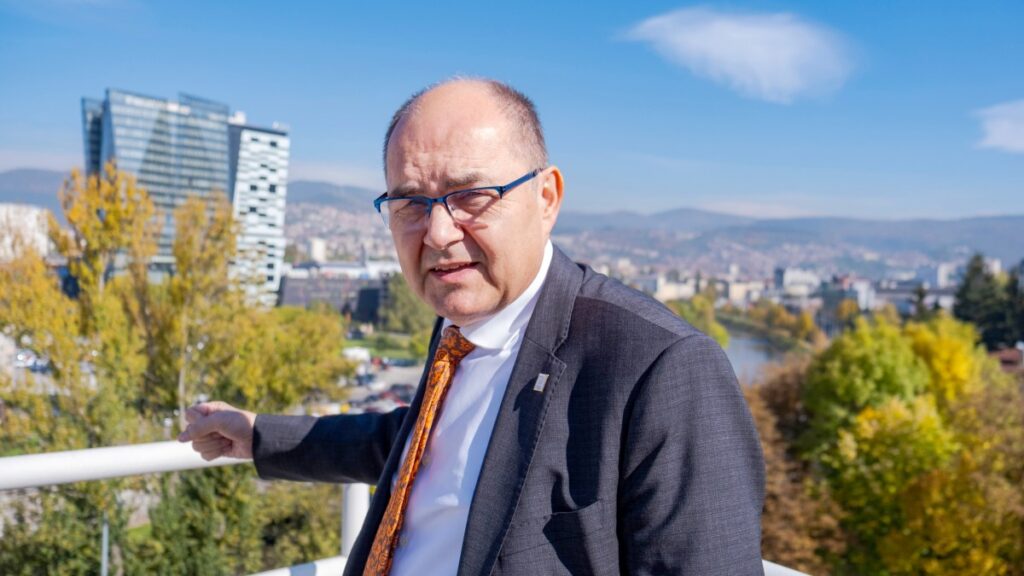
No one in global politics has a job quite like Christian Schmidt’s.
Sitting in his nondescript grey office block in Sarajevo, wearing an orange paisley tie, he recalled a recent conversation with a friend who is foreign minister of a European Union member state. “He said, ‘Look, I have now watched all eight tomes of Tom Cruise’s Mission: Impossible. I declare you the hero of tome nine. This is Mission: Impossible.’”
A decade ago Schmidt, 68, a mild-mannered baker’s son known for occasional outbursts of passion, was minister for agriculture under Angela Merkel. He left her government after a row over pesticide, in which, having been dressed down by the chancellor for breaking voting rules, he told TV cameras: “That’s just how Schmidt is.”
Now he lives with his wife, Ria, in the capital of Bosnia with one mission: to keep one of Europe’s most fragile and wounded states together as it is buffeted by sectarian separatist winds from Moscow.
Schmidt is the high representative to Bosnia and Herzegovina, in charge of maintaining the country’s peace deal, forged around a negotiating table in a US base in Ohio, 30 years ago.
In the 1990s, a Serb campaign of ethnic cleansing ripped Bosnia apart. At least 100,000 died in a war in which militia rounded tens of thousands into camps, dumped bodies in mass graves and murdered 8,000 men and boys in a massacre at the salt mining town of Srebrenica, which The Hague found to be an act of genocide.
The Bosnian Serb leader, Radovan Karadzic, known as “the Butcher of Bosnia”, was among several convicted of war crimes, and is serving life imprisonment at a jail on the Isle of Wight.
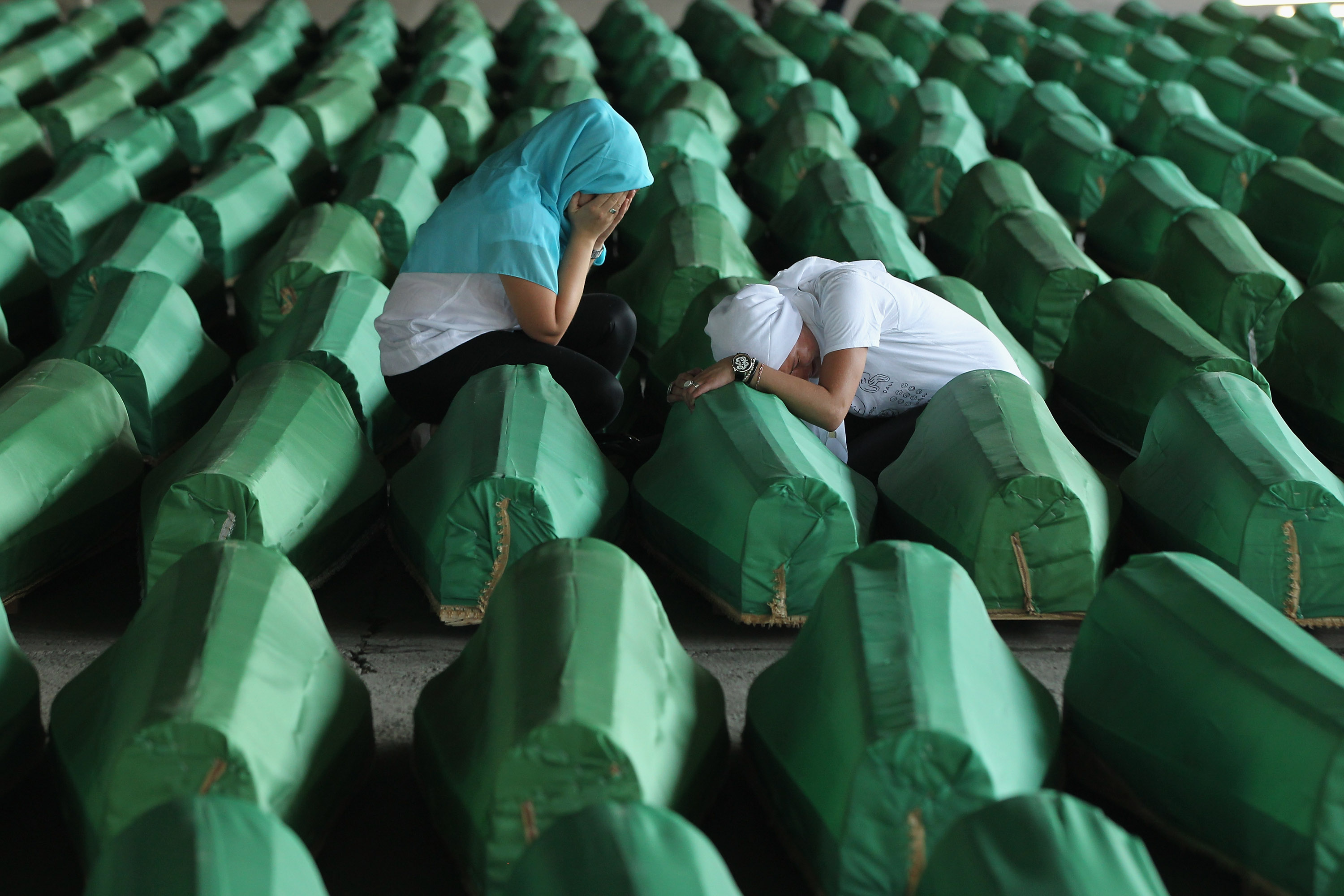
Two Muslim women by the coffins of victims of the 1995 Srebrenica massacre in Potocari, Bosnia and Herzegovina
SEAN GALLUP/GETTY IMAGES
The peace deal that ended the war, the Dayton accords, created Bosnia and Herzegovina, a country split between an ethnic Serb half, called Republika Srpska, and a mostly Bosniak (Muslim) and Croat half, the Federation. For a population of three million, Bosnia has three presidents, 14 governments, and more than 180 ministers.
“This needs nearly every year a Nobel prize winner to manage [it],” said Schmidt. As high representative, Schmidt wields powers that his predecessor, Paddy Ashdown, the late former leader of the Liberal Democrats, called “terrifying”.
Supported by a peacekeeping force of about 1,500 European troops, Schmidt can annul Bosnian laws, change the number of MPs and have elected officials stripped from office. All of which he has done since being installed by the world’s states and multilateral bodies in 2021. “My mandate is to defend Dayton and to take this very, very seriously,” he said.
His job may be harder than ever before. President Putin has seized on a resurgent Serb nationalism in Bosnia, his latest opportunity to pick at the West. The Russian leader has leant his support to Milorad Dodik, a populist who was once a friend of Nato and the EU but now leads a movement to create a breakaway Serb state, and has denied the Srebrenica genocide.

Dodik after a court sentenced him to one year in prison and banned him from engaging in politics for six years
RADIVOJE PAVICIC/AP
The two have met several times in Moscow this year, with Russia consistently voting in Dodik’s favour at the UN security council as he pushed to undermine the Bosnian constitution.
• Leader of Serbian enclave sentenced for separatist laws
Last month Dodik, 66, finally stepped down as president of Republika Srpska, after months of refusing to obey a conviction by a Sarajevo court for defying Schmidt’s rulings. He is banned from public office for six years, and the presidency forever, though no one believes he will disappear as a political force.
Despite his apparent success in bringing Dodik down, Schmidt refuses to sound triumphant. “In the Balkans, a crisis is never over,” he said.
Dodik has named a protégée, Ana Trisic Babic, as his interim successor, before elections on November 23. He still vows to hold a referendum within Republika Srpska on whether he should accept Schmidt’s authority, an old trick in the Balkans to garner support for further actions.
In what is being seen as a bargaining chip in exchange for Dodik’s departure, President Trump’s government has lifted sanctions on four of his allies, though Dodik himself remains under US sanctions for undermining the terms of Dayton.
Schmidt’s critics argue his hard line on Dodik has put the country at risk of further division. Some Bosnians think Schmidt arrogant, though at least part of that is a picture painted by Dodik, who has mocked him variously as “primitive”, “a stinker” and a “German tourist”. Schmidt described Dodik as a “piece used” by Putin. “I could say a puppet,” he added.
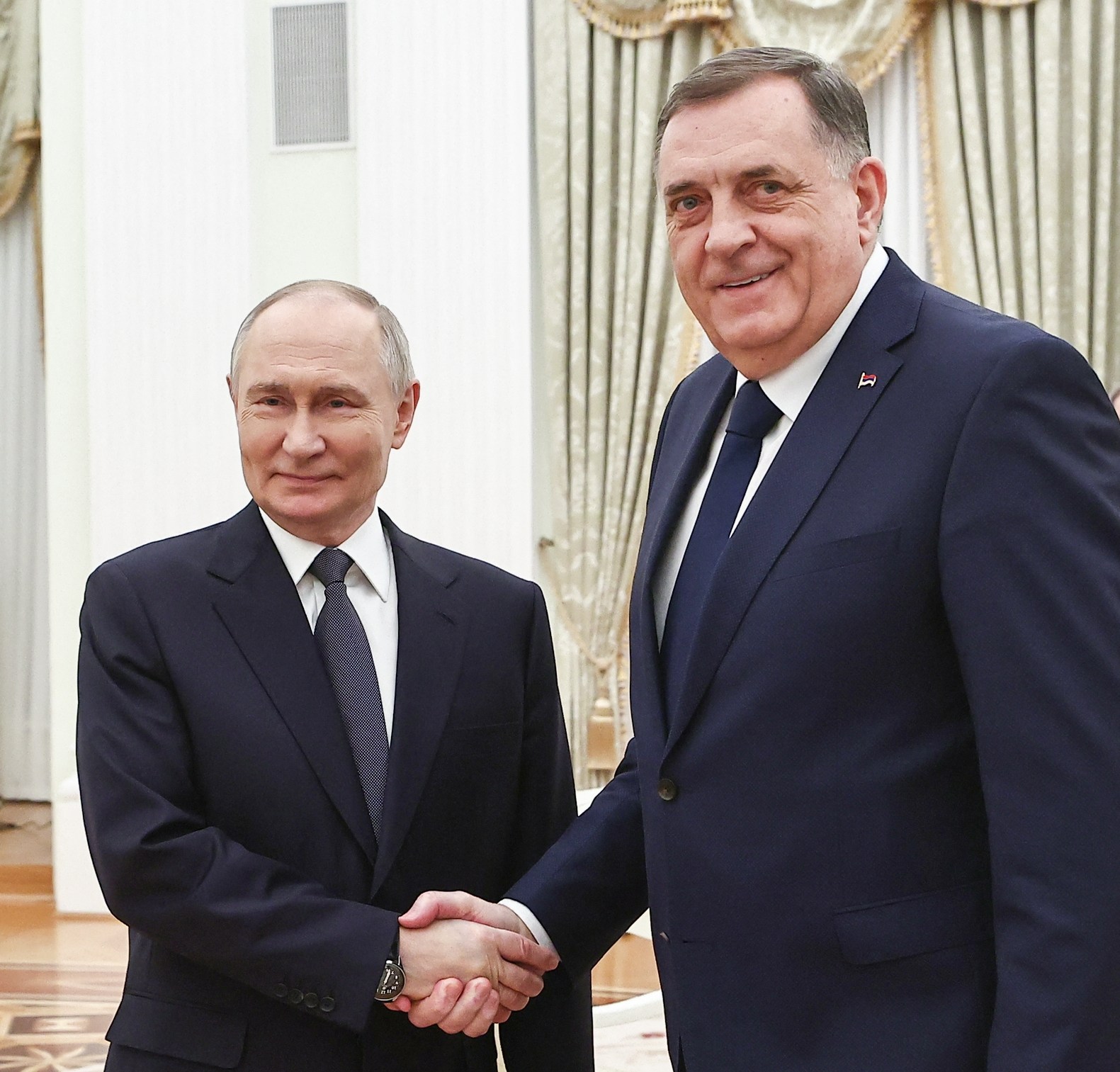
President Putin with Milorad Dodik at the Kremlin in April
MIKHAIL TERESHCHENKO/POOL/AFP/GETTY IMAGES
Nato statements in recent months have stressed the need to avert another war in Bosnia, which is not a Nato member. Next-door Croatia and Montenegro are, while Serbia, which backs Dodik’s separatist drive, is not.
“I do not see that people have an interest or see that there is a danger for war,” Schmidt said. “There is uncertainty … wars in the Balkans, unlike in other regions, do not develop because there is a great strategy.”
From the roof of his offices, he can see the hills around Sarajevo, now a riot of autumn colour. During the war, these hills were crawling with Serb soldiers, who besieged the city for three years as it floundered without water or electricity, living on aid packages.
He pointed down at a memorial of flowers on a nearby river bridge. “On April 6 [1992] it started here,” he said. Schmidt was then in Sarajevo as an observer of the Bosnian referendum that triggered the war.

A woman runs for cover in Sarajevo, in June 1992; below, the “Momo and Uzeir twin towers” burn in the city
SANTIAGO LYON/AP
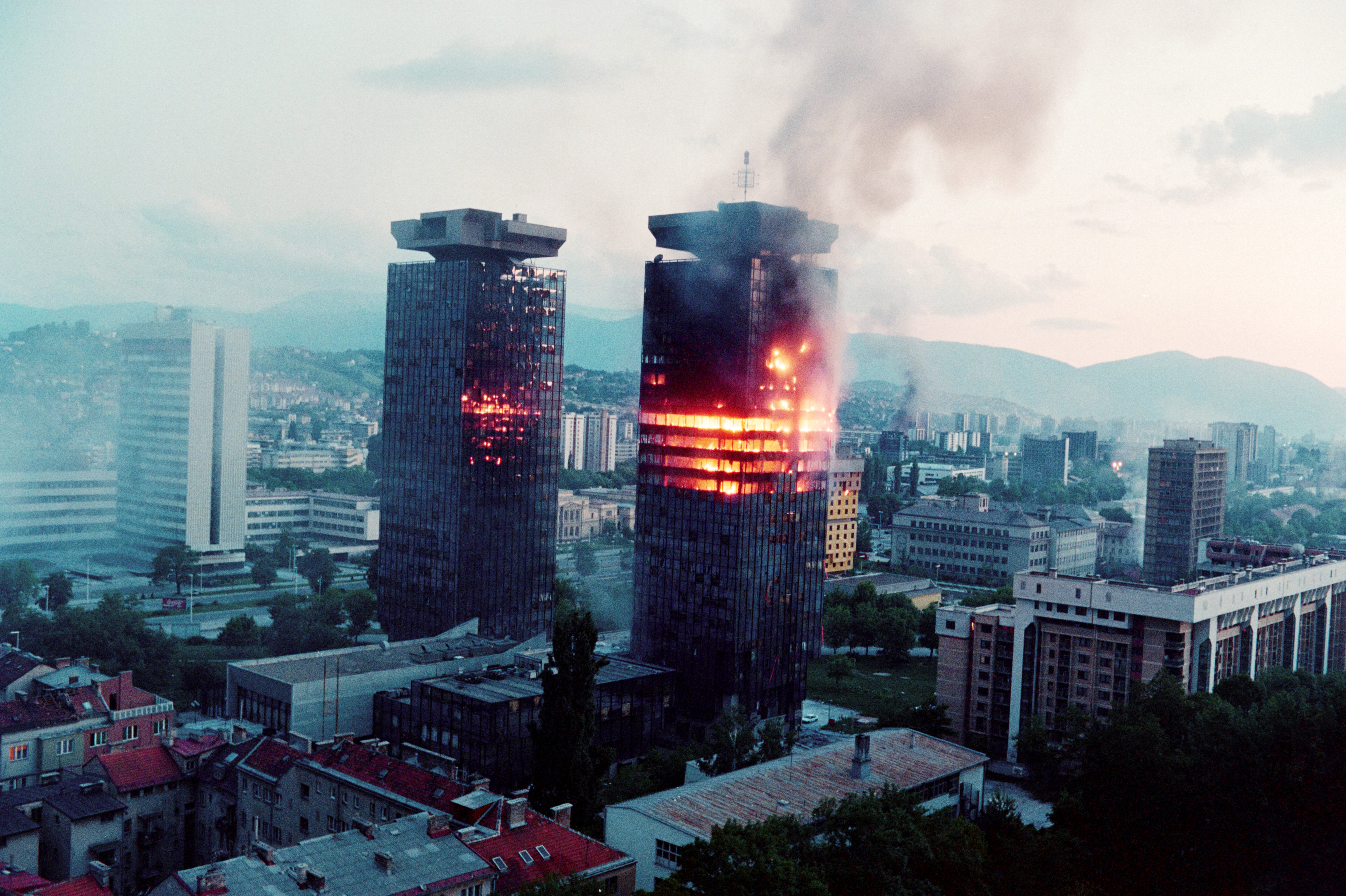
GEORGES GOBET/AFP/GETTY IMAGES
He pointed towards a yellow building. “This was the famous Holiday Inn,” he said. “In the upper floors, Karadzic had his representation. We were in the lower floors.” The world’s press and diplomats watched until the Americans bombed the Serbs out of the hills and on to the Dayton negotiating table.
Unlike his predecessors, Schmidt and his wife are frequently seen at galas and arts festivals, however small. His press officer showed a picture of him shaking a bride’s hand in a restaurant, which went viral in Bosnia. “I’m going into a restaurant and every child in Bosnia knows me, people are coming and say, first, maybe, ‘Thank you for what you are doing for us.’ Second, ‘Could we have a selfie with you?’,” Schmidt said.
“Maybe he sees himself as a pop star, I don’t know,” said Nedzma Dzananovic, a professor of politics at the University of Sarajevo. “He’s not necessarily a typical German that we expected. He’s much more emotional.”
Dzananovic said apart from disagreeing with Schmidt’s changes to electoral law in 2022, she admired Schmidt’s commitment to honouring Dayton. “There is still a lot of trauma, a lot of fear sometimes, and that makes people see these years of peace as something really precious. The peace settlement did not settle things in an optimal way for anyone, really. But that’s what makes it so durable.
“Ideally wars end with bad guys losing, and good guys winning. Here, a convincing defeat of either side would hardly save Bosnia as a country,” she added. “That’s what the value of the compromise was … I think that Americans at the time understood it, understood the nature of Bosnia much better, perhaps, than even the negotiators themselves.”
While some politicians, such as Dodik, continue to deny the Srebrenica genocide, young people are more focused on corruption and the economy than ethnic rivalries, with many migrating. Civil servants have friends across ethnicities, while private sector companies hire people who once pointed guns at each other. Many observers say it is the political class of Dodik and his opponents that poisons Bosnians’ thinking.
Putin does not have designs on Bosnia, Schmidt said. “I think this is more making noise … to deviate … especially about Ukraine.” But he is not complacent: “Be careful. If we see that some sleepers are coming in, maybe with consent from the Russian side … You need not that much to create a mess in the Balkans.”
The Dayton accords and position of high representative have no time limit, with the agreement stating that Bosnia must fulfil conditions in areas like the rule of law and fiscal sustainability, under a promise since the war to join the EU. Critics say the system stifles the economy and encourages corruption. But it has, so far, kept the peace.
When Schmidt took the job, he wanted to be the last high representative to take the job. He was recently told he was the fifth in post to have that ambition. “I am a little bit more reserved than I have been half a year ago to say [that]. But seriously, I think this is time to find a way out.”