

During the Asian and European sessions on Monday (October 27), the euro-dollar exchange rate fluctuated near parity, currently trading around 1.1632. The upward potential of the euro remains constrained by a strengthening US dollar and political instability in France; however, Germany’s IFO business survey showed a slight outperformance, briefly boosting the euro.
The euro-dollar exchange rate may continue to oscillate above 1.1600 in the short term, with markets focusing on guidance from the ECB interest rate decision and Eurozone economic data.

German IFO Data Boosts Euro
As a key leading indicator for the Eurozone economy, this data encompasses business sentiment across more than 7,000 enterprises in sectors such as manufacturing and construction. Market expectations were for the overall business climate index to edge up slightly from 87.7 in September to 87.8, but the actual figure came in slightly above expectations at 88.4.
 The data, consistent with forward-looking improvements, suggests the euro-dollar exchange rate may maintain range-bound fluctuations. With the unexpected rise of the business climate index above the 88 threshold, market expectations for stabilization in Germany’s economy will likely be reinforced, providing substantive support to the euro. Coupled with ECB Governing Council member Pablo Hernández de Cos’ statement over the weekend—expressing satisfaction with current interest rate levels and confirming that inflation targets have been met—the euro’s downside risks in the short term could significantly diminish.
Impact of French Political Turmoil on the Euro Eases
French political turmoil has emerged as a primary bearish catalyst: Socialist Party leader Olivier Faure threatened to submit a no-confidence motion, with his party’s swing votes potentially toppling the Le Cornec government. This political deadlock has led to a 1.5% decline in French corporate investment, posing spillover risks to the Eurozone economy.
Moody’s downgraded France’s outlook from stable to negative, while S&P maintained Belgium’s outlook as negative. Notably, the market had widely anticipated downgrades to A1 and AA- for the two countries respectively, but this did not occur, partially offsetting concerns about the euro.
The downgrade in outlook occurred against the political backdrop of the French government struggling to pass its budget proposal.
However, amid escalating concerns over political turmoil in France, the euro remains weak against the dollar. Socialist Party leader Olivier Faure has threatened to submit a motion of no confidence, and his party’s pivotal swing votes could lead to the collapse of the Le Cornu government. This political deadlock has caused a 1.5% decline in French corporate investment and poses spillover risks to the Eurozone economy.
Key Outlook on Policy and Data
The market consensus expects the European Central Bank (ECB) to maintain the current interest rate level at its monetary policy meeting on Thursday.
Meanwhile, signals from a slowdown in the labor market and weaker-than-expected CPI inflation data suggest that the Federal Reserve is likely to initiate an interest rate cut.
Later this week, the Eurozone will release preliminary Q3 GDP data and core inflation figures for October.
These data points will provide crucial support for a deeper analysis of the economic outlook in the region.
Both policy developments and key data releases warrant close attention: markets widely anticipate that the ECB will keep rates unchanged on Thursday, while expectations of diverging policies—such as a potential Fed rate cut due to a slowing labor market—could reshape exchange rate dynamics. The Eurozone’s Q3 GDP and October inflation data, set for release this week, will offer critical guidance for the ECB’s policy trajectory.
Technical Analysis:
As shown on the daily chart, the EUR/USD exchange rate has remained above the 1.1600 bullish-bearish dividing line for four consecutive days, while also staying above the upward trendline. The euro is expected to maintain range-bound fluctuations above 1.1600 in the near term. Bullish traders may wait for short-term moving averages to converge and turn upward before considering further upside moves.
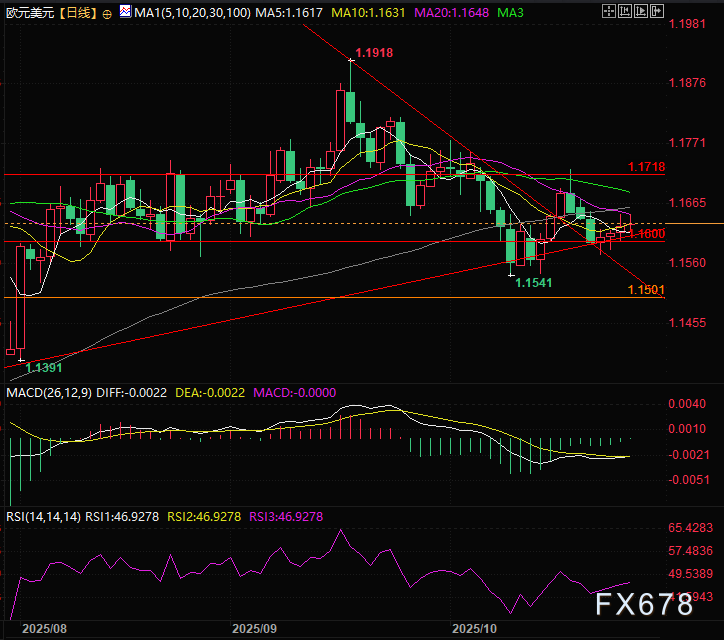
(Euro to US Dollar daily chart, Source: Easy Forex)
At 17:35 Beijing time, the euro is trading at 1.1633/34 against the US dollar.