
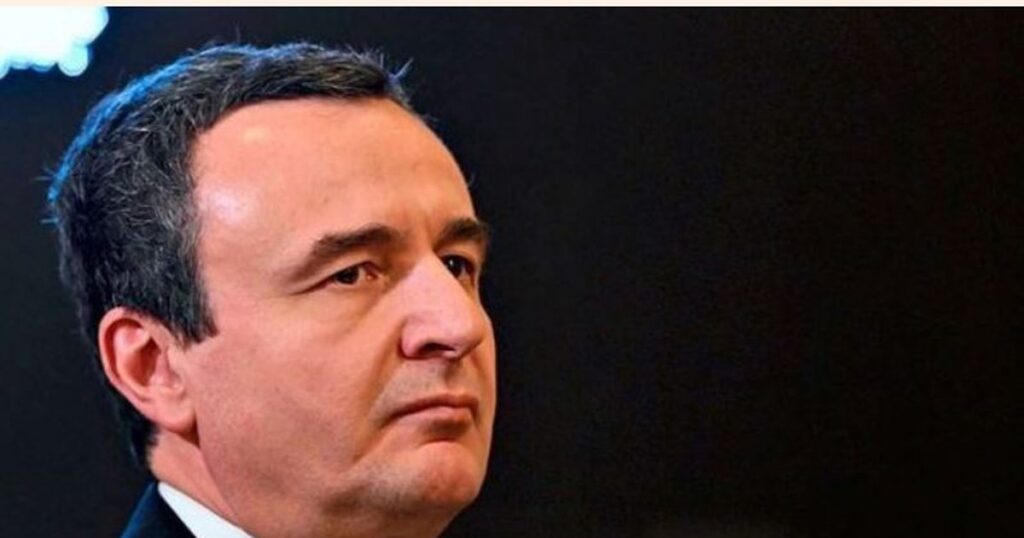
The failure to form a new government has increased the risk that Kosovo will enter 2026 without a budget.
For financial expert Haki Shatri, the state risks going bankrupt, as it may not have money for salaries, pensions, or child benefits at the beginning of next year.
In an interview with Radio Free Europe, Shatri says that only a government with full powers can take initiatives to amend the budget law, or to continue budget allocations for the first months of 2026.
“If no solution is found to operationalize one-twelfth of the budget in January, even if there is an earthquake, no one dares to undertake anything,” he says.
The former Minister of Economy and Finance says that without a new government, in January there will be no money for the army or the police.
Radio Free Europe: Kosovo’s acting Prime Minister, Albin Kurti, did not secure the necessary votes to form a new government. October 30 is the deadline for the government to approve the budget, while the Assembly must vote on it by December 31. What economic consequences could there be if this process is not completed within the deadline?
Haki Shatri: The regular deadlines for budget approval procedures in the Assembly are these. If we do not have a fully-fledged government with a full mandate, which can process a document of a legal nature, such as the budget, then there is no one to send the draft budget law to the Assembly, even if it was prepared by civil staff within the Ministry of Finance, or by the bodies competent for its preparation.
In this situation, there is no one to propose an amendment to the current budget law. A possible option is one-twelfth of this year’s budget, for the months of January and February of next year. Procedurally, it is a proposal to amend this year’s budget law, so it follows the same procedure as the adoption of the budget law itself. If there is no new government from January 1, there will be no one to propose this continuation of budgetary expenditures and public money.
Only a government with a full mandate “can amend the budget law”
Radio Free Europe: In the current situation, does the incumbent government have the legal right to propose continuing spending for the first two months of next year?
Haki Shatri: The budget law states that [all budget allocations for the fiscal year 2025 expire] on December 31, 2025. The plenipotentiary government issues a decision to change the date of December 31, and a decision is made that the 2025 budget law continues to be implemented in January and February of 2026, which falls under the amendment of the law, meaning the same procedure as the approval of the law. The [acting] government [of Kosovo] does not have this right. I am already speaking outside the professional responsibility that I have, only if the deputies close their eyes because their salary or some personal interests are violated, and say “come on, even though it is not in accordance with the law, we are swallowing this variant”. But, this is illegal. I say this with full responsibility: it is illegal.
Radio Free Europe: Why do you think it is illegal?
Haki Shatri: Because this government has no authority to propose a law or change a law. It only has authority to implement the laws that are in force.
Radio Free Europe: Until when do we have a budget, in the situation we are in, with the Government in office?
Haki Shatri: In the situation we are in, the budget is approved until December 31. It is implemented, salaries, pensions are processed, all payments that are not foreseen by the budget law continue normally, both with and without the government. Because there is no need for the minister to deal with that work anymore. The Treasury is taken over, the Budget Directorate is taken over, and it is only implemented. From December 31, this law is repealed. To make this law fully effective after January 1, the law must be amended. The amendment is formal, it is changed with two sentences, but it is a legal procedure. A decision by the Government to continue this budget for the next year is not in accordance with the law, because the incumbent Government has no competence.
Only a fully-fledged government can propose to the Assembly that the budget be extended for another month, as needed, as has happened in the past.
Radio Free Europe: But Kosovo already has a constituted Assembly. Is there any mechanism within this body that would allow the budget to be extended for another two months?
Haki Shatri: As far as I know, the laws that are in force foresee the possibility of continuation, when there is a full-fledged government. So, for [the executive] to propose it to the Assembly, and then the Assembly to make a decision.
Radio Free Europe: Kosovo is facing the possibility of holding early elections, which themselves have deadlines. How much is this situation expected to affect the country’s financial stability, and the budget planning process for 2026?
Haki Shatri: People who are leaders of the country, I am talking about all parties, must think ahead, manage time and circumstances. It was not necessary to waste a year, for the end of the year to come and there would be no consolidated institutions. Naturally, now we have problems of this nature, with the budget.
Within this year, we may have extraordinary elections, but there will be no new government. I do not know whether the Assembly has the right to give the Government a mandate, with a special decision, to make a decision on the budget.
From January 1st “there will be no salaries, no pensions”
Radio Free Europe: But, in your opinion, what is the solution, since you led the Ministry of Finance in the Government of Kosovo for a term?
Haki Shatri: According to the experience I have had in the Assembly, the Assembly can go a little “into the red”, if the deputies agree with a majority of votes, to ask the Government to make a decision regarding the budget. Otherwise, there is no other way.
I’m simply saddened by how far things have come. To have a situation come to this, after 25 years of liberation, for the state to go bankrupt, for the state to close down, for it to not function.
If on January 1st we do not have a final decision to continue one-twelfth of this year’s budget, there will be no salaries, pensions, child allowances, there will be no more money for any kind of expense, not even enough fuel to put the key in a [government] car to start it.
Radio Free Europe: What about emergency cases, is there legal scope?
Haki Shatri: If no solution is found to make one-twelfth of the budget operational in January, even if there is an earthquake, no one dares to undertake anything.
Radio Free Europe: Not even for the military or certain other important sectors?
Haki Shatri: Not for the army, not for the police, not for anything. The budget is a law that no one dares to violate.