
- In New Zealand, conservationists are looking at new ways to protect the country’s native bird species, some of which were believed to be extinct for decades
- As they attempt to eradicate invasive species that pose a threat to the flightless birds, they are turning to AI
- The goal is to have the country pest-free by 2050
New Zealand is turning to artificial intelligence to find new ways to protect incredibly rare species of birds that were once thought to be extinct.
The country’s bird population was decimated when settlers moved in hundreds of years ago, bringing invasive species such as stoats, a relative of ferrets, rats and similar mammals.
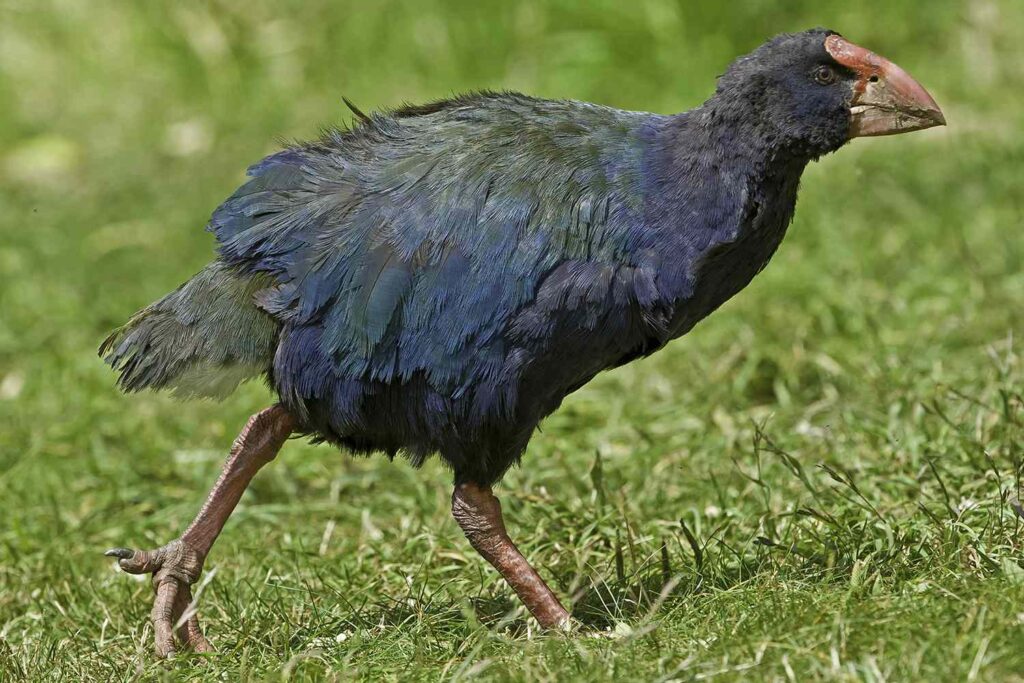
Flightless birds like the takahē, with their distinctive red beak and legs, and the kākāpō, a bright green parrot that weighs as much as 8 lbs., were not prepared to adapt to the creatures that came with the settlers.
A Kakapo parrot.
Lei Zhu/Getty
In 1898, the takahē was declared extinct, according to The Guardian. However, in 1948 scientists realized that a small population of the creatures still survived, leading to a conservation effort that’s ongoing decades later.
There are now more than 500 takahē living in New Zealand, according to NPR. Keeping the breed and other native species alive is challenging.
New Zealand is currently dedicated to eradicating invasive species that pose a threat to birds by 2050. In the meantime, they have developed ecosanctuaries, which NPR described as “the equivalent of a high-security facility for wildlife, complete with a Jurassic Park-style fence.”
Madison Kelly, who works at an ecosanctuary called Orokonui noted that the space is more than a “biodiversity project,” saying, “It’s also a community project — a place where some of our stories, our forests, our species, our taoka — our treasures, can be active.”
These sanctuaries are designed to keep invasive species out, but they aren’t foolproof and cannot be the only solution to the problem.
That’s where the goal of eradicating invasive species comes into play. However, doing so poses a challenge thanks to the sheer size of the country. Efforts to trap and humanely euthanize pests comes with expenses estimated at over $100 million annually.
According to NPR, scientists are looking for new, more affordable solutions. For some, that means the use of AI.
The outlet noted that new traps are equipped with sensors and mechanisms that allow them to reset and lay bait. Additional technology includes AI-assisted cameras, which help ensure that the trap is only targeting identified species.
“Machine learning and artificial intelligence can really help improve our work, save us a lot of time and money and actually make it so much more effective,” Jonah Kitto-Verhoef of the Halo Project, a group managing the traps, told NPR.
The conservationist reflected on the efforts, saying that he believed that “animals that have been here for millions of years, evolving in isolation, have an intrinsic right to life.” To preserve them, he believed it was fair to eliminate invasive species.
A takahē bird.
snoopaya/Getty
Never miss a story — sign up for PEOPLE’s free daily newsletter to stay up-to-date on the best of what PEOPLE has to offer, from celebrity news to compelling human interest stories.
Brent Beaven, a manager of the Predator Free 2050 program at New Zealand’s Department of Conservation, told NPR that the group might realize their 2050 goal is “unrealistic.” However, that doesn’t mean that they will be unsuccessful.
“We’ll still be in a position where we’ve created a whole lot of new tools and technology that’s going to allow us to better protect our native wildlife,” he said.
He continued, saying, “We should have thriving native wildlife in areas like we’ve never had before, so there is no loss to this.”
According to Beaven, the use of technology can be responsible for “completely step-changing the way we approach conservation in New Zealand.”
“We want to keep refining and developing new technology to drive that cost down, because trying to achieve eradication over 26 million hectares is going to be quite a pricey exercise,” he shared.