
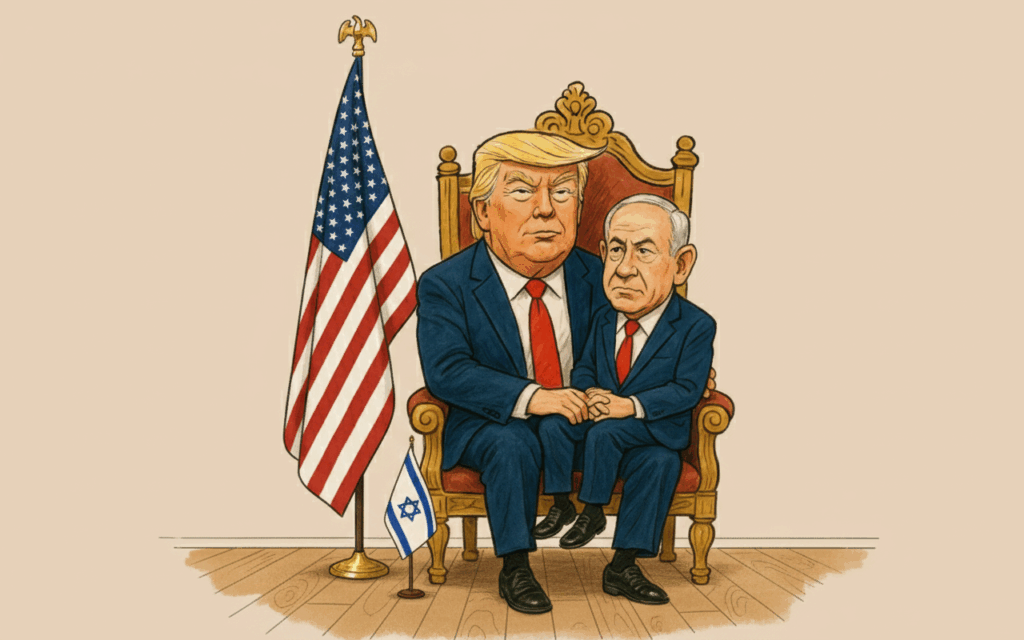
The question of whether Israel has become a client state of the United States is not just provocative—it’s politically radioactive. For many Israelis, especially on the right, even raising it sounds like an accusation of weakness. Vice President JD Vance and Secretary of State Marco Rubio have recently tried to neutralize that idea, insisting that the US–Israel relationship remains a partnership of equals. Yet their reassurances ring hollow in the shadow of President Donald Trump’s increasingly personal interventions in Israeli decision-making.
To be clear: Israel is no satellite state. It is a regional powerhouse with world-class intelligence services, cutting-edge military technology, and a strategic location that anchors American interests in the Middle East. Its influence in Washington — through AIPAC, bipartisan congressional support, and evangelical networks — far exceeds what might be expected of a country of ten million people. But influence does not equal autonomy, and partnership does not always preclude hierarchy.
The term client state may evoke Cold War imagery, but the core logic endures. When one nation depends heavily on another for military assistance, diplomatic cover, and access to strategic technologies, the power asymmetry becomes structural—whether either side wishes to admit it or not.
Under the 2016 US–Israel Memorandum of Understanding, Washington provides approximately $3.3 billion annually in Foreign Military Financing, plus around $500 million per year for missile-defense cooperation—a total of about $3.8 billion. These funds ensure Israel’s qualitative military edge, but they also tie much of Israel’s defense procurement to US supply chains and congressional approval. In wartime, the flow surges dramatically: independent estimates suggest US military support exceeded $17 billion in the twelve months following October 2023. Aid of this magnitude is not mere friendship—it is leverage.
Trump has wielded that leverage in ways both transactional and theatrical. From moving the US embassy to Jerusalem to recognizing Israeli sovereignty over the Golan Heights, he has claimed personal ownership of decisions that most Israelis viewed as sovereign achievements. More recently, he boasted that he personally “stopped Netanyahu” from continuing the Gaza war—portraying himself as the decisive actor compelling Israel to stand down. That language is not the rhetoric of a partner; it is the language of a patron.
This personalization of power distorts the traditional alliance model. It transforms strategy into performance, turning foreign policy into a stage for loyalty and obedience. Trump’s reported willingness to empower Qatar and Turkey in Gaza’s post-war reconstruction—despite their adversarial posture toward Israel—only underscores how Israeli priorities can be subordinated to his broader geopolitical choreography.
Vance and Rubio’s desire to reframe the relationship as an equal partnership is understandable. They seek to preserve the dignity of both nations and maintain bipartisan support. But Trump’s own words often undercut that narrative. When the patron assigns roles, dictates timelines, and publicly claims credit for outcomes, the subordinate’s autonomy becomes visibly constrained.
Still, Israel is no passive actor. Its leaders have long mastered the art of navigating American politics—securing bipartisan backing, leveraging Congress to offset White House pressure, and ensuring continued access to US technologies that sustain deterrence. Israeli intelligence and innovation remain indispensable to US operations worldwide. In many respects, Israel punches far above its weight not despite the asymmetric relationship, but because of its ability to work within it.
Yet the dependency has limits. Israel’s air force, for all its sophistication, still lacks independent access to certain US strategic weapons—particularly the Massive Ordnance Penetrator and similar deep-earth munitions needed to neutralize fortified Iranian nuclear sites like Fordow. Analysts widely believe that any such operation would require American approval or participation. That dependency is not theoretical; it defines the operational boundaries of Israel’s most existential security challenge.
The real danger lies not in labels but in blurred lines of sovereignty. When loyalty is demanded rather than earned, when symbolic gestures eclipse substantive dialogue, both nations risk losing sight of their shared interests. Israel’s security and America’s credibility depend on a relationship rooted in mutual respect and strategic clarity—not personal allegiance.
Ultimately, the question is not whether Israel is a client state, but whether it can remain a sovereign actor in an era where power is increasingly personalized. For Israel, safeguarding independence means preserving the ability to say “no” even to a friend. For the United States, genuine partnership requires restraint—the wisdom to empower rather than dominate. Only then can the US–Israel alliance transcend perception and truly live up to its promise.
Mr. Keenan is a retired Middle East Intelligence Analyst who served at NATO and the Pentagon. He lived and worked in the Middle East/North Africa for over 15 years. He is the author of ARABIA – Nine Years in the Kingdom.