
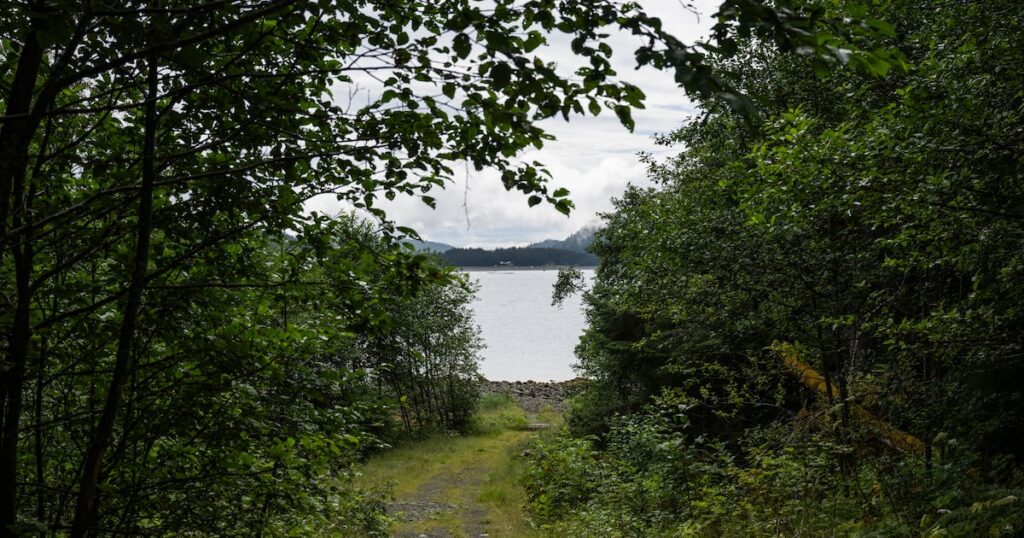
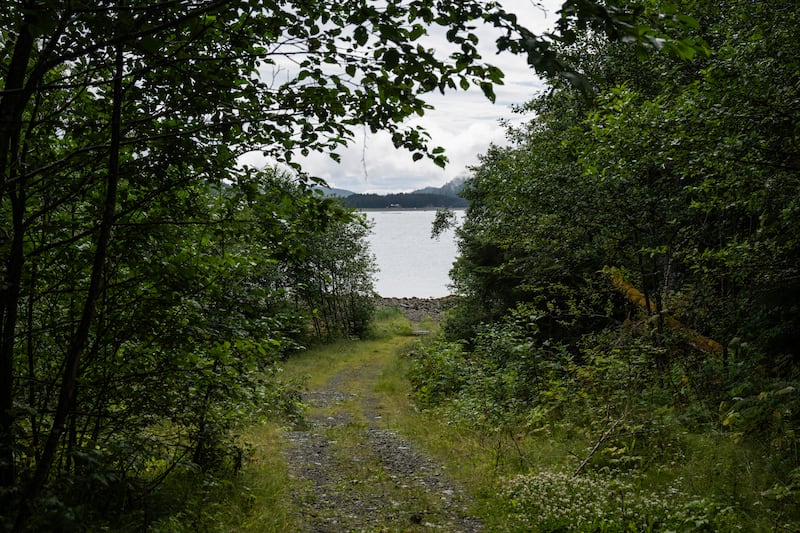
 A rocky path leads to the coast at Cascade Point, about 28 miles north of Juneau. Cascade Point is the location of a planned Alaska Marine Highway System ferry terminal project. An economic analysis commissioned by the Alaska Department of Transportation found the terminal could benefit a proposed mine in the area. Members of the marine highway oversight board said in October 2025 that the project was not aligned with the ferry system’s long-range plan. (Marc Lester / ADN)
Members of a board advising Alaska’s state-run ferry system said Friday that a report on the economic value of a new ferry terminal north of Juneau did not prove that the project was worthwhile.
The state Department of Transportation and Public Facilities earlier this month published a long-requested economic analysis of the Cascade Point ferry terminal, more than two months after it signed a $28 million contract to begin work on the project.
The economic impacts of the new ferry terminal “are contingent upon speculative, yet potentially significant, industrial development opportunities,” economist Ed King wrote in a report commissioned by the Department of Transportation, adding that Alaska Marine Highway System “operational savings alone do not justify the capital cost from a pure finance perspective” but “the value of broader public-sector benefits should be considered.”
Among the potential benefits of the new terminal listed in the report is its possible use by a Canadian company looking to build a new mine north of Juneau.
“The Cascade Point terminal could deliver significant logistical advantages for the mining sector by facilitating the movement of workers, supplies, and extracted materials,” the report states.
“Outside of mining, most other effects — including tourism, commuting, and general freight handling — are best described as redistributive rather than generative,” the report concludes.
The administration of Gov. Mike Dunleavy quietly added the Cascade Point project to the ferry system’s 20-year plan, paving the way for the state to complete the project using federal funding — at a projected cost of $100 million — without first consulting the Alaska Marine Highway Operations Board.
Alaska law states that the ferry system’s long-range plan must be prepared and revised “in consultation with the Alaska Marine Highway Operations Board.”
When asked why the transportation department did not advise the board of its plan to include the Cascade Point project in the long-range plan, spokesperson Shannon McCarthy said the board, which was created in statute during Dunleavy’s tenure as governor, “is not an oversight board, it is an advisory board.”
“While (the board) has the ability to advise AMHS on its capital program, it does not control the Alaska Marine Highway Capital Program,” McCarthy wrote.
Members of the board voted unanimously on Friday to send the Dunleavy administration and the Legislature a “corrective action report,” in which they seek to indicate that the new terminal deviated from the ferry system’s recently approved plan.
A draft of the long-range plan approved by the operations board earlier this year called for the “continuation of the Cascade Point feasibility study.” But a final version of the plan released without board review replaced that sentence, calling instead for the “continuation of the build out of the Cascade Point Ferry Terminal.”
Under Alaska law, if the Alaska Marine Highway Operations Board determines that the ferry system has “deviated” from the system’s long-range plan, “the board may prepare a report recommending corrective action” to the governor and the Legislature.
Bob Horchover, who was appointed to the oversight board by Dunleavy, said that the economic analysis of the project was “not really anchored in reality.”
“It read to me like a timeshare brochure,” he said.
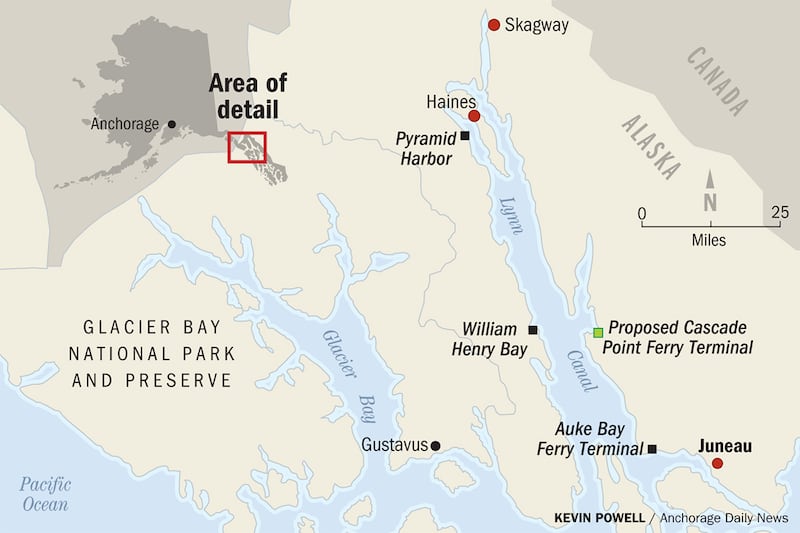
Norm Carson, another Dunleavy appointee, said he was disappointed the report did not give a detailed estimate for the cost of constructing and operating the new terminal, which is set to be located 28 miles north of the existing ferry terminal serving Juneau, on a stretch of road that lacks utilities like electricity and phone lines.
“It’s like me asking my wife for $5,000 to buy a new truck, and she gives it to me and I never tell her how much it’s going to cost,” Carson said. “We have to have a plan on what it’s going to cost and is it worth it to the state.”
An estimate shared by the Department of Transportation in May 2024 indicated the project could cost up to $100 million.
Paul Johnsen, another member of the board, said he thought the addition of the Cascade Point ferry terminal to the long-range plan was “politically motivated.”
Board Chair Wanetta Ayers said she thought the department’s economic analysis of the Cascade Point project was “put together in a very workmanlike way to try and, what I would say, build a case for Cascade Point, as opposed to evaluate options.”
The contract between the state and King, the economist who conducted the analysis, called for an “objective evaluation” of the project. The analysis was originally due to the state in February — more than seven months before it was eventually submitted. McCarthy did not immediately explain the reason for the delay in the report’s release.
King previously served as Dunleavy’s chief economist and has conducted economic analyses on other topics for the Dunleavy administration. He was paid at a rate of $250 per hour under the recent contract.
Deputy Transportation Commissioner Katherine Keith, who represents the department on the board, was absent from the Friday meeting. No other member of the department addressed the board’s concerns during the meeting.
The Cascade Point development is the latest in a series of initiatives by a succession of governors who have sought to extend a road from Juneau north up the Lynn Canal toward Haines and Skagway — two communities already connected by road to Canada.
The Cascade Point terminal, Dunleavy’s transportation officials have reasoned, could be combined with a new road along the Lynn Canal to vastly shorten the journey from Juneau to the mainland road system. But the road is still in its initial planning stages. A study of the proposal is expected to be completed in December.