
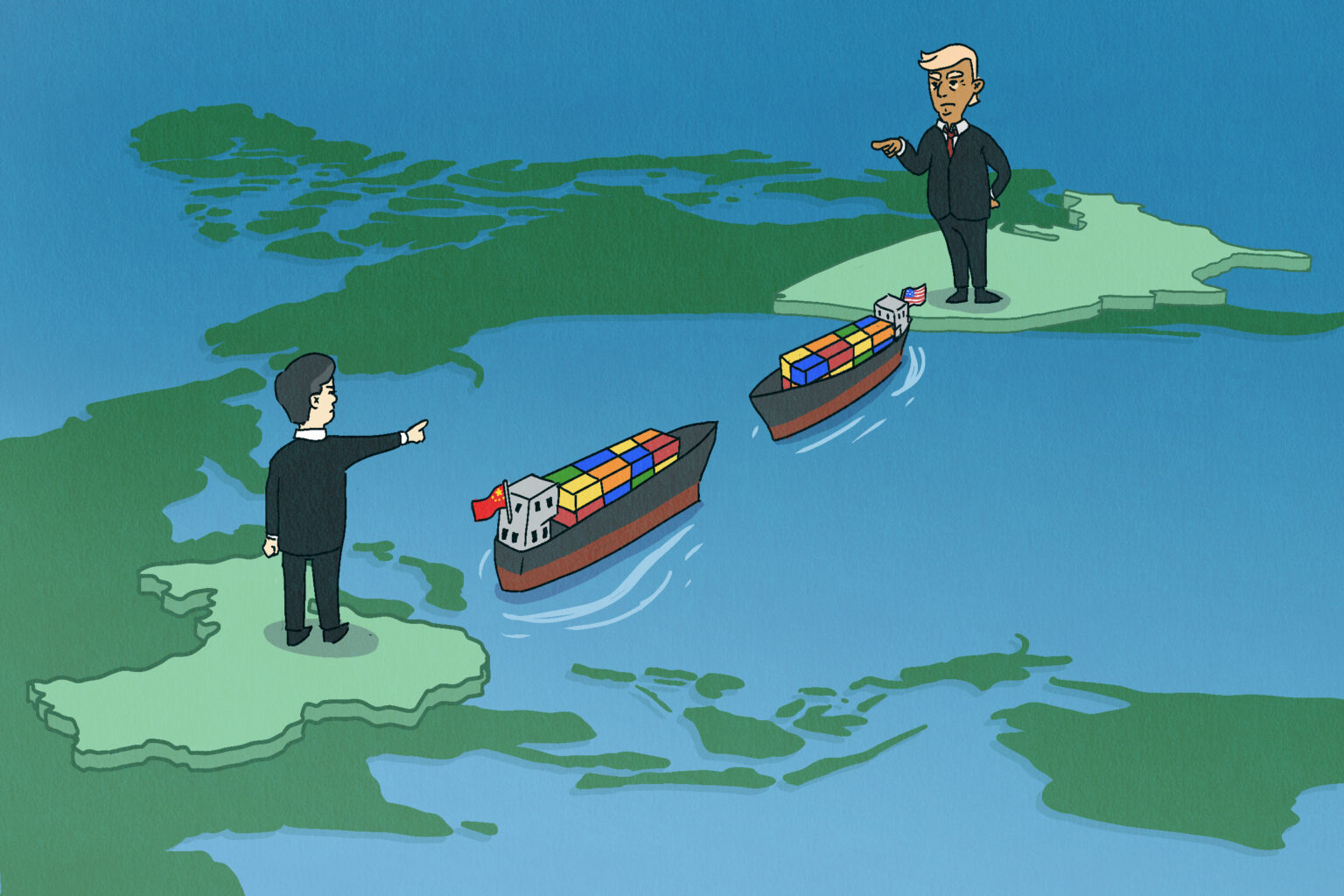
Since President Donald Trump took office in January, he has engaged the United States in a ramped-up exchange of economic restrictions, retaliations and countermeasures with China. Trump responded aggressively to China’s recent threat to impose far greater restrictions on its exports of rare earth minerals by suggesting he would increase tariffs on imported Chinese goods by 100%. China is set to impose export restrictions to battery manufacturing equipment Nov. 8 and their rare earths restrictions are planned to take effect Dec. 1.
By risking an all-out trade war with China, Trump’s all-or-nothing economic strategy spells doom for American businesses and consumers. Rather than pushing China away and inflaming tensions with more tariffs, he needs to continue negotiating with Chinese officials..
The strategic importance of rare earths and China’s dominance over their refinement and production exceeds the U.S. economy’s ability to weather export restrictions unscathed. China is responsible for 90% of global rare earth refinement and 61% of production. From 2020 to 2023, China accounted for 70% of U.S. imports of these critical minerals. For the United States, the procurement of Chinese-refined rare earth minerals is essential to a vast number of key technologies in medicine, defense, batteries and consumer electronics. The stability of our economy and national security are under threat without sufficient rare earth minerals.
By restricting the supply of these minerals, China can place our manufacturing industries in a stranglehold. In a recent report, Goldman Sachs estimated that a disruption of 10% in industries that rely on rare earths could directly result in $150 billion loss in U.S. economic output. The U.S. implementing 100% import tariff increases won’t make any difference in these industries’ attempts to procure rare earth minerals. Even Trump knows this. Meanwhile, the costs of supply chain shortages could be passed on to U.S. consumers in the form of price hikes. Phones, laptops, TVs, power tools and electric vehicles contain large quantities of rare earth minerals. Reduced supply of rare earths will result in greater manufacturing costs, leading to price increases for widely used consumer goods.
Without alternative sources for these minerals, the deck is so strongly stacked in China’s favor that increased retaliatory tariffs won’t motivate them to reopen exports. Trump’s plan to reduce the U.S.’s reliance on its rare earths by securing supply chains from other nations, such as Ukraine, Pakistan and Australia, is a good long-term approach. Australia is a particularly good target for such investments — it has a longstanding relationship with the United States, holds the fourth-largest supply of rare earths and has existing rare earth infrastructure, particularly in lithium, a key mineral in the production of batteries.
In the meantime, the best course of action for Trump is to favor negotiating with the Chinese over a reduction of American tariffs on China in return for a more mutually beneficial deal regarding rare earth minerals. For years, the United States has restricted the export of artificial intelligence chips to China to protect its advantage in hardware that supports AI infrastructure. Beyond a walk back of excessive tariffs, access to American chips is another source of leverage Trump could tap into to persuade China to scale back its restrictions on rare earth minerals.
China has spent decades building its dominance over the market for rare earth minerals. Reducing our reliance on Chinese rare earths will require many billions of dollars in investment in mining and refinement capabilities. If China’s lead is even surmountable, it will take decades to match China’s capacity for mining and refinement of rare earths. Not to mention, the refinement of rare earths is extremely energy-intensive and produces dangerous waste products such as heavy metals, radioactive elements and strong acids.
In the meantime, the United States cannot rely on tariffs to win its fight with China for global dominance. It requires long-term planning and the maintenance of a cordial relationship set on compromises, as it has for decades before Trump’s presidency. Thus far, Trump’s love of winning headlines and day-to-day triumphs has robbed him of the necessary foresight to win the U.S.’s contest with China.
Trump’s obsession with short-term gains radiates beyond the fight for rare earths. It is a hallmark of his foreign and economic policy, and in both cases, his lack of long-term planning results in an unsustainable degree of uncertainty. Trump puts tariffs in place, rescinds them, then puts them in place again. Amid all of this uncertainty, the price of gold reached an all-time high in October as central banks and investors flock to gold as a hedge against further turmoil. This isn’t a good sign, as it indicates declining trust in the U.S. dollar and our economy.
In the U.S. stock and cryptocurrency markets, a positive truth is all it takes to restabilize. Some of Trump’s truths border on deliberate market manipulation.
“THIS IS A GREAT TIME TO BUY,” Trump posted on Truth Social in April.
Just four hours later, he paused some of the harshest tariffs he’d imposed. The Dow Jones Industrial Average closed up by almost 3,000 points, after days of precipitous declines in response to the tariffs he’d imposed on almost every country on earth.
Following his Oct. 10 Truth Social post announcing the 100% increase in tariffs on China, the ensuing panic caused the Standard & Poor’s to drop 2.7% on its worst day in six months. Trump’s announcement also caused a dramatic crash in the crypto market. Shortly before, an anonymous trader placed a highly suspicious, massive short bet on Bitcoin, which resulted in profits of more than $160 million for the trader.
“It will all be fine,” Trump posted two days later to defuse American worries about his earlier threat of greatly increased tariffs on China.
The next day, markets reopened and rebounded by 1.6%.
Because his actions are so erratic, it is difficult to determine whether Trump is acting in the interests of the U.S. and its economy, or is only attempting to maintain the illusion of a healthy economy while enriching himself and his associates as much as possible from its highs and lows. His borderline corrupt ties with the crypto industry and billionaires such as Larry Ellison, Executive Chairman and Chief Technology Officer at Oracle Corporation, are a constant threat to his duty to the American people to uphold their interests. For our trade partners, this inconsistency makes it difficult to trust that the U.S. respects their interests in negotiations.
In conjunction, Trump’s consistent conciliatory rhetoric that attempts to restabilize markets and constant flip-flopping on tariff policy emphasize just how shaky and reactionary Trump’s economy really is. Thus far, the revenues extracted from his import tariffs are drastically outweighed by their cost to U.S. consumers, manufacturers and their broader impact on the U.S. economy in the long term.
The results of Trump’s general tariffs may be improved if they are targeted more toward goods critical to the U.S.’s long-term economic and industrial goals. Automotive CEOs such as Mary Barra and Elon Musk have voiced support for tariffs on Chinese automakers. This sector is critical as the U.S. intends to improve its capacity to compete with China in auto manufacturing. Chinese electric vehicle manufacturers produce EVs that are dramatically cheaper and more technologically advanced than any other EV currently offered in the United States. The European Union has allowed these EVs to be sold in Europe, and Chinese firms are already making significant inroads. High tariffs have protected U.S. manufacturers from a flood of cheap, superior Chinese EVs flooding our market, but increasingly cheaper EVs mean an EV that costs $10,000 in China would still be cheaper than the next-cheapest U.S.-made EV.
The problem with this tariff strategy is that it opens us up to greater retaliatory measures from China. As with rare earths, China boasts a dominant share of the world’s EV battery manufacturing, meaning American manufacturers rely heavily on Chinese manufacturers to produce essential components for their EVs. With tariffs on Chinese EVs, China may make it even harder for U.S. manufacturers to improve their EVs, which in the long term would increase China’s influence on the global auto market. The only way out is if Trump dramatically increases subsidies for EV adopters and manufacturers, which China used to great effect to establish its current position. By prioritizing innovation over protection, Trump may be able to set the U.S. auto industry on a course to compete with Chinese EVs.
Ultimately, Trump’s trade war is most painful for everyday consumers, who have already felt significant effects of the president’s inconsistent, shortsighted strategy. Trump has proven that tariffs and truths are an ineffective way to rebuild a struggling economy, and he must shift to an approach that values long-term improvements over short-term shocks to the system.
Opinion Columnist Max Schenke’s column “Transnational Times” typically focuses on international politics. He loves receiving criticism or otherwise at maxsch@umich.edu.
Related articles