
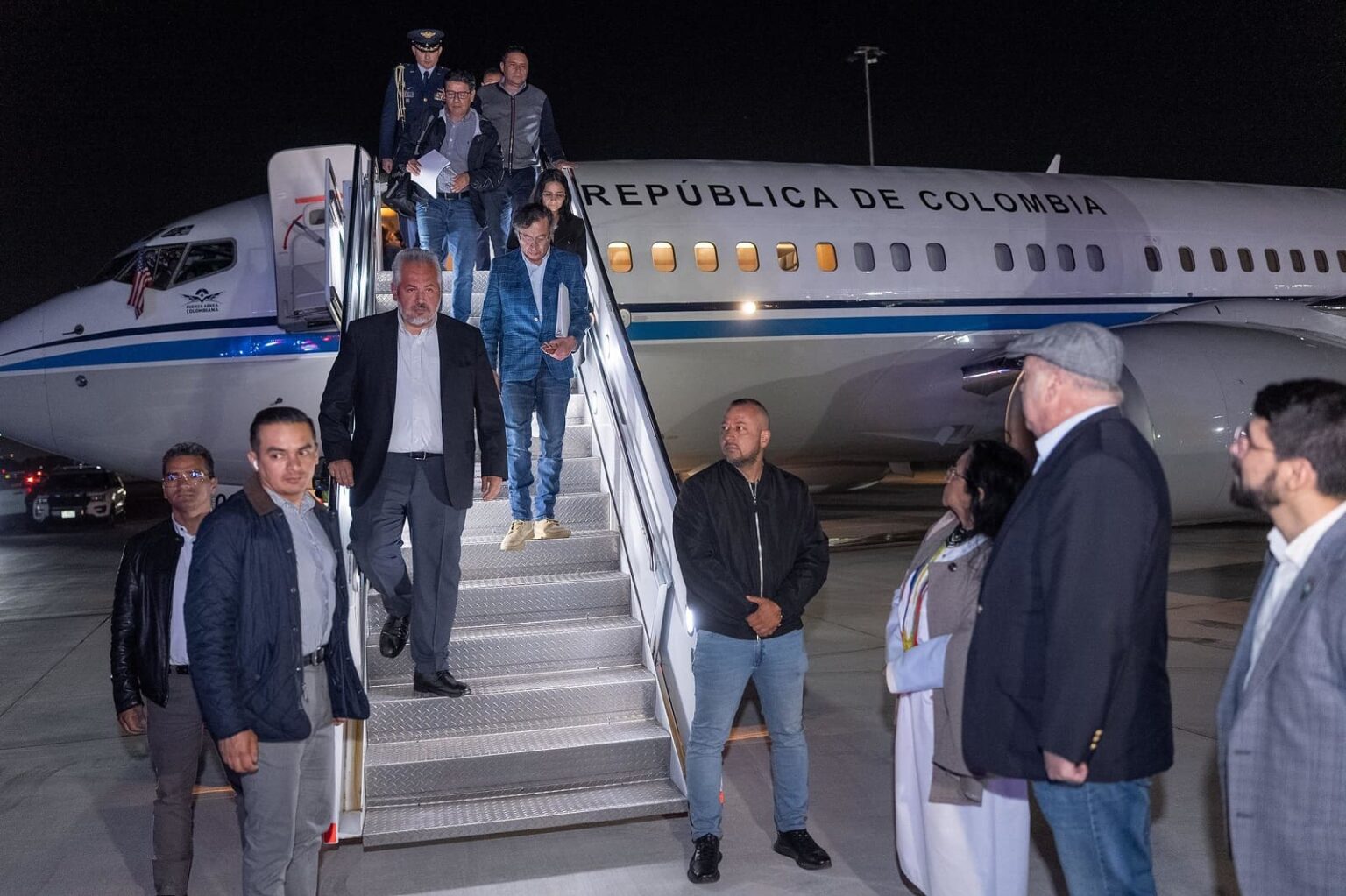
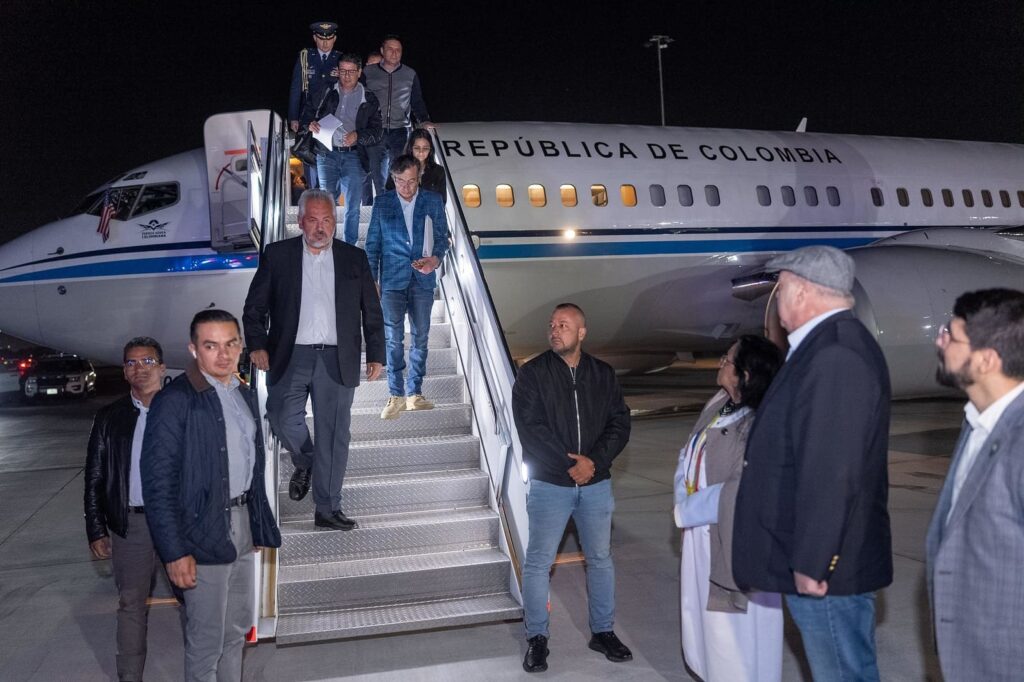
The Colombian president’s plane had trouble refueling in Madrid, Spain, following Gustavo Petro’s recent inclusion on the Clinton List. Credit: Juan Diego Cano / Presidency of Colombia. (File photo)
What was supposed to be a routine technical stopover for the plane carrying Colombian President Gustavo Petro this week turned into an unexpected incident that exposed the practical reach of international economic sanctions and control measures — such as the recent inclusion of the Colombian president and his family on the so-called Clinton List by decision of the United States President Donald Trump.
The aircraft of the Colombian Air Force, assigned to transport the president on his Middle East tour, landed at Madrid-Barajas Adolfo Suarez Airport in Spain for a technical stop. However, when refueling was attempted in order to continue the route, several fuel supply companies refused to provide it, claiming that — out of fear of violating the regulations of the U.S. Office of Foreign Assets Control (OFAC) — they could not operate with an aircraft linked to the president.
This episode highlights how sanctions designed to curb drug trafficking, money laundering, or other illicit ties can unexpectedly reach high-level diplomatic spheres. Although the plane does not belong directly to the head of state, his inclusion on the list triggered a domino effect that paralyzed a basic logistical service during an international flight, as Petro was en route to Saudi Arabia, the first stop of his Middle East tour.
Spain denies fuel to Colombian presidential jet after Petro’s inclusion on US Clinton List
The inclusion of Gustavo Petro on the Clinton List for alleged — but so far unproven — links to drug trafficking, is not merely a symbolic decision. The practical effects of this determination by U.S. President Donald Trump — who has experienced growing disagreements with his Colombian counterpart — had an immediate and direct impact that Petro himself suffered this week on his trip to Saudi Arabia.
During his journey to Saudi Arabia, Egypt, and Qatar — part of a diplomatic agenda seeking to expand Colombia’s geopolitical and economic horizons — Petro landed in Madrid, Spain, for a standard refueling procedure. At that point, the aircraft requested to fill its tanks, but the companies operating at Barajas Airport — according to sources, with U.S. capital or links — chose to refrain from supplying fuel out of simple caution not to violate OFAC sanctions.
After private companies refused, the Spanish government intervened, and the plane was transferred to a military base, from where it was finally able to refuel and continue its route. Although the incident did not cause a major delay in the schedule, it has been interpreted as an early sign that being on the Clinton List is not merely a symbolic stigma, but a real constraint on international operations.
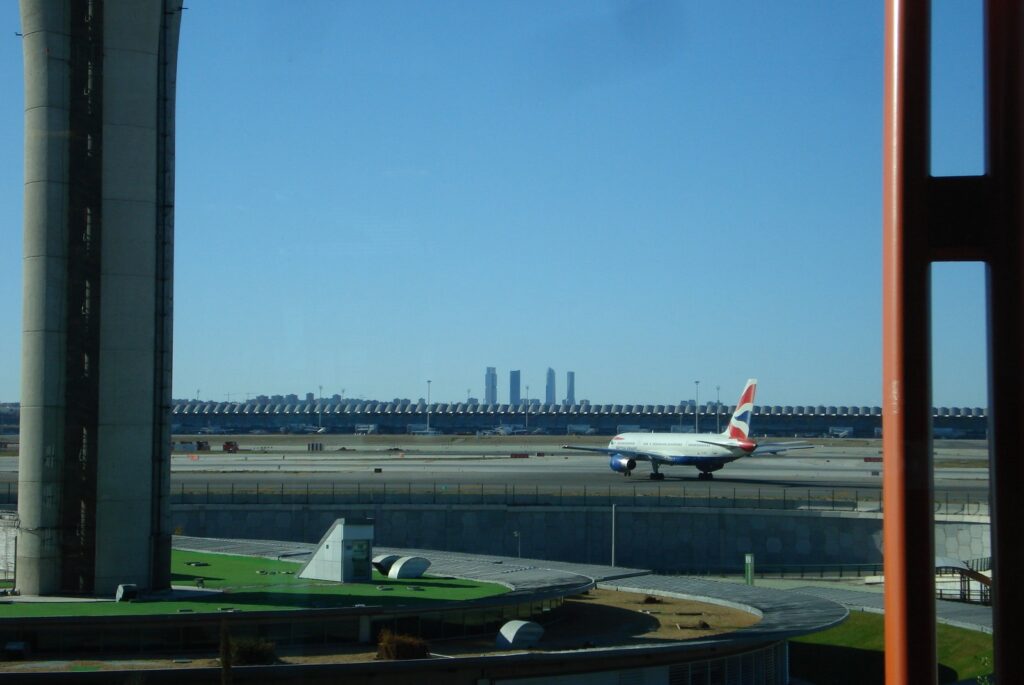
This week, Colombia’s presidential plane landed for a technical stopover in Madrid, Spain, on its way to Saudi Arabia, and encountered problems stemming from President Petro’s inclusion on the Clinton List. Credit: Vladimix, CC BY-SA 2.0 / Flickr.
What is the Clinton List, and why is its impact so far-reaching?
The Clinton List — formally known as the Specially Designated Nationals and Blocked Persons List (SDN) — is a mechanism managed by the Office of Foreign Assets Control (OFAC), an agency under the U.S. Department of the Treasury. Its original purpose was to combat drug trafficking, terrorism, money laundering, and other illicit activities.
Any person or organization included becomes subject to asset freezes, prohibitions on conducting financial transactions with U.S. entities, and is effectively boycotted by third parties who are urged to avoid dealings with them.
The domino effect is clear: Not only is the sanctioned individual directly affected, but also any company or person who engages with them, under the risk of penalties from the U.S. government. This leads many businesses to adopt ultra-cautious policies to avoid potential legal exposure.
What is evident is that, beyond its founding purpose of combating drug trafficking, Petro’s recent inclusion confirms what was already suspected: That the list has evolved into an instrument of diplomatic and political leverage.
The incident in Madrid has caused a strong impact within Colombia’s corridors of power. Inside the presidential palace, there is talk of “aftershocks” from the sanction already underway, and of the need to assess other vulnerabilities that might arise in international travel, contracts, or financial agreements.
Logistically, a key question arises: How prepared is the state to respond to unexpected blockages of basic services due to external regulatory reasons? In this case, it was fuel — but similar obstacles could emerge regarding aircraft maintenance, insurance, spare parts, or other auxiliary services whose providers have any exposure to the United States.
In diplomatic terms, the episode represents a moment of discomfort that goes beyond differences between the U.S. and Colombia — and in this case, had Spain as an involuntary protagonist. That a third country — in this case, the United States — can indirectly impose a restriction on an expression of national sovereignty, such as the international travel of a president, raises questions about state autonomy and chains of dependency within the international system.