
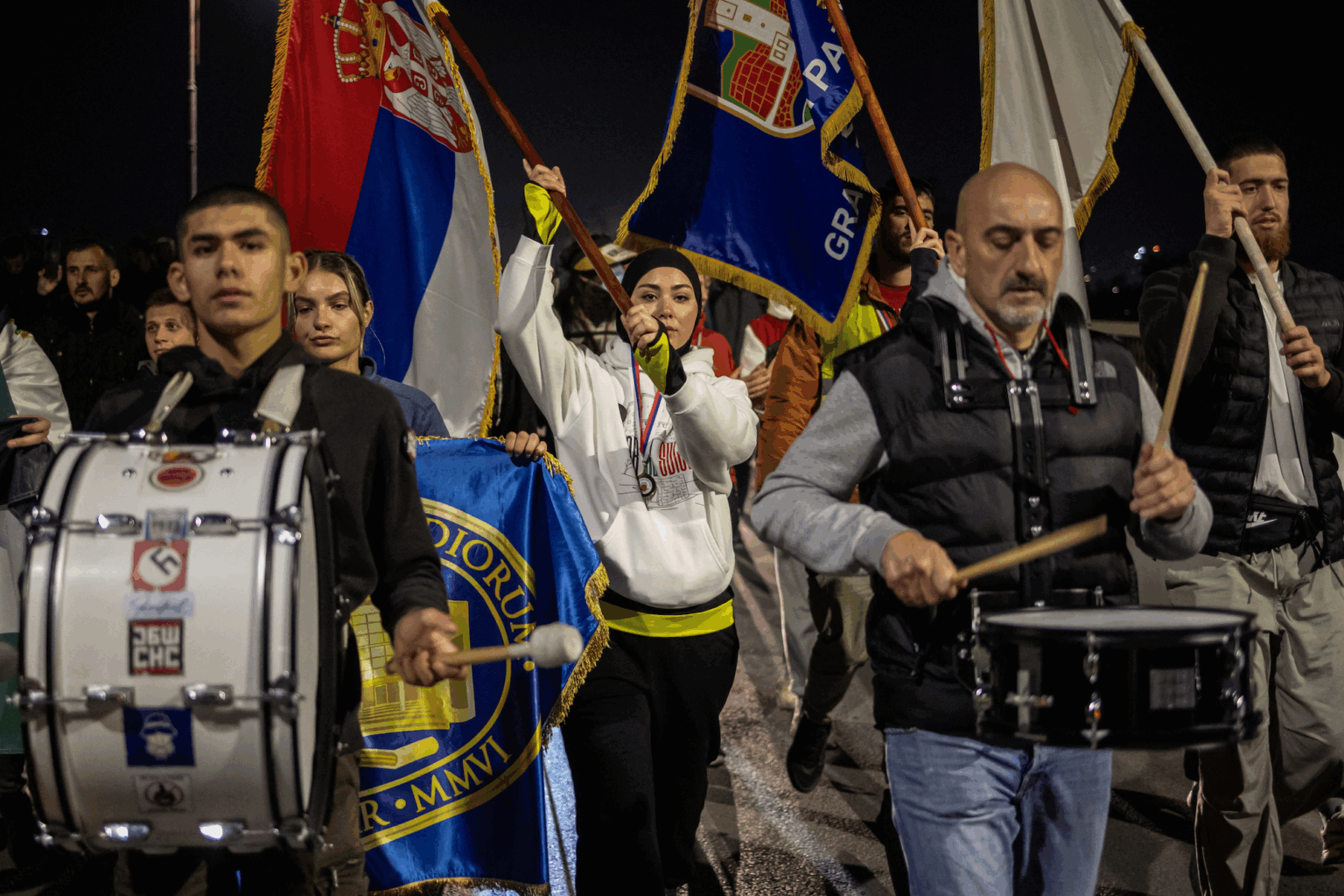
Belgrade buys into Russian intelligence claims that foreign powers are behind the yearlong student-led protests in Serbia.
The foreign conspiracy allegations by Russia’s Foreign Intelligence Service (SVR) echo many similar claims from Serbia’s President Aleksandar Vucic and other officials.
Serbia’s major pro-government media also latched on to the SVR’s 15 September statement with its allegations that the protests were “largely the product of subversive activities by the European Union and its member states” with an uprising planned for 1 November, the first anniversary of the Novi Sad railway station tragedy in which 16 people died in the collapse of a newly built station canopy. That sad event launched the protest movement, which lasts until today.
What was new this time was not the claims of a Western plot against Vucic’s regime, but their quick adoption by officials and much of the mainstream media.
For months, government officials in Serbia, led by Vucic, have claimed that student blockades and protests in the year following the train station disaster were part of an attempted “color revolution.” They saw the organizers and financiers of the protests in the West, just as Moscow does.
The SVR claim that the European Union was “preparing a Serbian Maidan” – referencing the uprising in Ukraine a decade ago – sparked reports in mainstream media that “European elites are ready to exploit” the anniversary of the tragedy.
“Brussels expects that by pumping money into media and NGOs it will mobilize the protest electorate, bring people onto the streets, and carry out the ‘Serbian Maidan’ according to a script that has been tested many times,” the daily Politika wrote.
Vucic: Thanks to Our Russian Partners
Reactions followed. As state-owned broadcaster RTS reported, Vucic said Serbian intelligence services would contact their Russian counterparts and that he expected a “final attempt to seize power by force.”
“I have no doubt that those who organized the color revolution cannot simply give up – too much money has been invested – so they will have to make a final attempt,” he said days after the publication of the SVR’s claims, adding, “So, thank you to our Russian partners for the information and intelligence. Our service will contact them further. We will preserve, defend, and protect Serbia.”
And he was not the only one who accepted the Russian allegations wholesale. One of Vucic’s closest associates, Finance Minister and First Deputy Prime Minister Sinisa Mali, joined the chorus.
“The discovery of Russia’s foreign intelligence service about the attempt at a Maidan is extremely important, and those who carefully read what their very respectable service – one of the best in the world – has said, will see that it is not far from the truth. And that only confirms what we have been saying, what the president has been saying: that a color revolution is underway in Serbia,” Mali said.
Former Prime Minister Milos Vucevic, now leader of Vucic’s Serbian Progressive Party, also commented on the Russians’ “findings” about preparations for a “Serbian Maidan,” saying he was “not surprised that such a scenario is being prepared.”
“There will be attempts at violence. They will exploit the tragedy, the loss of 16 lives, and try to monopolize it. The state will have to be ready, to ensure the state is not overthrown. If we lose the state now, we will not regain it for decades to come,” he declared.
Mainstream media kept the topic alive in the following days. TV Prva hosted the Russian ambassador to Belgrade, Aleksandr Botsan-Kharchenko, on its main news program, where one topic was the “threat of a new Maidan.” The Russian diplomat claimed that EU pressure on Serbia had not stopped and that Brussels wanted a leader who would obey.
“We understand that they [the EU] would like changes at the top, for someone to come in who will listen without objection and do what Brussels wants,” domestic and Russian outlets quoted Botsan-Kharchenko as saying.
‘Europe’ Accused, Fights Back
Claims of a “European” coup plot against the government had already surfaced in August, when 13 people, including a former construction minister, were arrested in connection with the Novi Sad disaster.
Mainstream media reported the news alongside claims that there had been a “massive attempted coup orchestrated by prosecutors on orders from the Europeans.” The main target of the campaign was the country’s chief organized crime prosecutor, Mladen Nenadic, with Vucic himself joining what a European Parliament resolution termed a “smear campaign,” claiming that “Europeans” had demanded the arrests, and alluding to an unnamed official who allegedly said “everything has been agreed with the Europeans.”
In a resolution adopted on 22 October, the EU parliament strongly condemned the ongoing political polarization and state repression in Serbia one year after the Novi Sad tragedy. The resolution slammed “the overt Russian Federation interference in the Serbian protests through disinformation spread by its officials, including Vladimir Putin, alleging that the protests form part of a Western-backed ‘colour revolution.’ ”
The EP also rejected accusations by Serbian officials and pro-government media that the EU and some of its member states were involved in organizing student protests with the aim of triggering a “color revolution,” and called on the authorities to take measures against such “malign propaganda in domestic media, instead of participating in its dissemination.”
These narratives are nothing new. “Moscow exposed the West’s plans for a Maidan in Belgrade” one headline screamed when opposition parties demanded the annulment of the December 2023 elections. Russian ambassador Botsan-Kharchenko announced, “The opposition has started protests that are being encouraged and supported from abroad,” after a meeting with Vucic. The president “has undeniable evidence that the incitement and support come from the West,” he said.
Ahead of a large protest against a proposed lithium mine in August 2024, the media were flooded with “warnings from Moscow.”
“Moscow warns of attempts to destabilize Serbia: a well-known infamous Western scheme, lithium is just an excuse,” the tabloid Alo trumpeted.
Just three days after the protest, the then-Deputy Prime Minister Aleksandar Vulin – the voice of nationalism and Serbian-Russian ties in the regime – met in Moscow with the secretary of the Russian Security Council, Sergey Shoigu.
“The deputy prime minister expressed gratitude to the Russian security structures that warned the leadership of Serbia about the preparation of mass unrest and an attempted coup d’etat,” the government website reported.
The highest state officials are following Russia’s playbook for suppressing dissent with disinformation, critics say. At the same time they are recycling a narrative from the era of Slobodan Milosevic about the opposition and civil society actors as “foreign mercenaries” behind attempts to overthrow the state. The media coordinated to quickly join them, disseminating misleading news that manipulates fear and sends threats to “internal enemies.” Government-aligned quasi-analysts enhance these fears with baseless interpretations of the ongoing crisis, as bots flood social media, echoing messages from the ruling Serbian Progressive Party. The well-timed allegations by Russian intelligence merely add quasi-legitimacy to these manipulative narratives.
Tijana Djordjevic is a journalist at Istinomer, a fact-checking publication operated by CRTA, an independent, non-partisan civil society organization committed to developing democratic culture and civic activism in Serbia.