
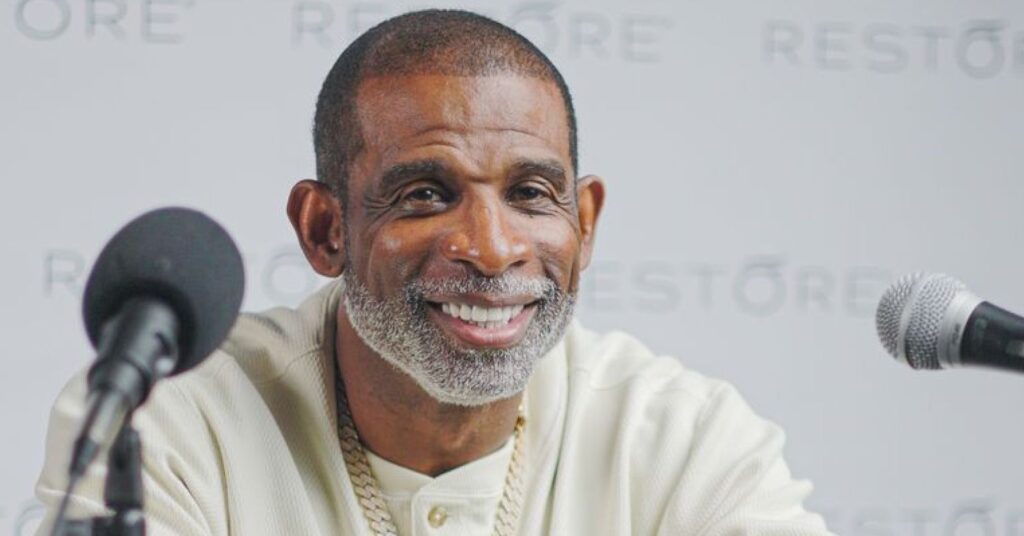
Deion Sanders has never been one to do things halfway. From his legendary athletic career to his bold, uncompromising coaching style, “Coach Prime” has built his life around performance, preparation, and pride. However, his recent health journey has challenged him to fully embrace this philosophy through vulnerability and self-acceptance.
In mid-2025, Sanders underwent surgery to remove a cancerous tumor, which required the removal of his bladder. Declared cancer-free shortly after, he has faced major adjustments since: learning to manage a neobladder, coping with incontinence (for which he has partnered with Depends to help destigmatize), and rebuilding his strength after additional surgeries to address blood clots. True to form, Sanders has met each of these health challenges with transparency and tenacity. He even keeps a portable bathroom on the sidelines, joking that adaptability is part of his playbook now.
By choosing to make his health and wellness journey public, he demonstrates that his motto, “You look good, you feel good,” extends far beyond external appearance, it’s about owning who you are unapologetically.
Self-Presentation and Confidence
According to Sanders, “if you take pride in what you put on, how you groom yourself, how you train, what you eat, it gives you a feeling of confidence and security.” He believes that self-presentation is an extension of self-respect. Sanders highlights that athletes (and others) should take advantage of health and well-being resources, including strength, conditioning, and nutrition services.
For Sanders, confidence begins within. “When you look good, you carry yourself differently,” he says. Before confidence can be displayed externally, it must be built from an internal sense of discipline and purpose. This aligns with research showing that authenticity (i.e., living in alignment with one’s true self) is strongly linked to higher well-being and engagement (Sutton, 2020). When we act from self-awareness rather than performance for others, confidence becomes sustainable over time and throughout life’s biggest hurdles.
Vulnerability and Masculinity
When asked how he balances the toughness of sports culture with being honest about his physical and mental health, Sanders didn’t hesitate. “I don’t know why we’re pretending to be tough when we’re not,” he says. “Whatever happened to just being you? To just being true to who you are?”
His message directly challenges traditional masculine norms that discourage vulnerability. Decades of research show that conformity to rigid masculine expectations is linked to poorer mental health outcomes and lower help-seeking behaviors (Wong, Ho, Wang, & Miller, 2017).
Sanders’s perspective offers an alternative: redefining strength as including honesty and care for self. “At this age and stage of life, if you don’t know who you are, that’s a problem,” he adds. For him, vulnerability and masculinity are partners in living an authentic and meaningful life.
Routine and Mental Health
“I try to stay well-groomed, train even with my limitations, eat properly, and be kind to others,” Sanders says. “A lot of it isn’t the physical part, it’s the mental part.” He emphasizes that real wellness, while it may be displayed externally, starts internally.
“Sometimes we’re so concerned with the outward appearance we don’t understand that the thing on the inside is eating us alive.” For him, creating daily structure, fostering confidence, and practicing gratitude are forms of psychological training that are just as essential as any workout. “I can’t wait to see tomorrow, but I’m going to dominate today to give myself the best chance that tomorrow is going to be great as well.”
Redefining Strength
When asked how men can redefine strength to include self-care and mental health, Sanders cut straight to the point. “Why are we so concerned with what others think? If I don’t know what makes me smile or what makes me weep at this stage, that’s a problem,” he says. “We can’t live for the respect or adoration of others; we have to live for the person in the mirror.”
Sanders’s message is clear: health, confidence, and authenticity are deeply intertwined. For him, looking good is not just about what you wear or how you present yourself, but about the internal work and reflection it takes to show up in the world as the most confident and genuine version of yourself.
Confidence Essential Reads
He pauses before adding one last truth: “It’s hard to give blessings to someone else when you’re stressing yourself.” His message reinforces that the more healing and understanding we extend to ourselves, the better positioned we are to give authentically to others.