

As deputy foreign minister under the Costas Simitis administration and one of the Greek prime minister’s closest confidants, Christos Rozakis played a crucial role in Athens’ negotiations with Ankara.
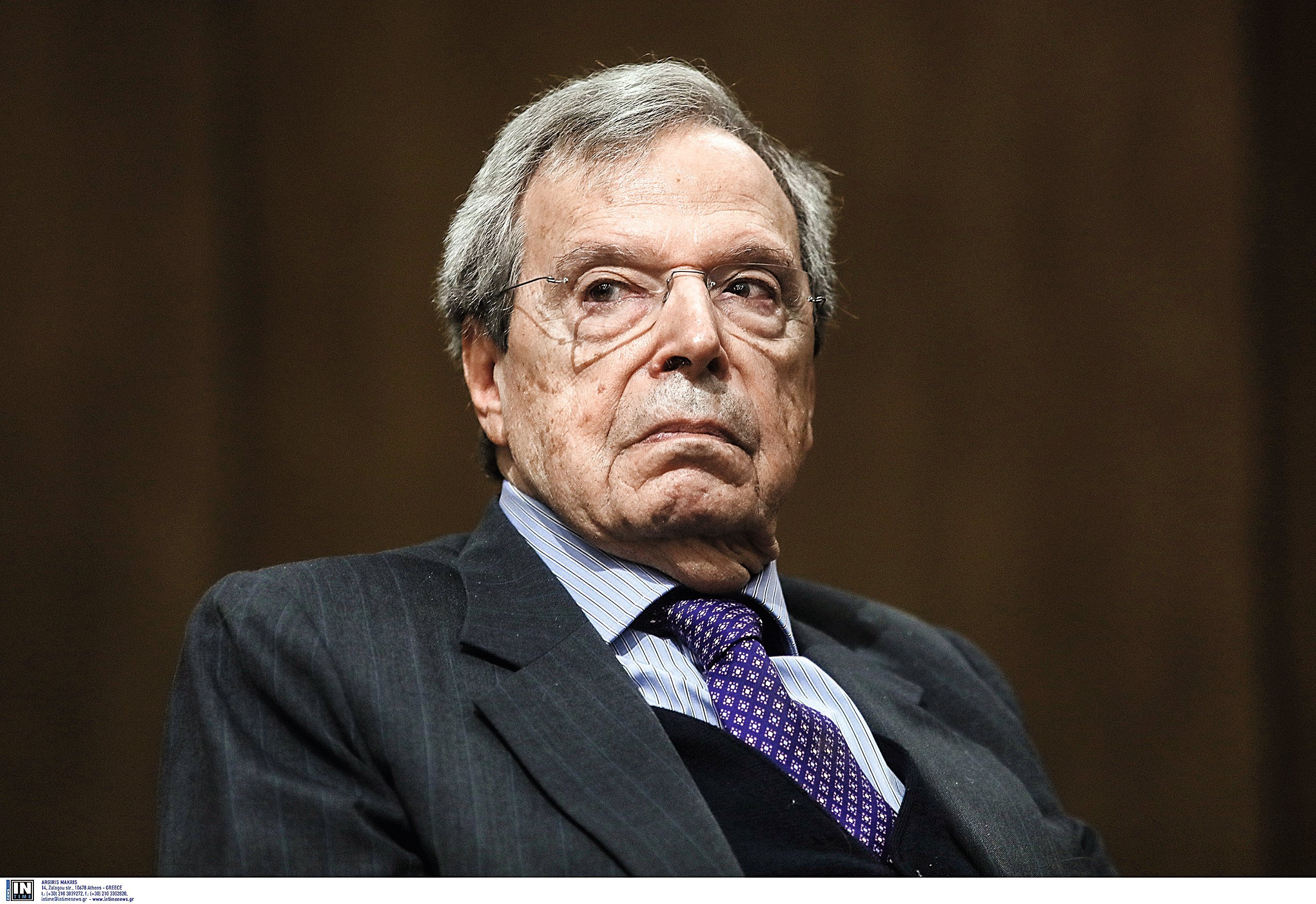 Kathimerini asked the emeritus professor of international law and legal expert about the content of those Greek-Turkish talks, which reached a more advanced stage than any others before or since in a bid to gain some clarity into the issues that continue to haunt Greece’s foreign policy.
1. When was the closest Greece came to an agreement with Turkey over the Aegean?
We came very close in 2003. The crucial issues at that time were the breadth of territorial waters in the Aegean and the delimitation of the continental shelf. The exploratory talks were aimed at helping the two sides approach the preliminary issues dividing them on the continental shelf dispute. This diplomatic effort, as some may recall, had been initiated by a European Council decision in December 1999, which made the commencement and future of Turkey’s European Union accession talks contingent upon the prior resolution of border disputes with its neighbors. Turkey had actually been given until the end of 2004 to make progress in bilateral negotiations or refer the issues to the International Court of Justice at The Hague. It was a time when both Turkey and the EU were very much in favor of the former’s accession to the bloc, a state of affairs that was reversed by the European Union a few years later as it struggled to absorb the impact of inducting 12 new member-states into its ranks. Greece took advantage of this situation by lifting its veto on Turkish accession, in exchange for Cyprus’ admission into the EU – without the prior resolution of its political problems – and for turning Greek-Turkish disputes into a community matter.
2. Why then didn’t the prime minister at the time, Costas Simitis, reach an agreement with Ankara in November 2003?
Simitis’ main problem was his own parliamentary group [PASOK]. He didn’t think he’d be able to secure Parliament’s approval for the arrangements discussed during the exploratory talks. The issue became further complicated by the acceleration of snap elections, as Simitis decided not to run for office again and handed over succession to his foreign minister. He believed George Papandreou would win the election and would be in a position to pass the legislation through Parliament with a fresh majority. Things did not go as he had anticipated, however, and the plan fell apart.
3. What did Simitis mean by “selective variations on territorial water limits”? Did he mean that territorial waters could be extended to 8, 9, 10 or 12 nautical miles in some areas and remain at 6 nautical miles in others?
Indeed, the progress of exploratory talks under two people who are no longer with us [Greece’s ambassador to London at the time, Tassos Skopelitis, and Athens University international law professor Arghyrios Fatouros] had actually come as far as Turkey accepting 12 nautical miles for all of Greece’s continental shores, for Evia, and for all the islands west of the 25th meridian, such as the Sporades islands. [The same 12 nautical miles would also apply to Turkey’s continental shores, of course.] Territorial waters would have remained at 6 nautical miles for the rest of the islands. Of course, before this position was reached, a number of proposals had been put forward – including solutions of 8 and 10 nautical miles – but these did not prevail. The final arrangement represented a reasonable compromise: The expansion of Greek sovereignty was not insignificant, yet it did not close off the central Aegean to the point of allowing only innocent passage as a substitute for free navigation – something that not only Turkey, but also other Aegean users such as all the Black Sea countries, the United States and Russia, did not want to see happen. Turkey later retreated from this position, too – once it was confident that the EU would not impose sanctions.
4. Wouldn’t this have been very complicated for international shipping?
No, because the solution was straightforward and did not create problems for maritime or air navigation, while it also provided sufficient areas of open sea, which was also useful for the delimitation of the continental shelf. Such flexibility would have been impossible if the territorial waters had been extended to 12 nautical miles everywhere.
5. Following the extension of Greek territorial waters as mentioned above, could Greece still proceed to increase its territorial waters in the future?
Yes, in areas where there would be a Greek continental shelf, after its delimitation, Greece could delimitate its maritime zones, following the model adopted in the Ionian Sea after the recent Greek-Italian agreement.
6. Did the so-called “fingers” theory – of variable territorial water limits – play any part in the efforts made at the time?
No, it did not, because the “fingers” theory concerns the continental shelf and discussions on the continental shelf never took place because we did not reach an agreement on the territorial waters. We must remember that the exploratory talks were the first stage of a broader arrangement that was to be carried out in two phases. The first was devoted to the issue of territorial waters. The second, which was contingent on a favorable outcome from the first, would have been formal negotiations on the continental shelf, which is where the so-called “fingers” theory would have come into play, if at all.
7. How would you have dealt with the challenges of Turkey’s claims of “gray zones” in the Aegean and demands for the demilitarization of the islands?
The issue of “gray zones” was never of concern to us. We believed that Turkey would not pursue the issue if we came to an agreement on all other matters. The issue of demilitarization, meanwhile, did not have the same dimensions back then as it does today, in that the Turks did not claim it was connected to the islands’ sovereignty. We had been planning, therefore, to include it in the exploratory talks.
8. Is the agreement captured in maps that also showed the percentages of sovereignty held by the two countries in the Aegean?
Of course. Greece was fully prepared and had help from a foreign geographer-cartographer who worked at an overseas institute. He prepared maps illustrating different scenarios for the delimitation of territorial waters and the continental shelf. These maps are still in the archives of the Greek Ministry of Foreign Affairs.
9. Were issues concerning the East Mediterranean included in a potential agreement? How were they to be resolved?
No, the discussions were exclusively about the Aegean. The Eastern Mediterranean came up later.
10. Do you think an agreement could have been reached on the Aegean through negotiations on maritime zones without first resolving the other specific issues?
Determining the limits of Greece’s territorial waters was crucial for either negotiations or a judicial settlement to take place. The reason was simple: Those limits constituted the internal boundaries of the continental shelf. Therefore, they were essential in order for negotiations to begin, and even more so for a referral to the International Court of Justice. As for the other issues [“gray zones,” demilitarization], there was no need for them to be resolved beforehand, since the disputed islets or rocks, by definition, had no continental shelf and demilitarization played no role whatsoever in the delimitation process.
11. Do you think that Turkey has hardened its stance compared to the “understanding” that had been achieved in 2004?
Yes, they have clearly hardened over time. First of all, the linkage between demilitarization and sovereignty did not exist at that time. Second, the so-called “gray zones” were more limited compared to the present, where they now include inhabited islands explicitly named in international treaties. Overall, we could say that Turkey has progressively expanded its claims – especially through the myth of the “Blue Homeland” – making it increasingly difficult to come to a resolution.
12. Was there an agreement on the extent of national airspace?
It would have followed the established international rule of alignment with the limits of the territorial waters.