
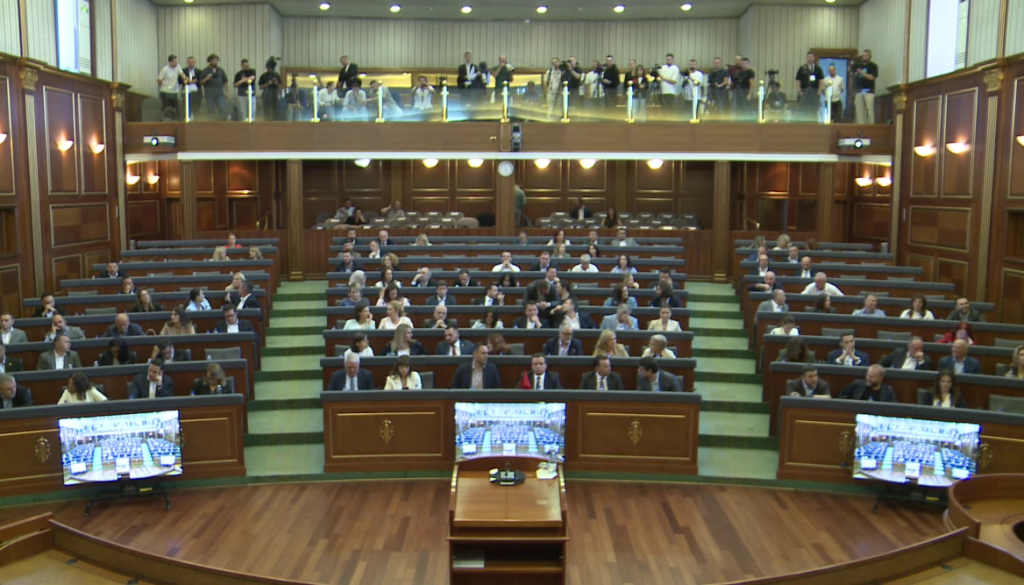
Almost nine months ago, on the ninth of February, parliamentary elections were held on Kosovo. However, the Government is still not formed, while the Assembly has only been constituted at the beginning October.
The first deadline after the constitution of the Assembly for the election of the new Government was on Sunday (October 26). The Government was not elected then. The proposal for prime minister was Aljbin Kurti, leader of the Self-Determination Movement and prime minister in a technical mandate. President of Kosovo Vjosa Osmani can no longer nominate him in this cycle.
After the failure of Kurti, the representatives of the Democratic Party of Kosovo (PDK) and the Democratic Union of Kosovo (LDK) declared that they would not nominate a candidate because, as they stated, they did not have enough votes. By the way, 61 votes out of 120 deputies are necessary to form a new government.
The opposition announced early elections and the possibility of a post-election alliance – without the participation of Self-Determination.
Procedural dance
However, despite the wishes of both Kurti and the opposition to immediately go to early elections, the Constitution of Kosovo says otherwise.
According to Article 95, if the composition of the proposed Government does not obtain the necessary majority, the President is obliged to appoint another candidate within 10 days, based on the same procedure.
“If the government is not elected a second time, then the President of Kosovo calls for elections, which should be held within 40 days,” the Constitution says.
In addition, the mandate of the President of Kosovo, Vjosa Osmani, expires in April next year.
Financial crisis?
Without a new government, Kosovo is threatened with a financial crisis, because the budget for 2026 cannot be adopted, economic experts warn. The deadline for the government to propose the budget for next year expires this Friday (October 31), and for the assembly to adopt it, on the last day of this year.
Mazljum Baraljiu, a professor of constitutional law at the University of Pristina, told the portal Alternativna that this “political class turned out to be very irresponsible towards society and citizens”.
“The parties have taken the obligation from the voters to work for the interest of citizens and institutions, and not for their personal and party interest,” Baraljiu emphasized.
Deadlock in the Assembly
The President of the Assembly of Kosovo was elected after a record 58 attempts at the constitutive session. However, this did not mean a constituted assembly because the vice president was not elected from among the Serbian community.
The vice president from the Serbian community was chosen by lot. Finally, Nenad Rašić, the leader of the party For Freedom, Justice and Survival and Minister for Communities and Return in a technical mandate, was elected.
The representatives of the Serbian List complained about this election to the Constitutional Court in Pristina and demanded “the introduction of a temporary measure to stop unconstitutional actions that can cause irreparable damage.”
For the time being, the Constitutional Court has confirmed that it is considering this appeal by the Serbian List.
At the same time, Osmani stated that the appeal was unnecessary, and that the delay created by the Serbian list harms the interests not only of Kosovo as a state, but also of all citizens, including Serbs.
Of the ten seats that are designated for the Serbian community, nine seats were won by Srpska lista, and one seat was won by Rašić.