
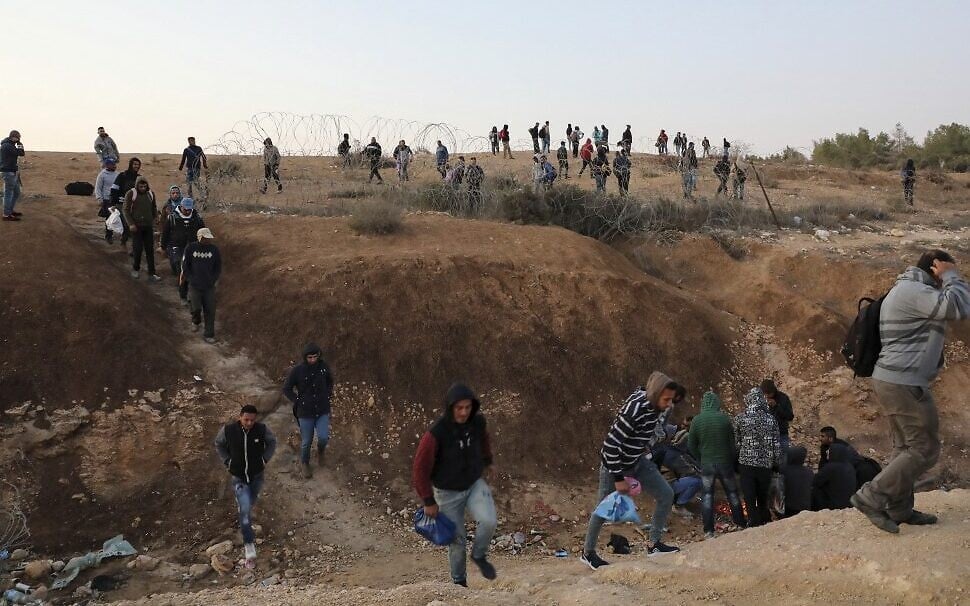
Since October 7, Israel has banned all Palestinian workers from entering Israel. Even with a ceasefire now in place, most of that ban remains. On paper, that may sound like security; in practice, it makes both economies poorer and the long game more dangerous. Here is the irony: work permits for Palestinians were born as a security tool, not as charity, because predictable income lowers desperation and desperation fuels radicalization.
After 1967, when Palestinians began slipping into Israel from the West Bank for day jobs, Israel chose to regularize the process and screen the workers, to channel labor rather than ban it. The Ministry of Defense, under Moshe Dayan, backed it explicitly as a security measure, the opposite of the Ministry of Defense’s stance today, because calm in the territories requires economic oxygen. The Treasury also approved work permits for Palestinians, citing the need for additional labor to sustain the economic boom.
Even ministries that balked wanted flexibility, a way to step back from the territories without binding Israeli employers forever. The compromise they reached was not lofty, it was practical. For every job opening, Israelis got first call, and Palestinians were only offered jobs in complementary roles, mainly construction, agriculture, and services. Permits became a gate that the security establishment could open or narrow as risks changed.
Oslo and the Paris Protocols did not romanticize this system; they wired it. Deductions and transfers were codified; the corridor became legal and visible. And when violence spiked, Israel tightened; when things cooled, flows resumed.
That calibration mattered, because the second intifada taught an ugly, empirical lesson. When legal work withered, participation in violence rose where access to jobs fell the most; for every one percentage point drop in the employment rate of men, the total number of Palestinian war-related fatalities per locality over the period increased by about 0.11. Over the same long stretch, attacks inside Israel by vetted permit holders were rare. The point is not that wages buy peace; it is that a screened, legal channel changes daily incentives and logistics in ways that lower risk.
The costs of today’s ban are measurable. Before October 7, about 169,600 Palestinians worked in Israel and the West Bank, roughly 37,500 without permits; by June 2025, only about 44,200 remained, mostly working in Israeli settlements, a lost income stream for roughly 125,400 workers. In 2022, wages earned by Palestinians in Israel contributed about 4.2 billion dollars to the Palestinian economy, nearly 20 percent of GDP; a West Bank construction worker earns around 860 dollars a month, while in Israel the average is about 2,250 dollars. Since Palestinian work in Israel was banned, West Bank unemployment jumped from 12.9 percent in October to about 35 percent by October 2024.
Israel pays too: Palestinians filled about 80 percent of the “wet trades” in construction, such as plastering and tiling; the sector faces a shortage of nearly 109,000 workers; projects stalled, and housing supply tightened. A policy that ignores these numbers is not security, it is self-harm.
And here is the part that Israeli officials prefer not to say out loud. When you erase the legal route, the illegal one comes back fast. This is not theoretical; during the Second Intifada, periods of tight closures saw spikes in off-the-books employment and risky crossings on dangerous paths. The state loses the basic information that a competent security system needs: who entered, where they work, when they leave.
It is also hypocritical that Israel allows Palestinian workers to continue working in Israeli settlements in the West Bank, but not inside Israel, which exposes the security argument as hollow. Since October 7, construction in Israel has not truly stopped; it has adapted. That is a red flag, not a comfort, because a black market is the opposite of a security screen. Shut that channel, and you do not remove the labor market; you remove the oversight.
Some Israelis believe that foreign workers can replace Palestinian labor. However, Israel’s efforts to recruit foreign workers have fallen short. Agreements with countries like India were able to increase the number of foreign construction workers from 28,000 in October 2023 to 54,500 in June 2025, which is insufficient to fill the gap. Palestinian workers offer unique advantages: they are experienced, require less training, and return home to the West Bank daily, eliminating the need for accommodations. Therefore, allowing Palestinians to work mitigates the crisis without creating additional needs.
At this point, some critics from the left may argue that the permit regime was built to entrench dependency, to split the Palestinian territories into labor reserves, to make Palestinian prosperity conditional on Israeli tolerance. There is substance here. During the Oslo years, the gate was explicitly regulated by military logic; access was volatile; Gaza was severed more than the West Bank; and work in settlements bound parts of the West Bank more tightly to Israel.
However, the 1969 move was not a master plan for permanent domination; it was a security-first response to civil unrest that paired control with income. Over time, yes, the system drifted, settlements grew, closures hardened, foreign workers arrived, and the corridor was used to reward and punish. That history should warn us against lazy dependence and against pretending that permits are development policy. It should not blind us to the other half of the ledger, the near-term security and economic costs of pulling the plug. War and recession shorten time horizons. Families with no paychecks do not wait politely for long-term industrial policy.
With a ceasefire in place, Israel should write a new policy that learns from both stories. Start with vetted West Bank workers; reissue permits in stages tied to weekly risk reviews; make entry and exit biometric; lock permits to a specific site and contractor; require daily digital manifests that the labor authority, police, and defense see in real time. Cut the oxygen to the permit black market, and ban third-party brokering.
None of this is charity. It is the same security logic that opened the gate in 1969, updated for 2025. A legal corridor gives the state eyes and leverage; it lowers the incentive to cheat; it helps Israel rebuild faster and cheaper; and it gives Palestinian households reasons to pick work over nihilism. Keep the door bolted, and you get the trifecta no one should want: deeper poverty next door, a noisier black market at home, and a thinner screen where you most need it. Bring the workers back, gradually and visibly. Put security and economics on the same side of the ledger again.
Avia Liberman is an Israeli economic analyst currently pursuing a Master in Public Policy at Yale University. His work focuses on economic peacebuilding and development. Before Yale, he worked as a researcher at Israel’s Ministry of Finance, the OECD Economics Department, and the Tachlith Institute for Israeli Public Policy.