
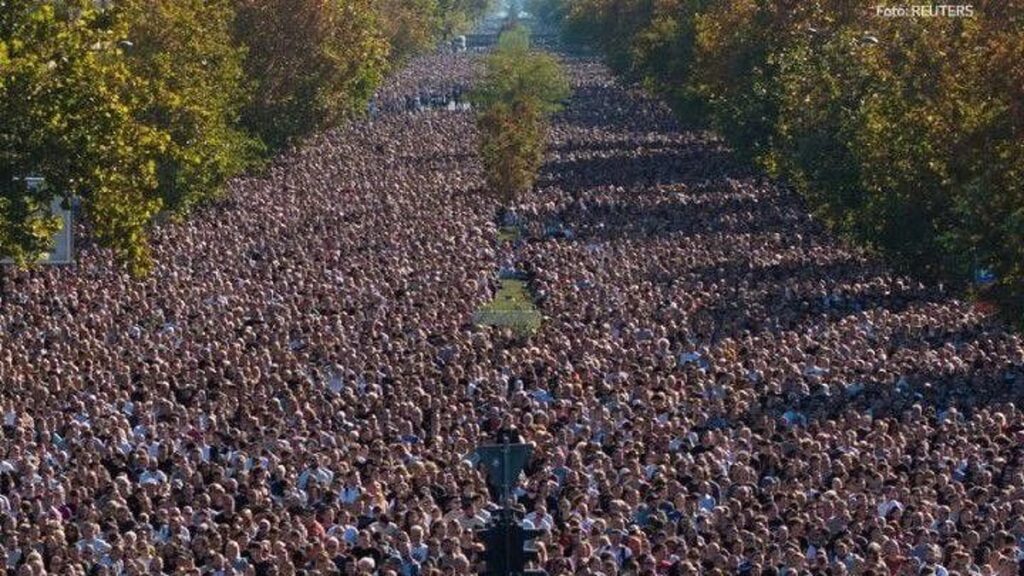
Milos, a man in his fifties who has been joining anti-government protests since the 1990s, said that “after cooling down” he understood the speeches as “a populist move — an attempt to reach broader audiences ahead of possible elections.”
The student call for early elections has not been successful. But ahead of scheduled local ballots in October, the heat turned up again.
Law students in Belgrade organized a rally demanding accountability for “violations of Serbian rights” in Kosovo. On social media, organizers accused Serbia’s government of “betraying Kosovo.”
Ultranationalist and far-right groups — some of them banned by Serbia’s Constitutional Court — appeared alongside students, although only about 1,000 people attended. This was far fewer than at many other protests.
‘Louder And Better Organized’
Shortly afterwards, a European Parliament resolution condemned what it called “nationalist narratives” in parts of the protest movement.
“The right is absolutely trying to take over the protests, but it’s not that big. It’s just louder and better organized,” Dusko Radosavljevic, a professor at the law and business faculty at the University of Novi Sad, told RFE/RL.
He added that the appearance of extremist groups at demonstrations was often staged.
“These are frequently provocations organized by security services on the state payroll, meant to create confusion,” he said.
“In a divided society like ours, many students still can’t tell the difference between healthy patriotism and nationalism,” said Boris Kojcinovic, a philosophy student from Novi Sad. He recalled nationalists grabbing European Union flags from protesters but added: “I feel most of us are here for one goal — to build a healthy society.”
‘You Won’t Divide Us’
That message has also resonated in Sandzak, a region in southwestern Serbia with a Muslim majority.
Marching under the message “You Won’t Divide Us,” students from Sandzak made a 400-kilometer protest march to Novi Sad, arriving on November 1, to mark the anniversary.
A welcome ceremony lasted for more than four hours. The largest group — nearly 4,000 students who had walked about 80 kilometers from Belgrade — marched into Novi Sad shortly before midnight.
“The feeling is incredible — this number of people, this amount of positive energy, and love in the air is something that can’t be described in words. It simply has to be experienced,” Marija, a student from Novi Pazar, told RFE/RL.
Vladimir Lekic, who came from Mladenovac, near Belgrade, to welcome the students in Novi Sad, told RFE/RL that in “normal countries,” the protesters’ demands “would have been met long ago, and the demonstrations would already be over.”
“Here, people have to give their last atom of strength to get anything done. This is a great student sacrifice — we’ll see what comes of it,” he said.
During earlier mass protests in March, President Vucic acknowledged the “enormous negative energy and anger” directed at authorities and said that “we will have to change ourselves.”
However, student groups have not been quieted, citing a lack of progress on reforms and on holding those responsible for the Novi Sad disaster accountable.
Copyright (c)2025 RFE/RL, Inc. Used with the permission of Radio Free Europe/Radio Liberty
[VP]
Suggested Reading: