
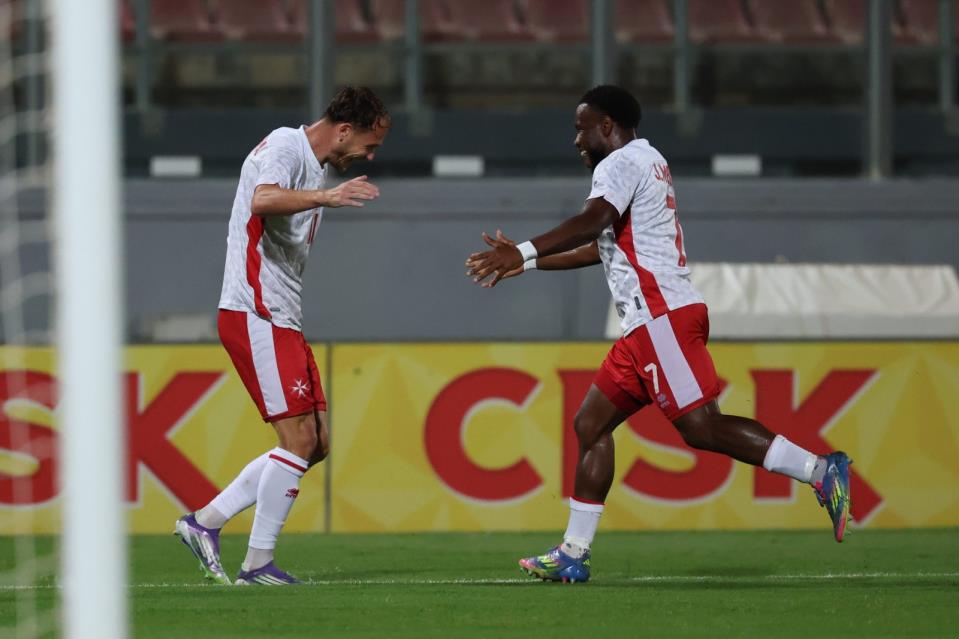

The strong footballing performances by the tiny Faroe Islands as of late compared to the less strong performances by the Malta football national team has prompted something of a reckoning in the Maltese football community.
The reckoning is in trying to understand why a tiny territory with a population of around 55,000 people is thriving in the beautiful game, while Malta continues to flounder.
In the first part of this analysis, published last week, The Malta Independent on Sunday compared the performances of the two national teams – finding that the Faroe Islands performs better at both senior and U21 level, despite the fact that at both levels the two countries have a comparable number of foreign-based players involved in their respective squads.
The second part of this analysis goes deeper, looking into Maltese and Faroese football at club level, and looking at the money backing each footballing world.
The clubs
The first domestic port of call in figuring out what’s so different between Malta and the Faroe Islands could be by looking at club level.
First and foremost, there is very little difference in the stature of the Faroese Premier League and the Maltese Premier League. UEFA’s league coefficients places the two countries on near enough equal footing: the top Faroese league is ranked 40th in Europe, while Malta’s top division is ranked 41st.
On a European participation level, there is also not much difference: Malta has its first ever team in a group stage of a continental competition this year, as Hamrun Spartans made it to the UEFA Conference League phase, while the Faroe Islands have been represented in the final stages of a continental competition once before as well – with KÍ Klaksvík making it into the Conference League in 2023.
KÍ Klaksvík secured a respectable four points in their group courtesy of a 3-0 win over Slovenian side Olimpija Ljubljana and a 0-0 draw over comparative French giants Lille, en-route to finishing bottom of their group.
They almost repeated the feat in both seasons since, but were knocked out at the final hurdle by Finnish champions HJK in 2024 and fell to Belorussian side Neman Grodno on penalties in the penultimate round this season.
As far as the domestic league format goes, the Faroese system is far less complex than Malta’s long-debated Opening Round and Closing Round format. The top tier is made up of 10 teams which play each other three times, and there are then three more lower tiers – making for a total of four leagues within the territory’s footballing pyramid.
A key difference however is that there are just 16 individual clubs in existence in the Faroe Islands. The four tiers are filled up because all 16 of those clubs have second and third reserve teams which play in lower divisions.
Malta also has four tiers, but there are more clubs in the country: 53 individual clubs exist in Malta, together with another 14 which exist in Gozo.
Another strong debate that has dominated Maltese football revolves around the number of foreign players who can play in domestic leagues. Right now, Maltese Premier League clubs are allowed up to eight non-homegrown players (defined as players who have not been trained at youth level in a Maltese club) on the pitch at one go.
That number drops to three for clubs in the Challenge League (Malta’s 2nd tier), two for clubs in the Amateur 1 League, and one for clubs in the Amateur 2 League.
Some argue that the number of non-homegrown – which invariably means foreign – players allowed at the top of Malta’s footballing pyramid is prohibitive for Maltese players to get the necessary game time. Others argue that more foreign players means upping the standard of the league, and therefore of local clubs and players.
As for the Faroese league, there are also some restrictions on foreign players: teams in the top league can only have four foreigners at one go on the pitch.
But there is a caveat in how a foreign player is defined: if a player has played in the Faroese league system for three consecutive seasons, then they are not counted as a foreigner – and likewise, players from Nordic countries (Denmark, Norway, Sweden, Iceland, and Finland) also do not count as foreign players in the eyes of the competition regulations.
Still, no team in the league has more than nine foreigners registered – in the case of KÍ Klaksvík only four out of nine come from non-Nordic countries, while newly-promoted TB Tvøroyri have six out of nine foreigners coming from non-Nordic countries. It hasn’t made much of a difference to their performance: they sit bottom in the league this season with just 13 points from 27 matches.
The comparison is quite stark: According to Transfermarkt, out of the 268 players registered across the 10 teams competing in the Faroese Premier League, 52 come from outside the Faroe Islands – 19.4%. As for Malta, out of the 296 players registered with the Premier League’s 12 clubs, 162 are foreign – 54.7%.
The money
Money makes the world go round, and no truer is that than in football.
But while Malta’s Premier League is nowadays an entirely professional league, the same cannot be said for the Faroese League, with many of the teams in the competition operating on a semi-pro basis.
Even KÍ Klaksvík – who have romped to league success over the past few years – are largely semi-pro. A UEFA article which highlighted their adventures when the club made it to the UEFA Conference League group stages in October 2023 shared details on this.
Their top scorer in the UEFA qualifying campaign, Árni Frederiksberg, for instance, worked as a director for a local wholesale food business, their captain Jákup Andreasen was studying to be a marine engineer, and key midfielder René Joensen worked as an electrician.
Frederiksberg was in the starting 11 in both historic World Cup qualifying victories over Montenegro and the Czech Republic, even scoring one of his country’s four goals against Montenegro. Andreasen also started against Montenegro and featured off the bench against Czech Republic.
Joensen missed out this international break through injury: he last featured for the national team in a friendly against Georgia last June, and has 62 caps to his name.
The disparity is also reflected in the market values of the leagues. Transfermarkt highlights the market value of the Faroese Premier League as being €12.99 million – far below the €46.27 million that the Maltese Premier League is valued at.
Indeed, the market value of the current top three teams in the Maltese Premier League – Floriana, Valletta, and Hamrun Spartans – stands at €14.59 million, exceeding the market value of all 10 teams in the Faroese league structure put together.
What about the federations? The most recent available Annual Report for the Faroese Footballing Federation (the FSF), which is for 2023, shows that the association had an income of 67,129,472 Faroese Krona – equivalent to around €9 million, and spent pretty much that amount to end the year with a minimal profit of around €12,000.
The Malta Football Association’s income in 2024 meanwhile stood at €13 million, and likewise the association ended the year with a minimal profit of €31,000.
The MFA, therefore, at least in theory, has a higher budget to work with.
An innate advantage?
There are some areas where, perhaps, some may suggest that the Faroe Islands just simply have an innate advantage over Malta.
The first and perhaps most obvious is geographical: the Faroe Islands is known to have weather which is far more inhospitable than most of Europe. It’s an archipelago some 320 kilometres north of the coast of the United Kingdom, known to be extremely cold and extremely windy.
These are weather conditions which can, ultimately, have an impact on a football match.
But out of the 27 positive results (wins or draws) that the Faroe Islands have registered since 2020 – just under half of them (13) were registered at home. This means it’s a pretty even split – although it must be said that the territory’s most famous results, such as the two wins from last week, a 2-1 over Turkey and the vital 3-2 Nations League win over Malta, were all registered at home.
One could argue that the Faroese players are naturally physically stronger: for instance, out of the national squad of 24, a whopping 18 come in as standing 1.8 metres or taller.
By comparison, only 15 from Malta’s squad of 30 are 1.8 metres or taller – and four out of those 15 weren’t even born in Malta.
The Faroes do put their height to good use: two out of four goals against Montenegro were headers, while one of their goals against the Czech Republic came from chaos created by a high ball – but highlights of their matches show that they are equally adept when it comes to incisive counter attacks as they are in the air.
So why are the Faroe Islands better than Malta?
After all of this, it’s still a difficult question to answer.
Malta has an association which has a higher income, clubs with more money, a fully professional league, foreign-based players in countries with higher footballing reputations, and a national team coach with a supposedly higher reputation.
Yet on the pitch, the Faroe Islands outperform Malta at both senior and youth level.
Many in the Maltese footballing community have had their say. Some say the problem is that not enough Maltese players are getting high-quality game time, others say that the problem starts from grassroots level with a lack of quality coaching, others say it’s simply a question of mentality.
What’s certain is that as teams like the Faroe Islands continue to improve, the inquest in Malta as to why this football-crazy country keeps floundering in the sport it loves the most will continue.