
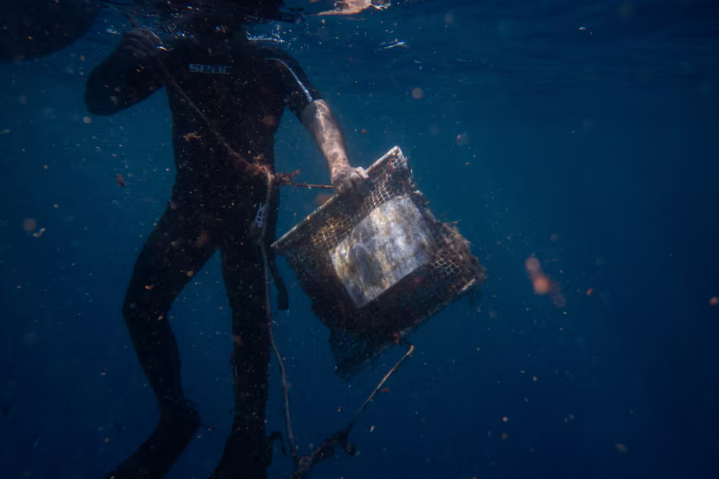
A diver retrieves a cage containing mussels used as bioindicators to monitor microplastic and chemical pollution, including heavy metals and organic contaminants, during a mission in the Saronic Gulf. [Stelios Misinas/Reuters]
Overtourism and heavy maritime traffic across the Mediterranean are contributing to a rise in pollution in Greece’s azure waters, say Greek scientists who have deployed thousands of mussels on the seafloor to help detect microplastics.
Mussels, filter-feeding organisms that absorb a range of contaminants into their tissue, including invisible microplastics, have been used globally for decades as a barometer of marine pollution.
Researchers at the Hellenic Centre for Marine Research (HCMR) have been using them in Greece, whose pristine beaches and limpid seas lure millions of tourists annually.
In May, they submerged cages with mussels at various depths and locations across Greece, from busy ports to remote islands. They retrieved them in September to analyze the particles the mussels had accumulated. To test surface water they use a floating net device.
“It blows your head that in just two kilometers you can collect all these tiny microplastics,” said oceanographer Argyro Adamopoulou, from the HCMR laboratory, referring to samples collected from the net that filters the water.
The entire Mediterranean Sea, a semi-enclosed basin, has become a hotspot for microplastics, the scientists said.
The particles retrieved in Greece varied in shape from fragments to film, microfibers or pellets and were mostly blue or transparent, indicating that they came from single-use plastics, such as rubbish bags and water bottles, said HCMR biologist Nikoletta Digka.
They are broken down over time by waves, currents and sun exposure, becoming harder to detect.
Concentrations are not yet high enough to be harmful to humans but microplastics are found in every single species the team has analysed so far, said Digka.
“On average, we find one or two microplastics per population we analyze,” Digka said, warning that without action, continued fragmentation will increase the amount of microplastics ingested by marine organisms, raising the risk to humans. [Reuters]